Products Categories
| CAS No.: | 103-29-7 |
|---|---|
| Name: | 1,2-Diphenylethane |
| Article Data: | 1953 |
| Molecular Structure: | |
|
|
|
| Formula: | C14H14 |
| Molecular Weight: | 182.265 |
| Synonyms: | Dibenzyl;Dihydrostilbene;Ethane, 1,2-diphenyl-;Ethylenebis[benzene];NSC30686;NSC 8789;sym-Diphenylethane;Bibenzyl(8CI);1,1'-(1,2-ethanediyl)bis[benzene];1,2-Diphenylethane;Dibenzil;Benzene,1,1'-(1,2-ethanediyl)bis-; |
| EINECS: | 203-096-4 |
| Density: | 1.014 g/mL at 25 ºC(lit.) |
| Melting Point: | 50-53 ºC(lit.) |
| Boiling Point: | 284 ºC |
| Flash Point: | >230 ºC |
| Solubility: | PRACTICALLY INSOLUBLE |
| Appearance: | White crystal |
| Hazard Symbols: |
 Xi Xi
|
| Risk Codes: | 36 |
| Safety: | Poison by intravenous route. Moderately toxic by intraperitoneal route. Combustible. To fight fire, use water, spray, mist, alcohol foam, dry chemical. When heated to decomposition it emits acrid smoke and fumes. |
| Transport Information: | 1325 |
| PSA: | 0.00000 |
| LogP: | 3.47180 |
- 144851-82-1METHYL2-AMINO-3-FLUOROBENZOATE
- 483366-12-7(2S,4R)-1-Boc-2-cyano-4-hydroxypyrrolidine
- 173606-50-3BOC-10-AMINODECANOIC ACID
- 361456-36-2METHYL (R)-(+)-ISOCYANATO-3-PHENYLPROPI&
- 5156-58-1N-(1-Benzyl-4-pipperidinyl)-N-phenylpropanamide HCl
- 81281-59-67-Benzylideneaminotheophylline
- 50288-62-5threo-Phenyl-2-piperidyl acetamide
- 82993-81-5D-threo-Ritalinic acid hydrochloride
- 47087-37-6Z-D-Glu-OMe
- 1219080-61-1IMIDAZOLE-2-BORONIC ACID

What can I do for you?
Get Best Price


Chemistry
Product Name: Bibenzyl (103-29-7)
CAS No:103-29-7
MP : 50-53 °C(lit.)
BP: 284 °C(lit.)
Empirical Formula: C14H14
Molecular Weight: 182.261
Density : 1.014 g/mL at 25 °C(lit.)
Fp : >230 °F
Water Solubility : PRACTICALLY INSOLUBLE
IUPAC Name: phenethylbenzene
Product Categories: Pharmaceutical Intermediates
Stability: Stable. Combustible. Incompatible with strong oxidizing agents
Appearance: white to light yellow crystal powder
Water Solubility: PRACTICALLY INSOLUBLE
Synonyms of Bibenzyl (103-29-7): (2-Phenylethyl)benzene ; 1,1’-(1,2-ethanediyl)bis-benzen ; 1,2-diphenyl-ethan ; 1,2-Diphenylethane(sym) ; 1,2-Diphenylethane, s ; Benzene, (phenylethyl)- ; Benzene, 1,1'-(1,2-ethanediyl)bis- ; Benzene,1,1’-(1,2-ethanediyl)bis-
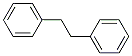
Molecular Structure of Bibenzyl(103-29-7):
Uses
Bibenzyl (103-29-7) is used as solvent for nitro fibre and in synthesis of other organic chemical products.
Toxicity Data With Reference
| 1. | ipr-mus LD50:2500 mg/kg | ARZNAD Arzneimittel-Forschung. Drug Research. 19 (1969),617. | ||
| 2. | ivn-mus LD50:78 mg/kg | ARZNAD Arzneimittel-Forschung. Drug Research. 19 (1969),617. |
Consensus Reports
Bibenzyl (103-29-7) was reported in EPA TSCA Inventory.
Safety Profile
Poison by intravenous route. Moderately toxic by intraperitoneal route. Combustible. To fight fire, use water, spray, mist, alcohol foam, dry chemical. When heated to decomposition Bibenzyl emits acrid smoke and fumes.
Hazard Codes:  Xi
Xi
Safety Statements: 22-24/25-182.26
S22: Do not breathe dust
S24/25: Avoid contact with skin and eyes
WGK Germany: 2
RTECS: DT4375000
Hazard Note: Irritant
Specification
European/International Regulations
European Labeling in Accordance with EC Directives
Hazard Symbols:Not available
Risk Phrases:
Safety Phrases:
S 24/25 Avoid contact with skin and eyes.
WGK (Water Danger/Protection)
CAS# 103-29-7: Not available
Canada
CAS# 103-29-7 is listed on Canada's DSL List
US Federal
TSCA
CAS# 103-29-7 is listed on the TSCA Inventory.