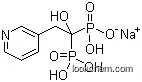
Detail of > 115436-72-1
- CAS Number:
- 115436-72-1
- Name:
Sodium risedronate
- Formula:
- C7H10NNaO7P2
- Molecular Structure:

- Synonyms:
- Risedronic acid [INN];Acidum risedronicum [INN-Latin];Acido risedronico [INN-Spanish];(1-Hydroxy-2-(3-pyridyl)ethylidene)diphosphonic acid;Actonel;NE-58095;RischorriteRisedronate sodium;Actonel (TN);Acide risedronique [INN-French];Risedronate sodium (USAN);Monosodium (1-hydroxy-2-(3-pyridinyl)ethylidene)bisphosphonate;Phosphonic acid, (1-hydroxy-2-(3-pyridinyl)ethylidene)bis-;Phosphonic acid,[1-hydroxy-2-(3-pyridinyl)- ethylidene]bis-,monosodium salt;Residronate sodium;RisedronateSodium;Risedronate Sodium;NE 58095;
- Molecular Weight:
- 350.13
- Boiling Point:
- 692.3 °C at 760 mmHg
- Flash Point:
- 372.5 °C
- Appearance:
- fine white to off-white crystalline powder
Related products
Other Products
- Titanium Dioxide Carbon black Glutathione Adenosine Cable pulling lubricant
- 10102-17-7Sodium thiosulfate pentahydrate
- 115436-72-1Sodium risedronate
- 124-22-1Dodecanamine
- 7101-31-7Diselenide, dimethyl(9CI)
- 3120-74-9Methylthiomethylphenol
- 96-13-91-Propanol,2,3-dibromo-
- 27828-71-35-Hydroxynicotinic acid
- 17692-51-2Carbamic acid, N-[[(8β)-1,6-dimethylergolin-8-yl]methyl]-,phenylmethyl ester
- 688-74-4Boric acid (H3BO3),tributyl ester
- 74316-27-1Cyclobutanecarboxylicacid, 3-amino-, cis-
- 12236-86-1C.I. Reactive Blue 21
- 111-41-1Ethanol,2-[(2-aminoethyl)amino]-
- 5873-43-8Pentanoic acid, ethenylester
- 87-62-7Benzenamine,2,6-dimethyl-
- 65-23-63,4-Pyridinedimethanol,5-hydroxy-6-methyl-
Refine Suppliers Do you want your product ranking ahead? Know what is 'Top Seller'!
- Supplier Location:
China (Mainland)(33)
India(13)
United States(4)
Canada(1)
Switzerland(1)
Czech Republic(1)
- Business Type:
- Importer/Exporter(35)Lab/Research institutions(4)Manufacturers(1)
- Certificates:
- ISO(2)Production License(1)QS(1)
Please post your buying leads,so that our qualified suppliers
will soon contact you!
*Required Fields
Reference
- Development and validation of a reversed-phase ion-pair high-performance liquid chromatographic method for the determination of risedronate in pharmaceutical preparations
- All Rights Reserved. Development and validation of a reversed-phase ion-pair high-performance liquid chromatographic method for the determination of risedronate in pharmaceutical preparations. Kyriakides, Demetra; Panderi, Irene (Division of Pharmaceutical Chemistry, School of Pharmacy, University of Athens, Athens 157 71, Greece). Analytica Chimica Acta, 584(1), 153-159 (English) 2007 Elsevier B.V. CODEN: ACACAM. ISSN: 0003-2670. DOCUMENT TYPE: Journal CA Section: 64 (Pharmaceutical Analysis) A stability indicating, reversed-phase ion-pair high-performance liq. chromatog. method was developed and validated for the detn. of risedronate in pharmaceutical dosage forms. The detn. was performed on a BDS C18 anal. column (250 mm ′ 4.6 mm i.d., 5 mm particle size); the mobile phase consisted of 0.005 M tetrabutylammonium hydroxide and 0.005 M pyrophosphate sodium (pH 7.0) mixed with acetonitrile in a ratio (, vol./vol.) and pumped at a flow rate 1.00 mL min-1. The UV detector was operated at 262 nm. The retention times of magnesium ascorbyl phosphate, which was used as internal std. and risedronate were 4.94 and 5.95 min, resp. The calibration graph was ranged from 2.50 to 20.00 mg mL-1, while detection and quantitation limits were found to be 0. 115436-72-1 which is the cas registry number of some chemical is mentioned.48 and 1.61 mg mL-1, resp. The intra- and inter-day percentage relative std. deviations, %R.S.D., were less than 5.9%, while the relative percentage error, %E r, was less than 0.4%. The method was applied to the quality control of com. tablets and content uniformity test and proved to be suitable for rapid and reliable quality control. .
- Importance of calcium co-medication in bisphosphonate therapy of osteoporosis: An approach to improving correct intake and drug adherence
- All Rights Reserved. Importance of calcium co-medication in bisphosphonate therapy of osteoporosis: An approach to improving correct intake and drug adherence. Ringe, Johann D.; van der Geest, Stefan A. P.; Moeller, Gerd (Medical Clinic 4, Klinikum Leverkusen, University of Cologne, Leverkusen, Germany). Drugs & Aging, 23(7), 569-578 (English) 2006 Adis International Ltd. CODEN: DRAGE6. ISSN: 1170-229X. DOCUMENT TYPE: Journal CA Section: 1 (Pharmacology) Background and objective: In all of the large, pivotal, multicenter trials of bisphosphonate therapy, patients have received added calcium in amts. ranging from 500 to 1000 mg/day above individual dietary intake. Accordingly, calcium supplements or calcium/vitamin D combinations are currently recommended as co-medication with anti-resorptive therapy in all recently published guidelines on the treatment of osteoporosis. However, the consistent use or effectiveness of calcium may be impaired by several factors in the individual patient, including low prescription rate or lack of advice to purchase calcium, reduced adherence because of the complexity of the regimen, and incorrect intake (e.g. taking calcium with bisphosphonates at the same time). Patients with osteoporosis who adhere to drug therapy experience a significantly lower fracture rate. Therefore, there is a need to improve correct intake of bisphosphonates together with calcium supplementation, which may enhance adherence. The dosage regimen could be simplified by providing the two compds. in an integrated pack. Such a pack, contg. one tablet of risedronic acid and six calcium carbonate tablets (Actonel, Procter & Gamble Pharmaceuticals, Weiterstadt, Germany), has been developed to facilitate correct intake. In this study, the impact of this fixed-combination pack on patient understanding of dosing instructions and on preference was tested by comparing the fixed combination with sep. risedronic acid and calcium packages. Patients and methods: A new blister strip was developed contg. one tablet of risedronic acid 35mg and six tablets of calcium carbonate 1250mg (500mg elemental calcium), representing 1 wk of therapy; the control was the same medications in sep. packaging. The study was conducted in a cohort of 164 postmenopausal women (mean age 69 years). Half of the participants were bisphosphonate users (n = 83). The combined understanding of five instructions - risedronic acid intake in the morning, only with water, without food, without other medication, and sep. from calcium - was tested in a crossover design. Participants were also asked to state their preference for the combination packaging vs. sep. packs. Results: Understanding of the five instructions for the sep. packaging was 70%. The combination pack significantly improved understanding of these instructions to 80% (p < 0.05). Eighty-three percent of participants preferred the combination pack over sep. packs (p < 0.05). The most frequently given reasons for preferring the combination pack were prefer one pack over two packs, easy/convenient to use/practical/handy, easy to understand/less confusion, and easier to remember/less likely to forget. Conclusions: The availability of a fixed-combination pack of risedronic acid 35 mg/wk and calcium tablets can increase the likelihood that postmenopausal osteoporotic patients will receive both a bisphosphonate and calcium, which in turn is likely to enhance the correct intake of combination therapy.Except for chemicals metioned above, 13598-36-2 and 115436-72-1 are also used. .
- About us
- |
- Payment
- |
- Contact us
- |
- Links
- |
- Help Center
- |
- Disclaimer
- |
- Add to favorite
- | SiteMap
- |
- Product SiteMap
- |
- Manufacturers
- |
- Suppliers
©2008 LookChem.com,License:ICP NO.:Zhejiang10014259
[Hangzhou]86-571-85317600,85317603,85317620