Products Categories
| CAS No.: | 131-91-9 |
|---|---|
| Name: | 1-Nitroso-2-naphthol |
| Article Data: | 17 |
| Molecular Structure: | |
|
|
|
| Formula: | C10H7NO2 |
| Molecular Weight: | 173.171 |
| Synonyms: | 2-Naphthol,1-nitroso- (8CI);1-Nitroso-2-hydroxynaphthalene;1-Nitroso-2-naphthalenol;2-Hydroxy-1-nitrosonaphthalene;NSC 4151;NSC 677525;a-Nitroso-b-naphthol; |
| EINECS: | 205-043-0 |
| Density: | 1.27 g/cm3 |
| Melting Point: | 106-108 °C (dec.)(lit.) |
| Boiling Point: | 357.6 °C at 760 mmHg |
| Flash Point: | 170.1 °C |
| Solubility: | Insoluble in water |
| Appearance: | brown powder |
| Hazard Symbols: |
 Xn Xn
|
| Risk Codes: | 22-36/37/38-33-20/21/22 |
| Safety: | 26-36-45 |
| Transport Information: | UN 3077 |
| PSA: | 49.66000 |
| LogP: | 2.94330 |
- 144851-82-1METHYL2-AMINO-3-FLUOROBENZOATE
- 483366-12-7(2S,4R)-1-Boc-2-cyano-4-hydroxypyrrolidine
- 173606-50-3BOC-10-AMINODECANOIC ACID
- 361456-36-2METHYL (R)-(+)-ISOCYANATO-3-PHENYLPROPI&
- 5156-58-1N-(1-Benzyl-4-pipperidinyl)-N-phenylpropanamide HCl
- 81281-59-67-Benzylideneaminotheophylline
- 50288-62-5threo-Phenyl-2-piperidyl acetamide
- 82993-81-5D-threo-Ritalinic acid hydrochloride
- 47087-37-6Z-D-Glu-OMe
- 73441-42-6METHYL-5-CHLORO-2,2-DIMETHYLVALERATE

What can I do for you?
Get Best Price


Chemistry
Chemical Name: 1-Nitroso-2-naphthol
IUPAC NAME: 1-nitrosonaphthalen-2-ol
CAS No.: 131-91-9
EINECS: 205-043-0
RTECS: QL4725000
RTECS Class: Agricultural Chemical and Pesticide; Mutagen
Molecular Formula: C10H7NO2
Molecular Weight: 173.17 g/mol
Density: 1.27 g/cm3
Melting Point: 106-108 °C (dec.)(lit.)
Flash Point: 170.1 °C
Boiling Point: 357.6 °C at 760 mmHg
1-NITROSO-2-NAPHTHOL(131-91-9)is stable under normal temperatures and pressures.but incompatible with strong oxidizing agents,strong bases.Following is the structure of 1-NITROSO-2-NAPHTHOL(131-91-9):
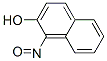
The chemical synonymous of 1-NITROSO-2-NAPHTHOL(131-91-9) are LABOTEST-BB LT00068477;CI NO 10005;ALPHA-NITROSO-BETA-NAPHTHOL;1-NITROSO-2-NAPHTHOL;TIMTEC-BB SBB009148;1,2-Napthtoquinone 1-oxime;1-Nitroso-2-naftol;1-nitroso-2-naphthaleno.
Uses
Production
Toxicity Data With Reference
| 1. | mmo-sat 10 µg/plate | ENMUDM Environmental Mutagenesis. 3 (1981),499. | ||
| 2. | dnr-bcs 10 mmol/L | JNSVA5 Journal of Nutritional Science and Vitaminology. 25 (1979),317. | ||
| mouse | LD50 | unreported | 400mg/kg (400mg/kg) | British Journal of Cancer. Vol. 6, Pg. 160, 1952. | |
| rat | LDLo | oral | 500mg/kg (500mg/kg) | National Academy of Sciences, National Research Council, Chemical-Biological Coordination Center, Review. Vol. 5, Pg. 35, 1953. |
Consensus Reports
Safety Profile
Hazard Codes:
Xn: Harmful

Risk Statements about 1-NITROSO-2-NAPHTHOL(131-91-9):
R22 Harmful if swallowed.
R33 Danger of cumulative effects.
R20/21/22: Harmful by inhalation, in contact with skin and if swallowed.
R36/37/38: Irritating to eyes, respiratory system and skin.
Safety Statements about 1-NITROSO-2-NAPHTHOL(131-91-9):
S26 In case of contact with eyes, rinse immediately with plenty of water and seek medical advice.
S36 Wear suitable protective clothing.
S45 In case of accident or if you feel unwell, seek medical advice immediately (show the label whenever possible.)
Specification
2. Handling: Wash thoroughly after handling. Remove contaminated clothing and wash before reuse. Use with adequate ventilation. Minimize dust generation and accumulation. Avoid contact with eyes, skin, and clothing. Keep container tightly closed. Avoid ingestion and inhalation.
3. Personal Protection: Eyes: Wear appropriate protective eyeglasses or chemical safety goggles as described by OSHA's eye and face protection regulations in 29 CFR 1910.133 or European Standard EN166. Skin: Wear appropriate protective gloves to prevent skin exposure. Clothing: Wear appropriate protective clothing to prevent skin exposure.
4. Fire Fighting: Wear a self-contained breathing apparatus in pressure-demand, MSHA/NIOSH (approved or equivalent), and full protective gear. During a fire, irritating and highly toxic gases may be generated by thermal decomposition or combustion. Runoff from fire control or dilution water may cause pollution. Extinguishing media: Use agent most appropriate to extinguish fire. In case of fire use water spray, dry chemical, carbon dioxide, or appropriate foam.