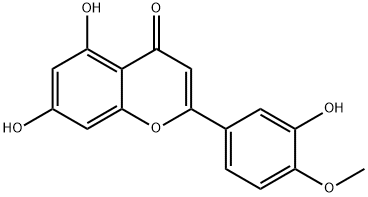
Detail of > 520-34-3
- CAS Number:
- 520-34-3
- Name:
4H-1-Benzopyran-4-one,5,7-dihydroxy-2-(3-hydroxy-4-methoxyphenyl)-
- Superlist Name:
- Diosmetin
- Formula:
- C16H12O6
- Molecular Structure:

- Synonyms:
- Diosmetin(6CI);Flavone, 3',5,7-trihydroxy-4'-methoxy- (7CI,8CI);3',5,7-Trihydroxy-4'-methoxyflavone;4'-Methylluteolin;Diosmetol;Luteolin 4'-methylether;Pillon;
- Molecular Weight:
- 300.26
- EINECS:
- 208-291-8
- Density:
- 1.512 g/cm3
- Melting Point:
- 256-258 °C
- Boiling Point:
- 576.7 °C at 760 mmHg
- Flash Point:
- 220.3 °C
- Appearance:
- Yellow powder
- Hazard Symbols:
Xi
Related products
Other Products
- Titanium Dioxide Carbon black Glutathione Adenosine Cable pulling lubricant
- 69010-88-462658-63-3
- 2795-39-3Potassium heptadecafluoro-1-octanesulfonate
- 519-32-41H-Purine-2,6-dione,3,9-dihydro-1,3,9-trimethyl-
- 14319-08-5Aluminum,tris(2,2,6,6-tetramethyl-3,5-heptanedionato-kO3,kO5)-, (OC-6-11)-
- 520-34-34H-1-Benzopyran-4-one,5,7-dihydroxy-2-(3-hydroxy-4-methoxyphenyl)-
- 5634-34-41-Propanol, 2-amino-2-methyl-, compd. with theophylline (1:1)
- 4441-12-7Morpholine,4,4',4''-phosphinylidynetris- (9CI)
- 7718-98-1Vanadium chloride(VCl3)
- 524-36-73-Pyridinemethanol,4-(aminomethyl)-5-hydroxy-6-methyl-, hydrochloride (1:2)
- 826-10-8l-METHAMPHETAMINE HYDROCHLORIDE
- 434-64-0Benzene,1,2,3,4,5-pentafluoro-6-(trifluoromethyl)-
- 59-14-3Uridine,5-bromo-2'-deoxy-
- 621-71-6Decanoic acid,1,1',1''-(1,2,3-propanetriyl) ester
- 17266-30-7Benzo[b]thiophene-3-aceticacid, 5-chloro-
- 14446-24-36-Isoquinolinol,1,2,3,4-tetrahydro-
Refine Suppliers Do you want your product ranking ahead? Know what is 'Top Seller'!
- Supplier Location:
China (Mainland)(17)
United States(2)
- Business Type:
- Importer/Exporter(13)Lab/Research institutions(4)Manufacturers(1)Other(1)
- Certificates:
- ISO(1)Production License(1)
Please post your buying leads,so that our qualified suppliers
will soon contact you!
*Required Fields
Reference
- Inhibition of the mutagenicity of bay-region diol-epoxides of polycyclic aromatic hydrocarbons by phenolic plant flavonoids
- Inhibition of the mutagenicity of bay-region diol-epoxides of polycyclic aromatic hydrocarbons by phenolic plant flavonoids. Huang, Mou Tuan; Wood, Alexander W.; Newmark, Harold L.; Sayer, Jane M.; Yagi, Haruhiko; Jerina, Donald M.; Conney, Allan H. (Dep. Biochem. Drug Metab., Hoffmann-La Roche Inc., Nutley, NJ 07110, USA). Carcinogenesis (London), 4(12), 1631-7 (English) 1983. CODEN: CRNGDP. ISSN: 0143-3334. DOCUMENT TYPE: Journal CA Section: 4 (Toxicology) Myricetin [529-44-2], robinetin [490-31-3], and luteolin [491-70-3] inhibited the mutagenic activity resulting from the metabolic activation of benzo[a]pyrene (I) [50-32-8] and (±)-trans-7,8-dihydroxy-7,8-dihydrobenzo[a]pyrene [61443-57-0] by rat liver microsomes. These naturally occurring plant flavonoids and 17 addnl. flavonoids and related derivs. with phenolic hydroxyl groups inhibited the mutagenic activity of (±)-7b,8a-dihydroxy-9a,10a-epoxy-7,8,9,10-tetrahydrobenzo[a]pyren e (B[a]P 7,8-diol-9,10-epoxide-2) [58917-67-2], which is an ultimate mutagenic and carcinogenic metabolite of I. Several flavonoids without phenolic hydroxyl groups of methylated phenolic hydroxyl groups were inactive. The mutagenic activity of 0.05 nmol BP 7,8-diol-9,10-epoxide-2 towards strain TA 100 of Salmonella typhimurium was inhibited 50% by incubation of the bacteria and the diol-epoxide with myricetin (2nmol), luteolin (5 nmol), quercetin [117-39-5] (5 nmol), 7-methoxyquercetin [90-19-7] (5 nmol), rutin [153-18-4] (5 nmol), quercitrin [522-12-3] (5 nmol), delphinidin chloride [528-53-0] (5 nmol), morin [480-16-0] (10 nmol), myricitrin [17912-87-7] (10 nmol), kaempferol [520-18-3] (10 nmol), diosmetin [520-34-3] (10 nmol), fisetin [528-48-3] (10 nmol), or apigenin [520-36-5] (10 nmol). Considerably less antimutagenic activity was obsd. for dihydroquercetin [480-18-2], naringenin [480-41-1], robinin [301-19-9], D-catechin [154-23-4], genistein [446-72-0], kaempferide [491-54-3], and chrysin [480-40-0]. Pentamethoxyquercetin [1247-97-8], tangeretin [481-53-8], nobiletin [478-01-3], 7,8-benzoflavone [604-59-1], 5,6-benzoflavone [6051-87-2], and flavone [525-82-6], which lack free phenolic groups, were inactive. The antimutagenic activity of hydroxylated flavonoids results from their direct interaction with B[a]P 7,8-diol-9,10-epoxide-2 since the rate of disappearance of the diol-epoxide from cell-free solns. in 1:9 dioxane:water was markedly stimulated by myricetin, robinetin, and quercetin. Myricetin was a highly potent inhibitor of the mutagenic activity of bay-region diol-epoxides of I, dibenzo[a,h]pyrene and dibenzo[a,i]pyrene, but higher concns. of myricetin were needed to inhibit the mutagenicity of the chem. less reactive benzo[a]pyrene 4,5-oxide and bay region diol-epoxides of benz[a]anthracene, chrysene, and benzo[c]phenanthrene.
- Flavonoids from some Yugoslavian Micromeria species: chemotaxonomical aspects
- Flavonoids from some Yugoslavian Micromeria species: chemotaxonomical aspects. Tomas-Barberan, Francisco A.; Gil, Maria I.; Marin, Petar, D.; Tomas-Lorente, Francisco (CEBAS, CSIC, Murcia 30080, Spain). Biochem. Syst. Ecol., 19(8), 697-8 (English) 1991. CODEN: BSECBU. ISSN: 0305-1978. DOCUMENT TYPE: Journal CA Section: 11 (Plant Biochemistry) M. albanica contained, as external lipophilic flavanoids, 4',5,6-trihydroxy-3',7-dimethoxyflavone, thymusin, thymonin, genkwanin, 5,6-dihydroxy-3',4',7,8-tetramethoxyflavone, ladanein, 4',5-dihydroxy-3',6,7,8-tetramethoxyflavone, 5-demethylnobiletin, and 5-hydroxy-3',4',6,7-tetramethyloxyflavone. M. dalmatica and M.There are some reagents with their cas registry numbers 520-34-3 and 2174-59-6 are used in this study. thymfolia, contained flavonoid patterns very similar to that of M. albanica, characterized by the presence of thymonin as a major component. The other Micromeria species studied (M. jubilance, M. parviflora, M. cristata, M. graeca, M. pseudocroatica, and M. croatica) yielded very small amts. of external flavonoids, including leteolin, apigenin, chrysoeriol, diosmetin, and acacetin. Vacuolar flavonoid glycosides detected in the Micromeria species were glycosides of luteolin, apigenin, chrysoeriol, and acacetin. M. thymifolia, M. dalmatica, and M. albanica contained mainly acacetin glycosides, with minor amts. of luteolin and apigenin glycosides, whereas the rest of the species accumulated luteolin and apigenin glycosides as major components and minor amts. of chrysoeriol and acacetin glycosides. The results suggest the sepn. of the studied species into 2 well-defined groups; the first group including M. albanica, M. dalmatica, and M. thymifolia, and a second group with the rest of the studied species. .
- About us
- |
- Payment
- |
- Contact us
- |
- Links
- |
- Help Center
- |
- Disclaimer
- |
- Add to favorite
- | SiteMap
- |
- Product SiteMap
- |
- Manufacturers
- |
- Suppliers
©2008 LookChem.com,License:ICP NO.:Zhejiang10014259
[Hangzhou]86-571-85317600,85317603,85317620