Products Categories
| CAS No.: | 700-06-1 |
|---|---|
| Name: | Indole-3-carbinol |
| Article Data: | 37 |
| Molecular Structure: | |
|
|
|
| Formula: | C9H9NO |
| Molecular Weight: | 147.177 |
| Synonyms: | Indole-3-methanol(6CI,7CI,8CI);3-(Hydroxymethyl)indole;3-Indolylcarbinol;3-Indolylmethanol;Indinol;NSC 525801;Indole-3-methanol; |
| EINECS: | 211-836-2 |
| Density: | 1.272 g/cm3 |
| Melting Point: | 96-99 °C(lit.) |
| Boiling Point: | 360.6 °C at 760 mmHg |
| Flash Point: | 171.9 °C |
| Appearance: | Off-white powder |
| Hazard Symbols: |
 Xi Xi
|
| Risk Codes: | 36/38 |
| Safety: | 26-36 |
| PSA: | 36.02000 |
| LogP: | 1.66020 |
- 81281-59-67-Benzylideneaminotheophylline
- 82993-81-5D-threo-Ritalinic acid hydrochloride
- 73441-42-6METHYL-5-CHLORO-2,2-DIMETHYLVALERATE
- 852475-26-4MC1568
- 958254-66-51H-Imidazo[4,5-b]pyridine-2-carboxaldehyde, 1-methyl-, hydrochloride
- 99170-93-1N-Methyl-2-oxazolamine
- 717878-06-31-(4-fluorophenyl)-4-nitro-1H-imidazole
- 914458-26-7[5-(2-fluorophenyl)-1-pentyl-1H-pyrrol-3-yl]-1-naphthalenyl-Methanone
- 894852-01-87-BROMO-2,2-DIMETHYL-2H-PYRIDO[3,2-B][1,4]OXAZIN-3(4H)-ONE
- 71825-51-92-methyl-2-(4-nitrophenyl)propanenitrile

| Conditions | Yield |
|---|---|
| With sodium methylate for 8h; Heating; | 100% |
| With methanol; sodium hydrogencarbonate | |
| With sodium methylate |
| Conditions | Yield |
|---|---|
| With sodium tetrahydroborate In methanol at 0℃; for 1h; | 100% |
| With formic acid In ethanol at 80℃; for 12h; Catalytic behavior; | 91% |
| With ammonia; calcium In tetrahydrofuran at -33℃; for 2h; other reagents: lithium, sodium, liq. ammonia; | 80% |
| Conditions | Yield |
|---|---|
| Stage #1: 3-methoxycarbonylindole With pentadec-3-en-2-one; trimethylsilyl trifluoromethanesulfonate; triphenylphosphine In dichloromethane at -78 - 0℃; for 1h; Inert atmosphere; Stage #2: With diisobutylaluminium hydride In hexane; dichloromethane at -78℃; Inert atmosphere; Stage #3: With potassium carbonate In methanol; hexane; dichloromethane at 20℃; for 0.5h; Inert atmosphere; | 84% |
- 487-89-8
Indole-3-carboxaldehyde

- 124-40-3
dimethyl amine

A
- 700-06-1
indole-3-carbinol
B
- 87-52-5
3-(Dimethylaminomethyl)indole
| Conditions | Yield |
|---|---|
| With sodium tetrahydroborate; water In methanol at 55 - 60℃; for 2.5h; | A 25% B 74% |
- 487-89-8
Indole-3-carboxaldehyde
A
- 700-06-1
indole-3-carbinol
B
- 22259-53-6
3-aminomethylindole
C
- 93742-14-4
bis(indol-3-ylmethyl)amine
| Conditions | Yield |
|---|---|
| With ammonium hydroxide; sodium tetrahydroborate In methanol at 14 - 18℃; for 20h; | A 72% B 9% C 13% |
- 487-89-8
Indole-3-carboxaldehyde
- 77287-34-4, 77287-35-5, 60100-09-6
formamide
A
- 700-06-1
indole-3-carbinol
| Conditions | Yield |
|---|---|
| With sodium tetrahydroborate In methanol at 20℃; for 1.5h; Leukardt-Wallach Amination; | A 30% B 49% |
- 87-51-4
indole-3-acetic acid
A
- 83-34-1
3-Methylindole
B
- 487-89-8
Indole-3-carboxaldehyde
C
- 700-06-1
indole-3-carbinol
D
- 59027-01-9
3-(3-methylindol-1-yl)methylindole
| Conditions | Yield |
|---|---|
| With 1,3,6,8-tetra-n-butylpyrimido<5,4-g>pteridine-2,4,5,7(1H,3H,6H,8H)-tetrone 10-oxide In acetonitrile for 0.0833333h; Irradiation; | A 14% B 36% C 12% D 8% |
| With 1,3,6,8-tetra-n-butylpyrimido<5,4-g>pteridine-2,4,5,7(1H,3H,6H,8H)-tetrone 10-oxide In acetonitrile for 0.166667h; Product distribution; Ambient temperature; Irradiation; depends on time and wavelength of irradiation and ratio of reacted compounds; |
- 17206-03-0
1-(1H-indol-3-yl)-N,N-dimethylmethanamine oxide
- 700-06-1
indole-3-carbinol
| Conditions | Yield |
|---|---|
| With sodium hydroxide; diethyl ether; water |
| Conditions | Yield |
|---|---|
| With sodium hydroxide; diethyl ether; water |
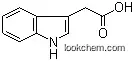

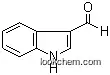
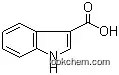
- 700370-10-11-Sulfobutyl-3-methylimidazolium p-Toluenesulfonate
- 700-58-32-Adamantanone
- 7006-59-9EthanaMiniuM, 2-hydroxy-N,N-bis(2-hydroxyethyl)-N-Methyl-, chloride
- 70070-12-14-[(5,6-dimethoxy-3,4-dihydro-1H-isochromen-1-yl)methyl]morpholine hydrochloride
- 701258-20-05-bromo-2-chloro-N,N-dimethylbenzamide
- 701-44-01-methyl-6-oxo-pyridine-3-carboxamide
- 70161-44-3Sodium hydroxymethylglycinate
- 70198-29-7Butanedioic acid polymer with 4-Hydroxy-2,2,6,6-tetramethyl-1-piperidineethanol
- 104987-11-3Tacrolimus
- 141-53-7Sodium formate
- 8001-54-5Quaternary ammonium compounds, alkylbenzyldimethyl, chlorides
- 9003-39-8Povidone
- 10161-34-9Trenbolone acetate
- 402957-28-2Telaprevir
- 68-19-9Cyanocobalamin

What can I do for you?
Get Best Price


Chemistry
Molecular Structure of Indole-3-methanol (CAS NO.700-06-1):
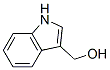
Molecular Formula: C9H9NO
Molecular Weight: 147.1739
IUPAC Name: 1H-Indol-3-ylmethanol
CAS NO: 700-06-1
Appearance:white to off white crystals
Melting point: 96-99 °C
Index of Refraction: 1.705
Molar Refractivity: 44.97 cm3
Molar Volume: 115.6 cm3
Surface Tension: 61.7 dyne/cm
Density: 1.272 g/cm3
Flash Point: 171.9 °C
Enthalpy of Vaporization: 63.98 kJ/mol
Boiling Point: 360.6 °C at 760 mmHg
Vapour Pressure: 7.89E-06 mmHg at 25°C
Classification Code: Anticarcinogenic agents; Antineoplastic Agents; Protective Agents; Reproductive Effect
Synonyms: 3-Hydroxymethylindole ; 3-Indolylcarbinol ; 5-21-03-00045 (Beilstein Handbook Reference) ; AI3-60090 ; BRN 0121323 ; CCRIS 3261 ; EINECS 211-836-2 ; Indinol ; Indole 3 carbinol ; Indole-3-carbinol ; NSC 525801 ; 1H-Indole-3-methanol (9CI)
SMILES: OCc2c1ccccc1nc2
InChI: InChI=1/C9H9NO/c11-6-7-5-10-9-4-2-1-3-8(7)9/h1-5,10-11H,6H2
InChIKey: IVYPNXXAYMYVSP-UHFFFAOYAO
Std. InChI: InChI=1S/C9H9NO/c11-6-7-5-10-9-4-2-1-3-8(7)9/h1-5,10-11H,6H2
Std. InChIKey: IVYPNXXAYMYVSP-UHFFFAOYSA-N
Uses
Indole-3-methanol (CAS NO.700-06-1) can prevent the development of estrogen-enhanced cancers including breast, endometrial and cervical cancers. It has be shown to inhibit carcinogenesis in several animal species, but it enhances tumor incidence if administered at a post-initiation stage.
Production
Indole-3-methanol (CAS NO.700-06-1) naturally exists in vegetables such as cabbage, broccoli, brussels sprouts, and kale. It is also widely available in supplement form. In 1985,B Sundberg and his Co-worker did a study about "Identification and Quantification of Indole-3-methanol in Etiolated Seedlings of Scots Pine"(Pinus sylvestris L.). Indole-3-methanol did exist in buffer extract from etiolated seedlings of Pinus sylvestris L.And the stability of indole-3-methanol at different pH levels was investigated.
As a metabolism of indole-3-acetic acid, Indole-3-methanol can be produced by the oxidation of indole-3-acetic acid catalyzed by two cytosolic basic isoperoxidases from Lupinus. This study has been done by A. Barceló in 1990. While indole-3-methanol is only a minor product of the oxidation of indole-3-acetic acid catalyzed by extracellular acidic isoperoxidases, it is the only product of the oxidation of indole-3-acetic acid catalyzed by two cytosolic basic isoperoxidases (EC 1.11.1.7) from lupin (Lupinus albus L.) hypocotyls. It can be produced by the breakdown of the glucosinolate glucobrassicin.
Toxicity Data With Reference
| Organism | Test Type | Route | Reported Dose (Normalized Dose) | Effect | Source |
|---|---|---|---|---|---|
| rat | LDLo | subcutaneous | 500mg/kg (500mg/kg) | BEHAVIORAL: COMA | Food and Cosmetics Toxicology. Vol. 18, Pg. 159, 1980. |
Safety Profile
Safty informations about Indole-3-methanol (CAS NO.700-06-1):
Hazard Codes:Xi
Risk Statements:36/38
36/38 (Irritating to the eyes and skin)
Safety Statements:26-36
26 (In case of contact with eyes,rinse immediately with plenty of water and seek medical advice)
36 (Wear suitable protective clothing)
WGK Germany:3
RTECS:NL9483000
Hazard Note:Irritant
Moderately toxic by subcutaneous route. An experimental teratogen. When heated to decomposition it emits toxic fumes of NOx.
Specification
Handling and Storage
Handling: Wash thoroughly after handling. Remove contaminated clothing and wash before reuse. Avoid breathing dust, vapor, mist, or gas. Avoid contact with skin and eyes.
Storage: Store in a tightly closed container. Store in a dry area. Keep refrigerated. (Store below 4oC/39oF.)
-
Premium Related Products