Products Categories
| CAS No.: | 87-87-6 |
|---|---|
| Name: | TETRACHLOROHYDROQUINONE |
| Article Data: | 123 |
| Molecular Structure: | |
|
|
|
| Formula: | C6H2 Cl4 O2 |
| Molecular Weight: | 247.893 |
| Synonyms: | Hydroquinone,tetrachloro- (6CI,7CI,8CI); 2,3,5,6-Tetrachloro-1,4-benzenediol;2,3,5,6-Tetrachloro-1,4-dihydroxybenzene; 2,3,5,6-Tetrachlorohydroquinone;Dihydro-p-chloranil; NSC 100888; NSC 4858; Nordrosophilin A;Perchlorohydroquinone; Tetrachloro-1,4-benzenediol;Tetrachloro-1,4-hydroquinone; Tetrachloro-p-benzohydroquinone;Tetrachloro-p-hydroquinone; Tetrachlorobenzoquinol |
| EINECS: | 201-779-1 |
| Density: | 1.848 g/cm3 |
| Melting Point: | 238-240ºC |
| Boiling Point: | 286.2 ºC |
| Flash Point: | 126.9ºC |
| Solubility: | 21.5mg/L(temperature not stated) |
| Appearance: | tan-coloured or yellowish powder |
| Hazard Symbols: |
 Xn Xn
|
| Risk Codes: | 22-41 |
| Safety: | Poison by ingestion and intraperitoneal routes. Mutation data reported. When heated to decomposition it emits toxic fumes of Cl−. |
| PSA: | 40.46000 |
| LogP: | 3.71140 |
- 958254-66-51H-Imidazo[4,5-b]pyridine-2-carboxaldehyde, 1-methyl-, hydrochloride
- 99170-93-1N-Methyl-2-oxazolamine
- 914458-26-7[5-(2-fluorophenyl)-1-pentyl-1H-pyrrol-3-yl]-1-naphthalenyl-Methanone
- 894852-01-87-BROMO-2,2-DIMETHYL-2H-PYRIDO[3,2-B][1,4]OXAZIN-3(4H)-ONE
- 90221-55-92-bromo-5-methylbenzaldehyde
- 885590-99-82,3-DIFLUORO-4-IODOBENZALDEHYDE
- 97730-31-9(S)-4'-(2-Methylbutyl)Biphenyl-4-Carbonitrile
- 926293-55-26-Bromo-2-methylpyridine-3-carboxaldehyde
- 911112-05-55-Iodo-3-(trifluoromethyl)-2-pyridinamine
- 886364-50-71-(5-Bromo-2-pyridinyl)-2,2,2-trifluoroethanone
- Total:24 Page 1 of 1 1

What can I do for you?
Get Best Price


Chemistry
Molecular Structure of Tetrachlorohydroquinone (CAS NO.87-87-6):
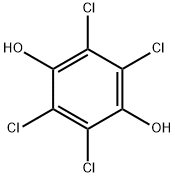
EINECS: 201-779-1
IUPAC Name: 2,3,5,6-Tetrachlorobenzene-1,4-diol
Molecular Formula: C6H2Cl4O2
Molecular Weight: 247.890880 g/mol
XLogP3: 4.1
H-Bond Donor: 2
H-Bond Acceptor: 2
Canonical SMILES: C1(=C(C(=C(C(=C1Cl)Cl)O)Cl)Cl)O
InChI: InChI=1S/C6H2Cl4O2/c7-1-2(8)6(12)4(10)3(9)5(1)11/h11-12H
InChIKey: STOSPPMGXZPHKP-UHFFFAOYSA-N
Index of Refraction: 1.661
Molar Refractivity: 49.59 cm3
Molar Volume: 134 cm3
Surface Tension: 65 dyne/cm
Density: 1.848 g/cm3
Flash Point: 126.9 °C
Enthalpy of Vaporization: 54.63 kJ/mol
Boiling Point: 286.2 °C at 760 mmHg
Vapour Pressure: 0.00156 mmHg at 25 °C
Melting Point: 238-240 °C
Water Solubility: 76.23 mg/L at 25 °C
BRN: 1876374
Toxicity Data With Reference
| 1. | dnd-omi 100 µmol/L | MUREAV Mutation Research. 145 (1985),71. | ||
| 2. | dnd-mam:lym 50 mmol/L | MUREAV Mutation Research. 145 (1985),71. | ||
| 3. | orl-mus LD50:368 mg/kg | TECSDY Toxicological and Environmental Chemistry. 11 (1986),37. | ||
| 4. | ipr-mus LD50:25 mg/kg | NTIS** National Technical Information Service. (Springfield, VA 22161) (Formerly U.S. Clearinghouse for Scientific and Technical Information) AD277-689 . |
Consensus Reports
Reported in EPA TSCA Inventory.
Safety Profile
Safety Information of Tetrachlorohydroquinone (CAS NO.87-87-6):
Hazard Codes: Xn 
Risk Statements: 22-41
R22:Harmful if swallowed
R41:Risk of serious damage to the eyes
Safety Statements: 26-36/37/39-39
S26: In case of contact with eyes, rinse immediately with plenty of water and seek medical advice
S36/37/39:Wear suitable protective clothing, gloves and eye/face protection
S39:Wear eye / face protection
RTECS: MX7700000
Poison by ingestion and intraperitoneal routes. Mutation data reported. When heated to decomposition it emits toxic fumes of Cl−.
Specification
Tetrachlorohydroquinone with CAS registry number of 87-87-6 is beige to orange crystals, known as 2,3,5,6-Tetrachloro-1,4-benzenediol ; 2,3,5,6-Tetrachlorohydroquinone ; 4-06-00-05775 (Beilstein Handbook Reference) ; AI3-15490 ; CCRIS 4143 ; Dihydro-p-chloranil ; NSC 100888 ; Nordrosophilin A ; Perchlorohydroquinone ; Tetrachloro p-hydroquinone ; Tetrachloro-p-benzohydroquinone ; Tetrachloro-p-hydroquinone ; Tetrachlorobenzoquinol ; USAF DO-62 ; 1,4-Benzenediol, 2,3,5,6-tetrachloro- ; Hydroquinone, tetrachloro- . When heated to decomposition, it emits irritating and toxic fumes and gases.