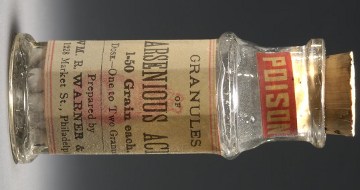
Arsenic
Arsenic General
| Name:Arsenic | Symbol:As |
| Type:Metalloid, Nitrogen group | Atomic weight:74.9216 |
| Density @ 293 K:5.776 g/cm3 | Atomic volume:12.97 cm3/mol |
|
Discovered:
Arsenic has been known since antiquity as the sulfide. Aristotle, in the fourth century BC, refers to "sandarach", renamed arhenicum by his student Theophrastus of Eresos. Olympiodorus of Thebes (5th century AD) roasted arsenic sulfide and obtained white arsenic (As2O3). Albertus Magnus (1193-1280) was the first to state that arsenic has a metal-like nature. In De Mineralibus he described how the metal could be obtained by heating orpiment (As2S3) with soap. |
|
Arsenic States
| State (s, l, g):solid | |
| Melting point:1090 K (817 °C) | Boiling point:887 K (614 °C) |
Arsenic Energies
| Specific heat capacity:0.33 J/gK | Heat of atomization:303 kJ mol-1 |
| Heat of fusion:24.44 kJ mol-1 | Heat of vaporization :32.4 kJ mol-1 |
| 1st ionization energy:946.5 kJ mol-1 | 2nd ionization energy:1797.8 kJ mol-1 |
| 3rd ionization energy:2735.4 kJ mol-1 | Electron affinity:78 kJ mol-1 |
Arsenic Oxidation & Electrons
| Shells:2,8,18,5 | Electron configuration: [Ar] 3d10 4s2 4p3 |
| Minimum oxidation number:-3 | Maximum oxidation number:5 |
| Min. common oxidation no.:-3 | Max. common oxidation no.:5 |
| Electronegativity (Pauling Scale):2.18 | Polarizability volume:4.3 Å3 |
Arsenic Appearance & Characteristics
| Structure:rhombohedral; layers of 6-member rings | Color:gray |
| Hardness:3.5 mohs | |
|
Harmful effects:
Arsenic is immediately dangerous to life or health at 5 mg m-3. |
|
|
Characteristics:
Arsenic occurs in three distinct solid forms. Uses: As a result of its toxicity, arsenic compounds are used in wood preservation and insecticides. |
|
Arsenic Reactions
| Reaction with air:mild, w/ht ⇒ As4O6 | Reaction with 6 M HCl:none |
| Reaction with 15 M HNO3:mild, w/ht ⇒ H3AsO4, NOx | Reaction with 6 M NaOH:none |
Arsenic Compounds
| Oxide(s):As2O3 | Chloride(s): AsCl3 AsCl5 |
| Hydride(s):AsH3 |
Arsenic Radius
| Atomic radius:115 pm | Ionic radius (1+ ion):pm |
| Ionic radius (2+ ion):pm | Ionic radius (3+ ion):72 pm |
| Ionic radius (2- ion):pm | Ionic radius (1- ion):pm |
Arsenic Conductivity
| Thermal conductivity:50.2 W m-1 K-1 | Electrical conductivity:3.85 x 10⁶ S cm-1 |
Arsenic Abundance & Isotopes
| Abundance earth's crust:1.8 parts per million by weight, 0.5 parts per million by moles | |
| Abundance solar system:12 parts per billion by weight, 0.21 parts per billion by moles | |
| Cost, pure:$320 per 100g | |
| Cost, bulk: $ per 100g | |
|
Source:
Most arsenic is obtained as a by-product of processing gold, silver, copper, and other metal ores. |
|
|
Isotopes:
23 whose half-lives are known, with mass numbers 65 to 87. Of these, only one is stable: 75As. |
|
Arsenic Other
|
Other:
|
|
Prev: Germanium Next: Selenium |