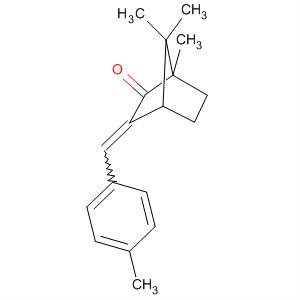
Chemical Property of 4-Methylbenzylidenecamphor
Chemical Property:
- Boiling Point:371.9oC at 760mmHg
- Flash Point:168.9oC
- PSA:17.07000
- Density:1.064g/cm3
- LogP:4.40360
- XLogP3:4.5
- Hydrogen Bond Donor Count:0
- Hydrogen Bond Acceptor Count:1
- Rotatable Bond Count:1
- Exact Mass:254.167065321
- Heavy Atom Count:19
- Complexity:423
- Purity/Quality:
-
98%,99%, *data from raw suppliers
3-(4-Methylbenzylidene)camphor ≥98.0% (GC) *data from reagent suppliers
Safty Information:
- Pictogram(s):
- Hazard Codes:
- MSDS Files:
-
SDS file from LookChem
Useful:
- Canonical SMILES:CC1=CC=C(C=C1)C=C2C3CCC(C2=O)(C3(C)C)C
- Isomeric SMILES:CC1=CC=C(C=C1)/C=C/2\[C@H]3CC[C@@](C2=O)(C3(C)C)C
-
Use Description
4-Methylbenzylidene camphor (4MBC) is a chemical compound with several applications across different fields. In the cosmetic and personal care industry, it is commonly used as a chemical UV filter in sunscreen and sunblock products, where it plays a crucial role in protecting the skin from the harmful effects of UV radiation by absorbing and dissipating UVB and UVA rays. In the field of materials science and polymer chemistry, it can be employed as an additive to enhance the UV stability and durability of various materials, including plastics, coatings, and textiles, which is important for outdoor applications that require UV resistance. Additionally, in research related to endocrine-disrupting chemicals (EDCs), 4MBC has been studied for its potential effects on hormone systems and aquatic life, raising concerns about its environmental impact when released into waterways. Its multifaceted roles as a UV filter, materials enhancer, and subject of environmental research highlight its significance in sun protection, materials development, and environmental awareness in various fields.