Welcome to LookChem.com Sign In|Join Free
  • or

Encyclopedia

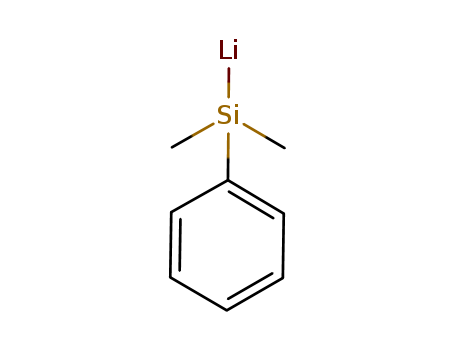
Lithium, (dimethylphenylsilyl)-

Base Information
  • Chemical Name:Lithium, (dimethylphenylsilyl)-
  • CAS No.:3839-31-4
  • Molecular Formula:C8H11LiSi
  • Molecular Weight:142.202
  • Hs Code.:
  • DSSTox Substance ID:DTXSID10449966
  • Mol file:3839-31-4.mol
Lithium, (dimethylphenylsilyl)-

Synonyms:phenyldimethylsilyllithium;PhMe2SiLi

Suppliers and Price of Lithium, (dimethylphenylsilyl)-
Supply Marketing:
Business phase:
The product has achieved commercial mass production*data from LookChem market partment
Manufacturers and distributors:
  • Manufacture/Brand
  • Chemicals and raw materials
  • Packaging
  • price
Total 7 raw suppliers
Chemical Property of Lithium, (dimethylphenylsilyl)-
Chemical Property:
  • Hydrogen Bond Donor Count:0
  • Hydrogen Bond Acceptor Count:1
  • Rotatable Bond Count:0
  • Exact Mass:142.07900532
  • Heavy Atom Count:10
  • Complexity:77.3
Purity/Quality:

99% *data from raw suppliers

Safty Information:
  • Pictogram(s):  
  • Hazard Codes: 
MSDS Files:

SDS file from LookChem

Useful:
  • Canonical SMILES:[Li+].C[Si-](C)C1=CC=CC=C1
Technology Process of Lithium, (dimethylphenylsilyl)-

There total 6 articles about Lithium, (dimethylphenylsilyl)- which guide to synthetic route it. The literature collected by LookChem mainly comes from the sharing of users and the free literature resources found by Internet computing technology. We keep the original model of the professional version of literature to make it easier and faster for users to retrieve and use. At the same time, we analyze and calculate the most feasible synthesis route with the highest yield for your reference as below:

synthetic route:
Guidance literature:
With lithium; In tetrahydrofuran; at 20 ℃; for 3h;
DOI:10.1021/jo011157s
Guidance literature:
With lithium; In tetrahydrofuran; at -8 ℃; for 36h;
DOI:10.1039/P19810002527
Guidance literature:
With lithium; In tetrahydrofuran; at -5 ℃;
DOI:10.1016/0040-4020(89)80083-3
Refernces

Tuning of α-Silyl Carbocation Reactivity into Enone Transposition: Application to the Synthesis of Peribysin D, E-Volkendousin, and E-Guggulsterone

10.1021/acs.orglett.1c02173

The research presents a novel method for enone transposition using a silyl group masking strategy. The purpose of the study was to develop a reliable and efficient method for transposing enones, which are versatile intermediates in organic synthesis, with highlights such as enantioswitching, substituent shuffling, and Z-selectivity. The researchers utilized key chemicals like PhMe2SiLi (phenyldimethylsilyllithium) for the addition to carbonyl groups, acetonitrile and water as solvents, and TFA (trifluoroacetic acid) for catalysis. The developed method was successfully applied to the first total synthesis and structural revision of peribysin D, a bioactive natural product, as well as the formal synthesis of E-guggulsterone and E-volkendousin. The study concludes that the silyl-based masking group approach is highly effective for enone transposition, offering a practical and versatile tool for organic synthesis, with potential applications in the synthesis of other bioactive compounds and natural products.


Post a RFQ

Enter 15 to 2000 letters.Word count: 0 letters

Attach files(File Format: Jpeg, Jpg, Gif, Png, PDF, PPT, Zip, Rar,Word or Excel Maximum File Size: 3MB)

1 Customer Service

What can I do for you?
Get Best Price

Get Best Price for 3839-31-4