Welcome to LookChem.com Sign In|Join Free
  • or

Encyclopedia

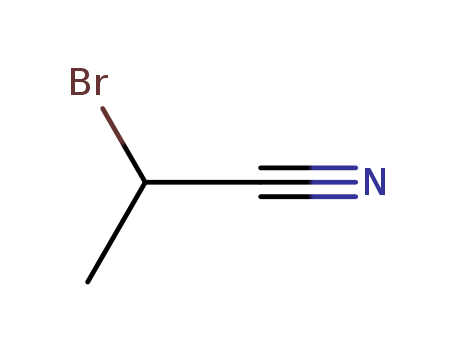
2-Bromopropionitrile

Base Information
  • Chemical Name:2-Bromopropionitrile
  • CAS No.:19481-82-4
  • Molecular Formula:C3H4 Br N
  • Molecular Weight:133.975
  • Hs Code.:2926909090
  • European Community (EC) Number:628-749-4
  • DSSTox Substance ID:DTXSID80941245
  • Nikkaji Number:J797.238E
  • Mol file:19481-82-4.mol
2-Bromopropionitrile

Synonyms:2-Bromopropionitrile;2-bromopropanenitrile;19481-82-4;Propanenitrile, 2-bromo-;Propanenitrile, bromo-;2-bromopropanitrile;2-bromo-propionitrile;(+/-)-2-Bromopropionitrile;alpha-Bromopropionitrile;2-bromoproprionitrile;(+) 2-bromo-propionitrile;2-Bromopropionitrile, 97%;SCHEMBL181237;DTXSID80941245;PYNYHMRMZOGVML-UHFFFAOYSA-N;AMY39192;MFCD00010383;AKOS015912645;s12043;BS-22302;()-2-Bromopropionitrile;-Bromopropionitrile;CS-0020094;FT-0637857;EN300-139994;J-508540

Suppliers and Price of 2-Bromopropionitrile
Supply Marketing:
Business phase:
The product has achieved commercial mass production*data from LookChem market partment
Manufacturers and distributors:
  • Manufacture/Brand
  • Chemicals and raw materials
  • Packaging
  • price
  • TRC
  • 2-Bromopropionitrile
  • 100mg
  • $ 75.00
  • Sigma-Aldrich
  • 2-Bromopropionitrile 97%
  • 5g
  • $ 102.00
  • Oakwood
  • 2-Bromopropanenitrile 97%
  • 5g
  • $ 95.00
  • Oakwood
  • 2-Bromopropanenitrile 97%
  • 1g
  • $ 40.00
  • Matrix Scientific
  • 2-Bromopropanenitrile 95+%
  • 10g
  • $ 290.00
  • Matrix Scientific
  • 2-Bromopropanenitrile 95+%
  • 5g
  • $ 84.00
  • Matrix Scientific
  • 2-Bromopropanenitrile 95+%
  • 1g
  • $ 24.00
  • Biosynth Carbosynth
  • 2-Bromopropionitrile
  • 1 g
  • $ 60.00
  • Biosynth Carbosynth
  • 2-Bromopropionitrile
  • 5 g
  • $ 225.00
  • Biosynth Carbosynth
  • 2-Bromopropionitrile
  • 2 g
  • $ 100.00
Total 26 raw suppliers
Chemical Property of 2-Bromopropionitrile
Chemical Property:
  • Vapor Pressure:5mmHg at 25°C 
  • Refractive Index:n20/D 1.461(lit.) 
  • Boiling Point:144.8°Cat760mmHg 
  • Flash Point:58.3°C 
  • PSA:23.79000 
  • Density:1.576g/cm3 
  • LogP:1.29338 
  • XLogP3:1.2
  • Hydrogen Bond Donor Count:0
  • Hydrogen Bond Acceptor Count:1
  • Rotatable Bond Count:0
  • Exact Mass:132.95271
  • Heavy Atom Count:5
  • Complexity:60.5
Purity/Quality:

98% *data from raw suppliers

2-Bromopropionitrile *data from reagent suppliers

Safty Information:
  • Pictogram(s):  
  • Hazard Codes:Xn 
  • Statements: 20/21/22-36/37/38 
  • Safety Statements: 23-26-28-36/37/39 
MSDS Files:

SDS file from LookChem

Total 1 MSDS from other Authors

Useful:
  • Canonical SMILES:CC(C#N)Br
  • Uses 2-Bromopropionitrile was used as an initiator in the atom transfer radical polymerization using activators generated by electron transfer (AGET ATRP) of acrylonitrile and the reaction was catalysed by Yb-based catalyst.
Technology Process of 2-Bromopropionitrile

There total 7 articles about 2-Bromopropionitrile which guide to synthetic route it. The literature collected by LookChem mainly comes from the sharing of users and the free literature resources found by Internet computing technology. We keep the original model of the professional version of literature to make it easier and faster for users to retrieve and use. At the same time, we analyze and calculate the most feasible synthesis route with the highest yield for your reference as below:

synthetic route:
Guidance literature:
With phosphorus pentoxide; silica gel; Heating;
DOI:10.1021/jo00224a074
Guidance literature:
With 2,4,4,6-Tetrabromo-2,5-cyclohexadien-1-one; triphenylphosphine; In dichloromethane; at 0 ℃; for 1h;
DOI:10.1070/mc2003v013n06abeh001830
Refernces

Cyclazines and their Analogs. 1. Thiazolopyrimidopyrimidines

10.1007/BF00475264

The research focuses on synthesizing derivatives of a new heterocyclic system, specifically formyl-substituted thiazolopyrimidopyrimidines, with the aim of developing new classes of polymethine dyes. The study involves reacting 3-amino-5-methyl-thiazolo[3,2-a]pyrimidinium salts, prepared from 2-mercaptopyrimidines and substituted acetonitriles, with the Vilsmeier reagent. Key chemicals used include 2-mercaptopyrimidines, various nitriles such as α-cyanobenzylbenzenesulfonate and α-bromopropionitrile, and phosphoryl chloride. The synthesized compounds exhibit strong UV absorption bands and a broad band near 600 nm, indicating potential for use in dyes. The study concludes that the position and intensity of these bands are significantly influenced by the nature of the substituents, suggesting that these new heterocyclic derivatives can be tailored for specific applications in dye synthesis.

Post a RFQ

Enter 15 to 2000 letters.Word count: 0 letters

Attach files(File Format: Jpeg, Jpg, Gif, Png, PDF, PPT, Zip, Rar,Word or Excel Maximum File Size: 3MB)

1 Customer Service

What can I do for you?
Get Best Price

Get Best Price for 19481-82-4