10.1016/S0960-894X(02)00830-2
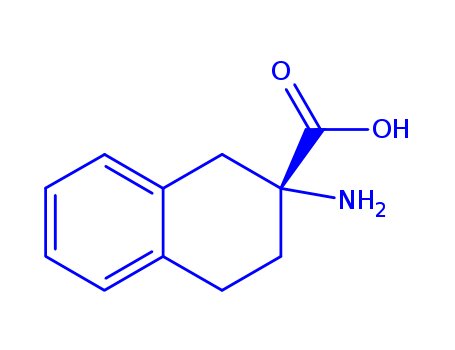
The research focuses on the structure-activity relationship of a linear peptide, Bu-His-DPhe-Arg-Trp-Gly-NH2, at the human melanocortin-1 and -4 receptors, with the aim of identifying potent and selective human melanocortin-4 receptor (hMC4R) agonists for the treatment of obesity. The study involved systematic substitution of the His6 residue using a non-selective hMC4R pentapeptide agonist as a template, leading to the discovery of Bu-Atc-DPhe-Arg-Trp-Gly-NH2 and its derivatives, which showed moderate to high selectivity towards hMC4R over hMC1R. Key chemicals used in the synthesis process included Fmoc-protected amino acids, various substituted β-tetralones, and rhodium catalysts for intramolecular Buchner reactions. The research concluded that rigid non-basic histidine surrogates, such as Atc (2-aminotetraline-2-carboxylic acid), could lead to excellent hMC4R selectivity in linear peptides, with pentapeptides containing 5-BrAtc and 5-Me2NAtc being potent hMC4R agonists and inactive in hMC1R, hMC3R, and hMC5R agonist assays.