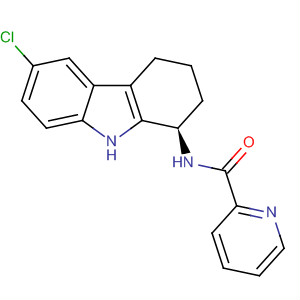
Chemical Property of (R)-N-(6-chloro-2,3,4,9-tetrahydro-1H-carbazol-1-yl)picolinamide
Chemical Property:
- XLogP3:3.5
- Hydrogen Bond Donor Count:2
- Hydrogen Bond Acceptor Count:2
- Rotatable Bond Count:2
- Exact Mass:325.0981898
- Heavy Atom Count:23
- Complexity:446
- Purity/Quality:
-
99% *data from raw suppliers
Safty Information:
- Pictogram(s):
- Hazard Codes:
- MSDS Files:
-
SDS file from LookChem
Useful:
- Canonical SMILES:C1CC(C2=C(C1)C3=C(N2)C=CC(=C3)Cl)NC(=O)C4=CC=CC=N4
- Isomeric SMILES:C1C[C@H](C2=C(C1)C3=C(N2)C=CC(=C3)Cl)NC(=O)C4=CC=CC=N4
-
Use Description
2-Pyridinecarboxamide, N-[(1R)-6-chloro-2,3,4,9-tetrahydro-1H-carbazol-1-yl]-, a specific chemical compound, serves diverse functions across various fields. In the realm of medicinal chemistry, it plays a crucial role as a potential pharmaceutical intermediate or building block in the synthesis of compounds with potential therapeutic applications, contributing to drug discovery and development efforts. In organic synthesis, 2-Pyridinecarboxamide,
N-[(1R)-6-chloro-2,3,4,9-tetrahydro-1H-carbazol-1-yl]- can serve as a versatile reagent, enabling the creation of complex molecular structures for research purposes. Moreover, in the field of chemical research, it may be explored for its potential interactions with biomolecules or its role in the development of novel compounds. Its applications in medicinal chemistry, organic synthesis, and chemical research underscore its significance in driving innovation, scientific exploration, and potential medical breakthroughs across these different domains.