Welcome to LookChem.com Sign In|Join Free
  • or

Encyclopedia

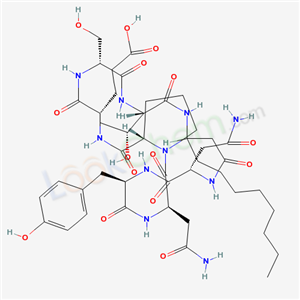
Bacillomycin D

Base Information
  • Chemical Name:Bacillomycin D
  • CAS No.:76012-17-4
  • Molecular Formula:C45H68N10O15
  • Molecular Weight:989.07942
  • Hs Code.:
  • Wikipedia:Bacillomycin
  • Wikidata:Q4838953
  • Mol file:76012-17-4.mol
Bacillomycin D

Synonyms:bacillomycin D

Suppliers and Price of Bacillomycin D
Supply Marketing:
Business phase:
The product has achieved commercial mass production*data from LookChem market partment
Manufacturers and distributors:
  • Manufacture/Brand
  • Chemicals and raw materials
  • Packaging
  • price
Total 19 raw suppliers
Chemical Property of Bacillomycin D
Chemical Property:
  • Vapor Pressure:0mmHg at 25°C 
  • Boiling Point:1536.6°C at 760 mmHg 
  • Flash Point:883.1°C 
  • Density:1.4g/cm3 
  • XLogP3:-1.1
  • Hydrogen Bond Donor Count:13
  • Hydrogen Bond Acceptor Count:15
  • Rotatable Bond Count:18
  • Exact Mass:988.48656150
  • Heavy Atom Count:70
  • Complexity:1860
Purity/Quality:

99% ,98%,Electron Grade , *data from raw suppliers

Safty Information:
  • Pictogram(s):  
  • Hazard Codes: 
MSDS Files:
Useful:
  • Canonical SMILES:CCCCCCCCC1CC(=O)NC(C(=O)NC(C(=O)NC(C(=O)N2CCCC2C(=O)NC(C(=O)NC(C(=O)NC(C(=O)N1)C(C)O)CO)CCC(=O)O)CC(=O)N)CC3=CC=C(C=C3)O)CC(=O)N
  • Isomeric SMILES:CCCCCCCCC1CC(=O)N[C@H](C(=O)N[C@@H](C(=O)N[C@@H](C(=O)N2CCC[C@H]2C(=O)N[C@H](C(=O)N[C@@H](C(=O)N[C@H](C(=O)N1)[C@@H](C)O)CO)CCC(=O)O)CC(=O)N)CC3=CC=C(C=C3)O)CC(=O)N
Refernces

How substrate solvation contributes to the enantioselectivity of subtilisin toward secondary alcohols

10.1021/ja0528937

The research investigates how substrate solvation affects the enantioselectivity of subtilisin, an enzyme, toward secondary alcohols. The purpose is to resolve inconsistencies in predicting enantiopreference of subtilisin in different solvents and to provide a more accurate model for designing enantioselective reactions. The study proposes a revised rule that subtilisin binds only one substituent of a secondary alcohol in its S1′ pocket, leaving the other in the solvent. This rule explains why solvent changes alter enantioselectivity and suggests that solvation of one substituent contributes to enantiopreference. Key chemicals include secondary alcohols like 1a-13a, dihydrocinnamoyl esters, and arylsulfinamides, which were used to test the revised rule. The study concludes that enantioselectivity in water varies linearly with the hydrophobicity difference between substituents, and increasing the polarity difference between substituents can enhance enantioselectivity. This model provides a strategy to improve enantioselectivity by modifying substrates and offers insights into how solvents influence enzyme-catalyzed reactions.

Post a RFQ

Enter 15 to 2000 letters.Word count: 0 letters

Attach files(File Format: Jpeg, Jpg, Gif, Png, PDF, PPT, Zip, Rar,Word or Excel Maximum File Size: 3MB)

1 Customer Service

What can I do for you?
Get Best Price

Get Best Price for 76012-17-4
