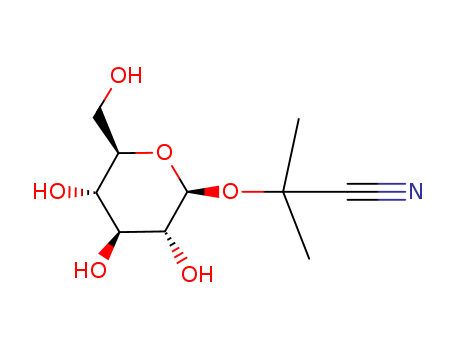
Chemical Property of Linamarin
Chemical Property:
- Vapor Pressure:6.02E-11mmHg at 25°C
- Melting Point:142-143°C
- Refractive Index:1.4610 (estimate)
- Boiling Point:473.3°Cat760mmHg
- PKA:12.73±0.70(Predicted)
- Flash Point:240°C
- PSA:123.17000
- Density:1.41g/cm3
- LogP:-1.89492
- Storage Temp.:2-8°C
- Solubility.:Soluble in DMSO, Methanol, and Ethanol
- XLogP3:-1.8
- Hydrogen Bond Donor Count:4
- Hydrogen Bond Acceptor Count:7
- Rotatable Bond Count:3
- Exact Mass:247.10558726
- Heavy Atom Count:17
- Complexity:311
- Purity/Quality:
-
99%, *data from raw suppliers
Linamarin *data from reagent suppliers
Safty Information:
- Pictogram(s):
Xn
- Hazard Codes:Xn
- Statements:
20/22-36/37/38
- Safety Statements:
26-36
- MSDS Files:
-
Total 1 MSDS from other Authors
Useful:
- Chemical Classes:Biological Agents -> Plant Oils and Extracts
- Canonical SMILES:CC(C)(C#N)OC1C(C(C(C(O1)CO)O)O)O
- Isomeric SMILES:CC(C)(C#N)O[C@H]1[C@@H]([C@H]([C@@H]([C@H](O1)CO)O)O)O
-
Description
Linamarin is a glucoside of acetone cyanohydrin found in the leaves and roots of cassava, lima beans, and flax. It is thought to function in the transport of nitrogen from plant leaves to roots in young plants but also serves as a plant defense mechanism. Linamarin is converted to toxic hydrocyanic acid or prussic acid when it comes into contact with linamarase, an enzyme that is released when the cells of cassava roots are ruptured.
-
Uses
Can be found in the seed skins and embryos of flax Can be found in the seed skins and embryos of flax.