Welcome to LookChem.com Sign In|Join Free
  • or

Encyclopedia

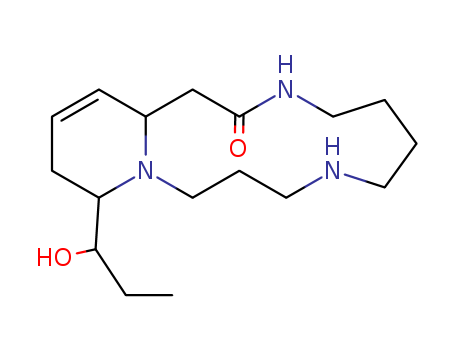
17-(1-Hydroxypropyl)-1,5,10-triazabicyclo[11.4.0]heptadec-14-en-11-one

Base Information
  • Chemical Name:17-(1-Hydroxypropyl)-1,5,10-triazabicyclo[11.4.0]heptadec-14-en-11-one
  • CAS No.:22324-44-3
  • Molecular Formula:C17H31N3O2
  • Molecular Weight:309.452
  • Hs Code.:
  • Mol file:22324-44-3.mol
17-(1-Hydroxypropyl)-1,5,10-triazabicyclo[11.4.0]heptadec-14-en-11-one

Synonyms:

Suppliers and Price of 17-(1-Hydroxypropyl)-1,5,10-triazabicyclo[11.4.0]heptadec-14-en-11-one
Supply Marketing:
Business phase:
The product has achieved commercial mass production*data from LookChem market partment
Manufacturers and distributors:
  • Manufacture/Brand
  • Chemicals and raw materials
  • Packaging
  • price
Total 3 raw suppliers
Chemical Property of 17-(1-Hydroxypropyl)-1,5,10-triazabicyclo[11.4.0]heptadec-14-en-11-one
Chemical Property:
  • Vapor Pressure:8.97E-13mmHg at 25°C 
  • Boiling Point:515.3°C at 760 mmHg 
  • Flash Point:265.4°C 
  • PSA:64.60000 
  • Density:1.09g/cm3 
  • LogP:1.63170 
  • XLogP3:1
  • Hydrogen Bond Donor Count:3
  • Hydrogen Bond Acceptor Count:4
  • Rotatable Bond Count:2
  • Exact Mass:309.24162724
  • Heavy Atom Count:22
  • Complexity:373
Purity/Quality:

99% *data from raw suppliers

Safty Information:
  • Pictogram(s):  
  • Hazard Codes: 
MSDS Files:
Useful:
  • Canonical SMILES:CCC(C1CC=CC2N1CCCNCCCCNC(=O)C2)O
  • Description This alkaloid from Equisetum palustra was first obtained by Glet and his colleagues and examined further by Karrer and Eugster. It is dextrorotatory with [α]19D + 15.8° (CHC13) and forms crystalline salts, e.g. the dihydrochloride hydrate, m.p. 188-190°C (dec.); [α]18D + 8.4° (H20) which yields an acid solu_x0002_tion in H20; diperchlorate, m.p. 270 C (dec.); dipicrate, m.p. lS0-lS0.SoC; platinichloride as orange crystals, m.p. 221-3°C (dec.); dipicrolonate, m.p. 154°C and the reineckate, m.p. 174°C. The alkaloid contains two active hydrogens but no methoxyl groups and on reduction yields the dihydro derivative. The latter base, on Hofmann degradation followed by hydrogenation and hydrolysis yields dihydropalustramic acid, 6-(fj-hydroxypropyl)-piperid-2-yl-acetic acid. From these observations, a modified structure for the alkaloid has been suggested although the complete structure is not yet known with certainty. The plant has sometimes given rise to cases of poisoning in cattle which appear to be due to the alkaloid
Technology Process of 17-(1-Hydroxypropyl)-1,5,10-triazabicyclo[11.4.0]heptadec-14-en-11-one

There total 20 articles about 17-(1-Hydroxypropyl)-1,5,10-triazabicyclo[11.4.0]heptadec-14-en-11-one which guide to synthetic route it. The literature collected by LookChem mainly comes from the sharing of users and the free literature resources found by Internet computing technology. We keep the original model of the professional version of literature to make it easier and faster for users to retrieve and use. At the same time, we analyze and calculate the most feasible synthesis route with the highest yield for your reference as below:

synthetic route:
Guidance literature:
Multi-step reaction with 15 steps
2: 88 percent / diisopropylethylamine / CH2Cl2 / 8 h / Heating
3: 100 percent / H2O, K2CO3 / methanol / 2 h / Ambient temperature
4: 1.) 1,1'-thiocarbonyldiimidazole, 2.) Bu3SnH, AIBN / 1.)ClCH2CH2Cl, r.t., 22 h, 2.) benzene, reflux, 10 h
5: Na / NH3; tetrahydrofuran / 0.08 h / -70 °C
6: K2CO3 / toluene; benzene; H2O / 1.)0 degC, 10 min., 2.) 10 degC, 1 h
7: 86 percent / LiAlH4 / tetrahydrofuran / 0.17 h / Heating
8: 97 percent / K2CO3 / dimethylformamide / 22 h / Ambient temperature
9: 80percent NH2NH2 / ethanol / 22 h / Ambient temperature
10: Et3N / CH2Cl2 / 0.25 h / -70 °C
11: p-TsOH*H2O, Me2CO / 1.) ) degC, 5 min., r.t. 1.5 h
12: Jones reagent, Me2CO / 0.25 h / 0 °C
13: diethyl ether; methanol / 0.08 h / 0 °C
15: 72 percent / Na / NH3; tetrahydrofuran / 0.17 h / -70 °C
With lithium aluminium tetrahydride; jones reagent; 2,2'-azobis(isobutyronitrile); water; tri-n-butyl-tin hydride; sodium; potassium carbonate; toluene-4-sulfonic acid; hydrazine hydrate; triethylamine; N-ethyl-N,N-diisopropylamine; 1,1'-Thiocarbonyldiimidazole; acetone; In tetrahydrofuran; methanol; diethyl ether; ethanol; dichloromethane; ammonia; water; N,N-dimethyl-formamide; toluene; benzene;
Guidance literature:
Multi-step reaction with 12 steps
1: 1.) 1,1'-thiocarbonyldiimidazole, 2.) Bu3SnH, AIBN / 1.)ClCH2CH2Cl, r.t., 22 h, 2.) benzene, reflux, 10 h
2: Na / NH3; tetrahydrofuran / 0.08 h / -70 °C
3: K2CO3 / toluene; benzene; H2O / 1.)0 degC, 10 min., 2.) 10 degC, 1 h
4: 86 percent / LiAlH4 / tetrahydrofuran / 0.17 h / Heating
5: 97 percent / K2CO3 / dimethylformamide / 22 h / Ambient temperature
6: 80percent NH2NH2 / ethanol / 22 h / Ambient temperature
7: Et3N / CH2Cl2 / 0.25 h / -70 °C
8: p-TsOH*H2O, Me2CO / 1.) ) degC, 5 min., r.t. 1.5 h
9: Jones reagent, Me2CO / 0.25 h / 0 °C
10: diethyl ether; methanol / 0.08 h / 0 °C
12: 72 percent / Na / NH3; tetrahydrofuran / 0.17 h / -70 °C
With lithium aluminium tetrahydride; jones reagent; 2,2'-azobis(isobutyronitrile); tri-n-butyl-tin hydride; sodium; potassium carbonate; toluene-4-sulfonic acid; hydrazine hydrate; triethylamine; 1,1'-Thiocarbonyldiimidazole; acetone; In tetrahydrofuran; methanol; diethyl ether; ethanol; dichloromethane; ammonia; water; N,N-dimethyl-formamide; toluene; benzene;

Post a RFQ

Enter 15 to 2000 letters.Word count: 0 letters

Attach files(File Format: Jpeg, Jpg, Gif, Png, PDF, PPT, Zip, Rar,Word or Excel Maximum File Size: 3MB)

1 Customer Service

What can I do for you?
Get Best Price

Get Best Price for 22324-44-3