Welcome to LookChem.com Sign In|Join Free
  • or

Encyclopedia

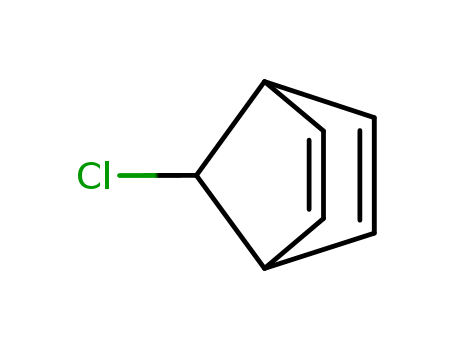
7-CHLORONORBORNADIENE

Base Information
  • Chemical Name:7-CHLORONORBORNADIENE
  • CAS No.:1609-39-8
  • Molecular Formula:C7H7Cl
  • Molecular Weight:126.586
  • Hs Code.:2903890090
  • Mol file:1609-39-8.mol
7-CHLORONORBORNADIENE

Synonyms:2,5-Norbornadiene,7-chloro- (6CI,7CI,8CI);7-Chloro-2,5-norbornadiene;7-Chloronorbornadiene;NSC249208;

Suppliers and Price of 7-CHLORONORBORNADIENE
Supply Marketing:
Business phase:
The product has achieved commercial mass production*data from LookChem market partment
Manufacturers and distributors:
  • Manufacture/Brand
  • Chemicals and raw materials
  • Packaging
  • price
  • Crysdot
  • 7-Chlorobicyclo[2.2.1]hepta-2,5-diene 95+%
  • 5g
  • $ 339.00
  • American Custom Chemicals Corporation
  • 7-CHLORO NORBORNADIENE 95.00%
  • 5MG
  • $ 495.50
Total 10 raw suppliers
Chemical Property of 7-CHLORONORBORNADIENE
Chemical Property:
  • Vapor Pressure:1.31mmHg at 25°C 
  • Melting Point:58-59 ºC 
  • Refractive Index:1.568 
  • Boiling Point:178.8 °C at 760 mmHg 
  • Flash Point:44.3 °C 
  • PSA:0.00000 
  • Density:1.18 g/cm3 
  • LogP:1.96580 
Purity/Quality:

99% *data from raw suppliers

7-Chlorobicyclo[2.2.1]hepta-2,5-diene 95+% *data from reagent suppliers

Safty Information:
  • Pictogram(s): R10:Flammable.; 
  • Hazard Codes:R10:Flammable.; 
  • Statements: 10 
  • Safety Statements: 16 
MSDS Files:

SDS file from LookChem

Useful:
  • General Description 7-Chloronorbornadiene is a reactive compound that participates in 1,3-dipolar cycloadditions with diazoalkanes, such as diazomethane, yielding a mixture of endo,syn and endo,anti isomers, demonstrating a lack of stereospecificity in these reactions. Its reactivity has been studied in the context of forming chemical adducts and exploring new synthetic pathways, including potential applications in carbohydrate synthesis. 7-CHLORONORBORNADIENE's behavior highlights the complexity of cycloaddition reactions and the challenges in achieving high specificity. Further research is ongoing to systematically investigate its reactivity and utility in organic synthesis.
Technology Process of 7-CHLORONORBORNADIENE

There total 13 articles about 7-CHLORONORBORNADIENE which guide to synthetic route it. The literature collected by LookChem mainly comes from the sharing of users and the free literature resources found by Internet computing technology. We keep the original model of the professional version of literature to make it easier and faster for users to retrieve and use. At the same time, we analyze and calculate the most feasible synthesis route with the highest yield for your reference as below:

synthetic route:
Guidance literature:
Multi-step reaction with 2 steps
1: (hydrolysis)
2: SOCl2
With thionyl chloride;
DOI:10.1021/ja01493a068
Guidance literature:
With methanesulfonyl chloride; triethylamine; In chloroform-d1; at -10 ℃; for 0.166667h;
DOI:10.1002/jlac.199719970134
Refernces

A Reactive Intermediate Formed by Triflate Rearrangement. A New Displacement Reaction for Carbohydrate Synthesis

10.1021/jo00363a050

The research focuses on the synthesis and characterization of chemical adducts formed by the reaction of diazomethane with 7-chloronorbornadiene, as well as the exploration of the Hanessian-Hullar reaction in carbohydrate chemistry. The purpose of the study was to investigate the selectivity and specificity of 1,3-dipolar cycloadditions involving diazoalkanes and 7-substituted norbornadienes, challenging previous claims of stereospecificity in such reactions. The researchers found that the reaction was not stereospecific, forming both endo,syn and endo,anti isomers, and that diazomethane and diazoethane formed a variety of adducts with different structures. They also discovered a new reactive intermediate formed by triflate rearrangement, which has potential for carbohydrate synthesis. The chemicals used in the process include diazomethane, 7-chloronorbornadiene, ether-hexane for TLC analysis, and various norbornadienes and 1,3-dipoles for studying selectivity and specificity in reactions. The conclusions drawn from the research indicate that while selectivity in these reactions can be high, specificity is never found, and the researchers are conducting further systematic studies on related reactions to be reported later.


Post a RFQ

Enter 15 to 2000 letters.Word count: 0 letters

Attach files(File Format: Jpeg, Jpg, Gif, Png, PDF, PPT, Zip, Rar,Word or Excel Maximum File Size: 3MB)

1 Customer Service

What can I do for you?
Get Best Price

Get Best Price for 1609-39-8