10.1002/ardp.19853180716
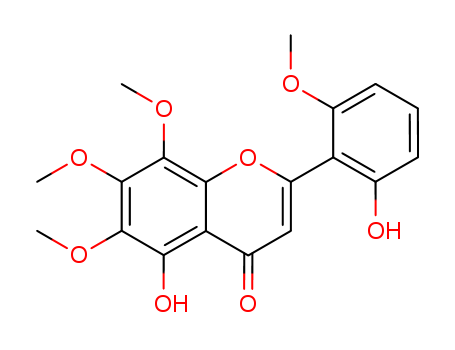
The research focuses on the synthesis and cytotoxic evaluation of certain flavones against L1210 cells. The purpose of the study was to investigate the relationship between the full oxygenation of the A-ring in flavones and their cytotoxic activity, as it was observed that 5,2'-dihydroxy-6,7,8,6'-tetramethoxyflavon (6c), isolated from the root of Scutellaria baicalensis, exhibited cytotoxic activity against L1210 cells, while other flavones from the same root did not. The researchers synthesized 5,2'-dihydroxy-6,7,8,6'-tetramethoxyflavon (6c) and other flavones with the same A-ring and tested their cytotoxicity. Key chemicals used in the synthesis process included 2-benzyloxyd-methoxybenzylchlorid (2c) as the starting substance for the B-ring, and various other intermediates such as 3c, 4d, and 4c. The conclusions drawn from the study were that 5,2'-dihydroxy-6,7,8,6'-tetramethoxyflavon (6c) is the active principle of Scutellariae Radix against L1210 cells, and that two other flavones, 5d and 9, with a fully oxygenated A-ring also showed cytotoxic activity. The cytotoxic activity of the flavones was expressed as ED50 values, with 6c showing the strongest inhibition of L1210 cell growth (ED50 = 2.5 μg/ml), followed by 9 and 5d with ED50 values of 7.5 and 4.5 μg/ml, respectively.