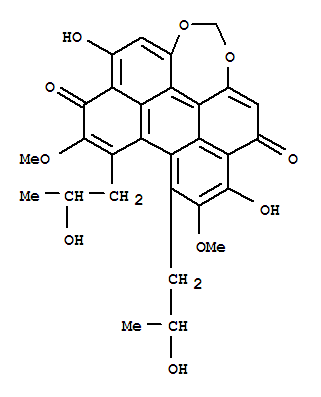
Chemical Property of Cercosporin
Chemical Property:
- Vapor Pressure:0mmHg at 25°C
- Melting Point:260℃
- Boiling Point:886.9°Cat760mmHg
- PKA:7.76±0.20(Predicted)
- Flash Point:299°C
- PSA:151.98000
- Density:1.59g/cm3
- LogP:3.56450
- Storage Temp.:2-8°C
- Solubility.:chloroform: soluble9.80 - 10.20mg/mL, clear, red to red-brown
- XLogP3:4
- Hydrogen Bond Donor Count:4
- Hydrogen Bond Acceptor Count:10
- Rotatable Bond Count:6
- Exact Mass:534.15259702
- Heavy Atom Count:39
- Complexity:988
- Purity/Quality:
-
97% *data from raw suppliers
Cercosporin *data from reagent suppliers
Safty Information:
- Pictogram(s):

- Hazard Codes:Xn
- MSDS Files:
-
SDS file from LookChem
Total 1 MSDS from other Authors
Useful:
- Canonical SMILES:CC(CC1=C2C3=C(C(=C(C4=C3C5=C6C2=C(C(=O)C=C6OCOC5=CC4=O)C(=C1OC)O)O)OC)CC(C)O)O
- Isomeric SMILES:C[C@H](CC1=C2C3=C(C(=C(C4=C3C5=C6C2=C(C(=O)C=C6OCOC5=CC4=O)C(=C1OC)O)O)OC)C[C@@H](C)O)O
-
Uses
Cercosporin is a perylenequinone reported in 1957 as the causative agent of soy bean purple speck disease due to the fungal pathogen, Cercsopsorium kikuchii, which is widely found in species of the Cercosporium genus. Cercosporin phytotoxicity is light-activated and this process contributes to a wider biological profile as a photodynamic antiviral and antitumor active. Cercosporin (CGP049090) is an antagonist of Tcf4/b-catenin signalling, inhibiting the expression of survivin and inducing apoptosis in several tumour cell lines. Cercosporin (CGP049090) is a perylenequinone reported in 1957 as the causative agent of soy bean purple speck disease due to the fungal pathogen, Cercsopsorium kikuchii, which is widely found in species of Cercosporium. Cercosporin phytotoxicity is light-activated and this process contributes to a wider biological profile as a photodynamic antiviral and antitumor active. Cercosporin is an antagonist of Tcf4/b-catenin signalling, inhibiting the expression of survivin and inducing apoptosis in several tumor cell lines. Cercosporin from Cercospora hayii is a light-induced polyketide phytotoxin reported to produce singlet oxygen when photoactivated.