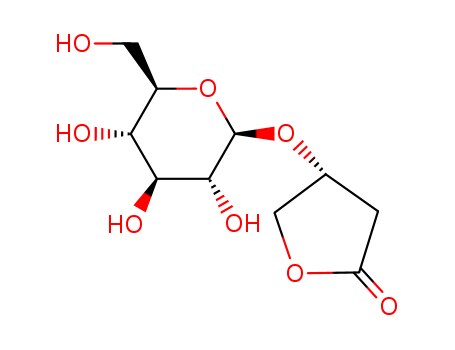
Chemical Property of Kinsenoside
Chemical Property:
- Boiling Point:570.2±50.0 °C(Predicted)
- PKA:12.81±0.70(Predicted)
- PSA:125.68000
- Density:1.59±0.1 g/cm3(Predicted)
- LogP:-2.88160
- XLogP3:-2.4
- Hydrogen Bond Donor Count:4
- Hydrogen Bond Acceptor Count:8
- Rotatable Bond Count:3
- Exact Mass:264.08451746
- Heavy Atom Count:18
- Complexity:308
- Purity/Quality:
-
≥98% *data from raw suppliers
Kinsenoside *data from reagent suppliers
Safty Information:
- Pictogram(s):
- Hazard Codes:
- MSDS Files:
-
SDS file from LookChem
Useful:
- Canonical SMILES:C1C(COC1=O)OC2C(C(C(C(O2)CO)O)O)O
- Isomeric SMILES:C1[C@H](COC1=O)O[C@H]2[C@@H]([C@H]([C@@H]([C@H](O2)CO)O)O)O
-
Description
Kinsenoside is a glycoside originally isolated from A. formosanus that has diverse biological activities, including antihyperlipidemic, immunosuppressive, and anti-inflammatory properties. It increases lipolysis mediated by adipose triglyceride lipase and increases hydrolysis of triglycerides in C3H10T1/2 adipocytes. It also increases phosphorylation of peroxisome proliferator-activated receptor α (PPARα) and CREB as well as protein levels of SIRT1, PGC-1α, and carnitine palmitoyltransferase I. Kinsenoside downregulates the expression and phosphorylation of VEGF receptor 2 (VEGFR2) and inhibits crosstalk between the JAK2/STAT3 and PI3K/AKT signaling pathways in dendritic cells in vitro. It decreases the production of IFN-γ, IL-17, and TNF-α and increases the production of IL-10 in splenocytes isolated from mice with collagen-induced arthritis (CIA). Kinsenoside (300 mg/kg per day) decreases the expression of IL-1β, TNF-α, and matrix metalloproteinase-9 (MMP-9) and increases the expression of IL-10 in inflamed joints in a mouse model of collagen-induced arthritis and prevents paw edema and reduces the severity of arthritis.
-
Uses
Kinsenoside is an anti-hyperlipidemic agent isolated from the plant Anoect chilus.