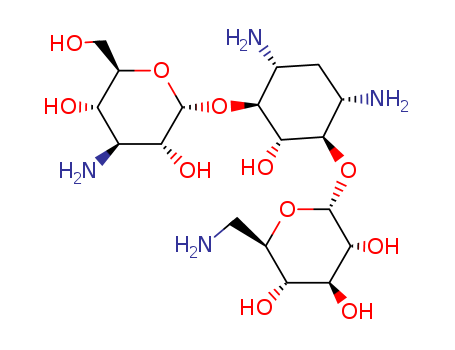
Chemical Property of Kanamycin
Chemical Property:
- Vapor Pressure:2.47E-30mmHg at 25°C
- Refractive Index:1.669
- Boiling Point:809.5°Cat760mmHg
- PKA:pKa 6.40/7.55/8.40/9.40(H2O) (Uncertain)
- Flash Point:443.4°C
- PSA:282.61000
- Density:1.62g/cm3
- LogP:-4.49020
- Storage Temp.:2-8°C
- Solubility.:Methanol (Slightly, Sonicated), Water (Slightly)
- XLogP3:-6.9
- Hydrogen Bond Donor Count:11
- Hydrogen Bond Acceptor Count:15
- Rotatable Bond Count:6
- Exact Mass:484.23805798
- Heavy Atom Count:33
- Complexity:638
- Purity/Quality:
-
99%, *data from raw suppliers
Kanamycin *data from reagent suppliers
Safty Information:
- Pictogram(s):
- Hazard Codes:
- MSDS Files:
-
SDS file from LookChem
Useful:
- Canonical SMILES:C1C(C(C(C(C1N)OC2C(C(C(C(O2)CN)O)O)O)O)OC3C(C(C(C(O3)CO)O)N)O)N
- Isomeric SMILES:C1[C@H]([C@@H]([C@H]([C@@H]([C@H]1N)O[C@@H]2[C@@H]([C@H]([C@@H]([C@H](O2)CN)O)O)O)O)O[C@@H]3[C@@H]([C@H]([C@@H]([C@H](O3)CO)O)N)O)N
- Recent ClinicalTrials:The Evaluation of a Standard Treatment Regimen of Anti-tuberculosis Drugs for Patients With MDR-TB
- Recent NIPH Clinical Trials:Preoperative less painful mechanical bowel preparation in elective resection colorectal cancer surgery: a multicenter randomized non-Inferiority study
-
Description
Kanamycin is a well-known bactericidal antibiotic. It belongs to the aminoglycoside antibiotic group. It can be used for the treatment of various pathogens including E. coli, Proteus species (both indole-positive and indole-negative), Enterobacter aerogenes, Klebsiella pneumoniae, Serratia marcescens and Acinetobacter species1-4. Kanamycin is isolated from the bacterium Streptomyces kanamyceticus and its most commonly used form is kanamycin sulfate5. Aminoglycoside-type drug take actions through “irreversibly” binding to the 30S subunit of the ribosome, further blocking the protein synthesis. Kanamycin kills bacteria cells binds to four nucleotides of 16S rRNA and a single amino acid of protein S12. This interferes with decoding site in the vicinity of nucleotide 1400 in 16S rRNA of 30S subunit. This region interacts with the wobble base in the anticodon of tRNA. This leads to interference with the initiation complex, misreading of mRNA so incorrect amino acids are inserted into the polypeptide leading to nonfunctional or toxic peptides and the breakup of polysomes into nonfunctional monosomes5.
-
Uses
Kanamycin A is an antibiotic complex produced by Streptomyces kanamyceticus Okami & Umezawa from Japanese soil. Comprised of three components, kanamycin A, the major component, and kanamycins B and C, two minor congeners. Antibacterial.
-
Indications
Kanamycin, O-3-amino-3-deoxy-α-D-glucopyranosyl-(1→6)-O-[6-deoxy-
6-amino-α-D-glucopyranosyl-(1→4)]–2-deoxy-D-streptamine (32.4.6), is isolated from a
culture fluid of the actinomycete Streptomyces kanamyceticus, which produces three
antibiotics—kanamycins A, B, and C.Kanamycin A is similar to streptomycin and neomycines, and it possesses a broad spec�trum of antimicrobial action. It is active with respect to most Gram-positive and Gram�negative microorganisms (staphylococci, colon bacillus, klebisella, Fridlender’s bacillus,
proteus, shigella, salmonella).It is used to treat sepsis, meningitis, osteomyelitis, peritonitis, pneumonia, pyelonephri�tis, pyelocystitis, infected wounds, and post-operational, purulent complications that are
caused by microorganisms sensitive to this drug. Kanamycin is used to treat tuberculosis
of the lungs and other organs upon resistance to other antituberculosis drugs. Synonyms of
this drug are karmycin, kamaxin, resistomycin, and many others.
-
Clinical Use
Formerly used for severe infection with susceptible organisms,
it has largely been superseded by other aminoglycosides.