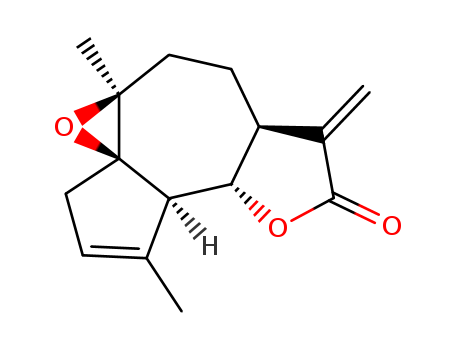
Chemical Property of Mesatlantin C
Chemical Property:
- Vapor Pressure:9.34E-07mmHg at 25°C
- Melting Point:100-102 °C
- Boiling Point:404.6°C at 760 mmHg
- Flash Point:171.3°C
- PSA:38.83000
- Density:1.22g/cm3
- LogP:2.37190
- Storage Temp.:Amber Vial, -20°C Freezer, Under inert atmosphere
- Solubility.:Chloroform (Slightly)
- XLogP3:1.7
- Hydrogen Bond Donor Count:0
- Hydrogen Bond Acceptor Count:3
- Rotatable Bond Count:0
- Exact Mass:246.125594432
- Heavy Atom Count:18
- Complexity:506
- Purity/Quality:
-
99% *data from raw suppliers
Arglabin *data from reagent suppliers
Safty Information:
- Pictogram(s):
- Hazard Codes:
- MSDS Files:
-
SDS file from LookChem
Useful:
- Canonical SMILES:CC1=CCC23C1C4C(CCC2(O3)C)C(=C)C(=O)O4
- Isomeric SMILES:CC1=CC[C@]23[C@H]1[C@@H]4[C@@H](CC[C@]2(O3)C)C(=C)C(=O)O4
-
Description
Arglabin is a new antineoplastic agent launched in Russia for the
treatment of a variety of cancers. It is a sesquiterpene gamma-lactone extracted
from Artemisia glabella, a plant from Kazakstan; it was first developed in
Kazakstan followed by US and other countries as an ethical pharmaceutical.
Arglabin can be obtained by resin extraction from A.glabella, purification by
chromatography and finally recrystallization. Arglabin is a potent and selective
inhibitor of farnesyl transferase, an enzyme critical to the function of the Ras
oncogene in cancer cell reproduction. It showed a strong Inhibitory effect against
tumor cells proliferation in in vitro models of transformed mouse hepatocytes
and splenocytes. This cytotoxic effect against tumor cells was 50-100 times
higher than that on intact cells. In many patients with various cancers, Arglabin
was shown to stop or inhibit the tumour development, alone or in combination
with other anticancer agents, and was reportedly well tolerated with few sideeffects.
Promising response rates were also reported with Arglabin after treating
other 《difficult-to-treat cancers》 such as breast, ovarian, lung or colon cancers.
-
Uses
Arglabin is a sesquiterpene lactone used in the inhibition of glucose induced NF-kB activation and MCP-1/TGF-β1 expression treating diabetic nephropathy. Cytocoxic.