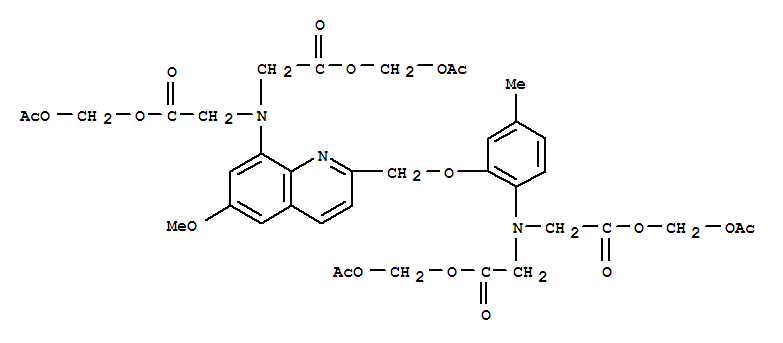
Chemical Property of Quin2-acetoxymethyl ester
Chemical Property:
- Appearance/Colour:Yellow orange solid
- Vapor Pressure:2.25E-30mmHg at 25°C
- Refractive Index:1.576
- Boiling Point:865.6 °C at 760 mmHg
- Flash Point:477.3 °C
- PSA:248.23000
- Density:1.36 g/cm3
- LogP:1.99880
- Storage Temp.:?20°C
- Solubility.:DMSO: soluble
- XLogP3:3.9
- Hydrogen Bond Donor Count:0
- Hydrogen Bond Acceptor Count:21
- Rotatable Bond Count:30
- Exact Mass:829.25416153
- Heavy Atom Count:59
- Complexity:1380
- Purity/Quality:
-
98%min *data from raw suppliers
Quin2-AM *data from reagent suppliers
Safty Information:
- Pictogram(s):
 Xi
Xi
- Hazard Codes:Xi
- Statements:
36/37/38
- Safety Statements:
26-36
- MSDS Files:
-
SDS file from LookChem
Useful:
- Canonical SMILES:CC1=CC(=C(C=C1)N(CC(=O)OCOC(=O)C)CC(=O)OCOC(=O)C)OCC2=NC3=C(C=C(C=C3C=C2)OC)N(CC(=O)OCOC(=O)C)CC(=O)OCOC(=O)C
-
Description
Quin-2 AM is a cell-permeant acetoxymethyl ester of the high affinity fluorescent calcium indicator quin-2 . As quin-2 AM enters cells, it is hydrolyzed by intracellular esterases to produce quin-2. Quin-2 binds calcium with a Kd value of 115 nM. It displays high selectivity for calcium, as it is not affected by sodium gradients, membrane potential, or intracellular pH. High affinity probes like quin-2 are ideal for monitoring low levels of calcium, as are found in resting cells. Loadings of up to 2 mM quin-2 are without serious toxic effects, so quin-2 may be used to buffer intracellular calcium transients. Excitation and emission maxima for quin-2 are 339 and 492 nm, respectively.
-
Uses
2-[(2-Amino-5-methylphenoxy)methyl]-6-methoxy-8-aminoquinoline-N,N,N',N'-tetraacetic acid tetrakis(acetoxymethyl ester) Fluorescent probe for measurement of calcium in biological systems and for selected divalent cations. Quin 2-AM is a cell permeable fluorescent probe for Ca2+ that gives a large shift in the UV absorption spectrum and a 20-fold increase in fluorescence upon Ca2+ binding.