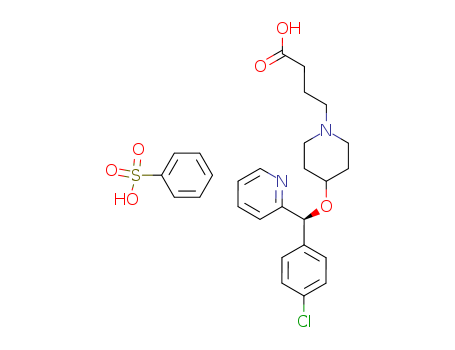
Chemical Property of Bepotastine besilate
Chemical Property:
- Appearance/Colour:Brown Viscous liquid
- Vapor Pressure:8.63E-13mmHg at 25°C
- Melting Point:161-163°
- Boiling Point:546.8 °C at 760 mmHg
- Flash Point:284.5 °C
- PSA:125.41000
- LogP:6.12220
- Storage Temp.:-196°C
- Solubility.:DMSO (Slightly, Heated), Methanol (Slightly, Heated)
- Hydrogen Bond Donor Count:2
- Hydrogen Bond Acceptor Count:8
- Rotatable Bond Count:9
- Exact Mass:546.1591356
- Heavy Atom Count:37
- Complexity:632
- Purity/Quality:
-
99%, *data from raw suppliers
Bepotastine Besylate *data from reagent suppliers
Safty Information:
- Pictogram(s):
- Hazard Codes:
- MSDS Files:
-
SDS file from LookChem
Useful:
- Canonical SMILES:C1CN(CCC1OC(C2=CC=C(C=C2)Cl)C3=CC=CC=N3)CCCC(=O)O.C1=CC=C(C=C1)S(=O)(=O)O
- Isomeric SMILES:C1CN(CCC1O[C@@H](C2=CC=C(C=C2)Cl)C3=CC=CC=N3)CCCC(=O)O.C1=CC=C(C=C1)S(=O)(=O)O
- Recent ClinicalTrials:Clinical Study for the Evaluation of Safety and Tolerability of PRO-172 Ophthalmic Solution+
- Recent NIPH Clinical Trials:Efficacy of bepotastine besilate for seasonal allergic rhinitis patients - about laryngeal symptoms, olfactory disorder, sleep disorder, QOL and symptoms caused by Asian sand dust
-
Description
Betotastine was introduced in Japan for the treatment of allergic rhinitis. This
structurally-related derivative of chlorpheniramine and ebastine is prepared by
condensation of optically-resolved 4-[1-(4-chlorophenyl)-1-(2-pyridyl)-methoxy]piperidine
with ethyl 4-bromobutyrate followed by ester hydrolysis. Betotastine is the seventh
marketed non-sedating histamine H1 antagonist. Its very low sedative side effect is due to
very poor penetration in the central nervous system. Besides its potent and long-acting
activity in models of allergic rhinitis, betotastine was also shown to act as a PAF antagonist and inhibit LTD4 in tracheal smooth muscle and ileum, IL-5 production by human peripheral
blood mononuclear cells as well as eosinophil infiltration in the airway and peripheral
blood. As a consequence, it is currently being developed against other allergic and
respiratory disorders. Bepotastine is an antagonist of the histamine H1 receptor that is selective over H3, α1-, α2-, and β-adrenergic, dopamine D2long, serotonin 5-HT2, muscarinic acetylcholine, and benzodiazepine receptors. It reduces dye leakage from the nasal passages of rats acutely sensitized to an antigen (ED50 = 0.03 mg/kg) and inhibits histamine-induced bronchoconstriction in the anesthetized dog (ED50 = 3.2 μg/kg). Bepotastine prevents conjunctival vascular hyperpermeability in a guinea pig model of conjunctivitis in a dose-dependent manner. Formulations containing bepotastine have been used in the treatment of itching associated with allergic conjunctivitis.
-
Uses
Bepotastine is a non-sedating, selective antagonist of histamine 1 (H1) receptor with pIC50 of 5.7 Bepotastine is a histamine H1 receptor anatagonist. Bepotastine suppresses some allergic inflammatory processes such as allergic rhinitis, chronic urticaria or pruritus associated with skin conditions
(eczema/dermatitis, prurigo or pruritus cutaneus).
-
Therapeutic Function
Antiallergic