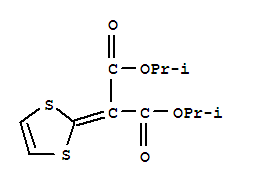
Chemical Property of Malotilate
Chemical Property:
- Vapor Pressure:0.000296mmHg at 25°C
- Melting Point:60.5°
- Refractive Index:1.562
- Boiling Point:321.53 °C at 760 mmHg
- Flash Point:138.668 °C
- PSA:103.20000
- Density:1.256 g/cm3
- LogP:3.05240
- Storage Temp.:2-8°C
- Solubility.:soluble in Methanol,Ether,Benzene
- XLogP3:3.8
- Hydrogen Bond Donor Count:0
- Hydrogen Bond Acceptor Count:6
- Rotatable Bond Count:6
- Exact Mass:288.04900133
- Heavy Atom Count:18
- Complexity:363
- Purity/Quality:
-
98.0-102.0% *data from raw suppliers
Malotilate >98.0%(GC) *data from reagent suppliers
Safty Information:
- Pictogram(s):
 Xi
Xi
- Hazard Codes:Xi
- MSDS Files:
-
SDS file from LookChem
Useful:
- Canonical SMILES:CC(C)OC(=O)C(=C1SC=CS1)C(=O)OC(C)C
-
Description
Malotilate is a hepatoprotective agent. It inhibits A23187-induced metabolism of arachidonic acid (Item Nos. 90010 | 90010.1 | 10006607) to the 5-lipoxygenase (5-LO) metabolites leukotriene B4 (LTB4; ) and 5-HETE in macrophages isolated from the ascitic fluid of patients with alcoholic liver cirrhosis. Malotilate (50 mg/kg) prevents increases in plasma glutamic-pyruvic transaminase (GPT) and glutamic-oxaloacetic transaminase (GOT) activities in a rat model of carbon tetrachloride-induced liver injury. It reduces hepatic deposition of type III procollagen, type IV collagen, laminin, and fibronectin in a rat model of dimethylnitrosamine-induced hepatic fibrosis when administered at a dose of 100 mg/kg. Malotilate is a hepatoprotective agent reported to be effective in the treatment
of cirrhosis, chronic hepatitis and similar liver disorders. It appears to improve
hepatic function by increasing blood and bile flow and improving protein synthesis.