Welcome to LookChem.com Sign In|Join Free
  • or

Encyclopedia

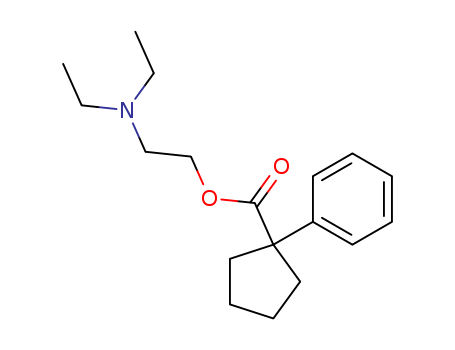
Caramiphen

Base Information
  • Chemical Name:Caramiphen
  • CAS No.:77-22-5
  • Molecular Formula:C18H27NO2
  • Molecular Weight:289.418
  • Hs Code.:
  • European Community (EC) Number:201-013-6
  • UNII:97J7NP0XJY
  • DSSTox Substance ID:DTXSID0022729
  • Nikkaji Number:J4.197A
  • Wikipedia:Caramiphen
  • Wikidata:Q5037673
  • NCI Thesaurus Code:C81594
  • Pharos Ligand ID:ZJCJKFCM67W1
  • Metabolomics Workbench ID:152683
  • ChEMBL ID:CHEMBL61946
  • Mol file:77-22-5.mol
Caramiphen

Synonyms:caramiphen

Suppliers and Price of Caramiphen
Supply Marketing:
Business phase:
The product has achieved commercial mass production*data from LookChem market partment
Manufacturers and distributors:
  • Manufacture/Brand
  • Chemicals and raw materials
  • Packaging
  • price
  • Sigma-Aldrich
  • Pentoxyverine impurity B European Pharmacopoeia (EP) Reference Standard
  • y0000099
  • $ 190.00
Total 17 raw suppliers
Chemical Property of Caramiphen
Chemical Property:
  • Vapor Pressure:2.35E-06mmHg at 25°C 
  • Refractive Index:1.523 
  • Boiling Point:392.1 °C at 760 mmHg 
  • Flash Point:124.8 °C 
  • PSA:29.54000 
  • Density:1.038 g/cm3 
  • LogP:3.38340 
  • XLogP3:3.9
  • Hydrogen Bond Donor Count:0
  • Hydrogen Bond Acceptor Count:3
  • Rotatable Bond Count:8
  • Exact Mass:289.204179104
  • Heavy Atom Count:21
  • Complexity:313
Purity/Quality:

98%,99%, *data from raw suppliers

Pentoxyverine impurity B European Pharmacopoeia (EP) Reference Standard *data from reagent suppliers

Safty Information:
  • Pictogram(s):  
  • Hazard Codes: 
MSDS Files:

SDS file from LookChem

Useful:
  • Canonical SMILES:CCN(CC)CCOC(=O)C1(CCCC1)C2=CC=CC=C2
Technology Process of Caramiphen

There total 9 articles about Caramiphen which guide to synthetic route it. The literature collected by LookChem mainly comes from the sharing of users and the free literature resources found by Internet computing technology. We keep the original model of the professional version of literature to make it easier and faster for users to retrieve and use. At the same time, we analyze and calculate the most feasible synthesis route with the highest yield for your reference as below:

synthetic route:
Guidance literature:
With sodium; xylene; at 140 - 150 ℃;
DOI:10.1021/ja01203a077
Guidance literature:
Multi-step reaction with 2 steps
1: benzene; SOCl2
With thionyl chloride; benzene;
Refernces

10.1021/jo01375a001

The study focuses on the synthesis and characterization of neopentyl esters of acrylic and methacrylic acids. Neopentyl alcohol, a key reactant, was prepared using two methods: the Whitmore method involving tert-butylmagnesium chloride and pivalyl chloride, and the more practical lithium aluminum hydride reduction of pivalic acid. Neopentyl acrylate was synthesized from neopentyl alcohol and either acryloyl chloride or acrylic acid, while neopentyl methacrylate was prepared from neopentyl alcohol and either methacryloyl chloride or methacrylic acid. The esters' physical properties were measured and reported. The study also highlighted the partly hindered character of neopentyl methacrylate, which affected its saponification process.

Nickel-catalyzed hydrodehalogenation of aryl halides

10.1016/j.jorganchem.2013.01.014

The research focuses on the nickel-catalyzed hydrodehalogenation of aryl and alkyl halides using iso-propyl zinc bromide or tert-butylmagnesium chloride as reagents. The purpose of this study is to develop an efficient and selective method for the transformation of carbon-halogen bonds into carbon-hydrogen bonds, which is crucial for organic synthesis and industry, particularly for the conversion of chlorinated arenes due to their negative environmental and health impacts. The researchers used a straightforward nickel complex as a pre-catalyst, achieving good to excellent yields and chemoselectivities for a variety of aryl and alkyl halides. The study concluded that a well-defined nickel complex, specifically complex 6, could effectively convert a range of aryl and alkyl halides under mild reaction conditions. Future work is planned to deepen the understanding of the reaction mechanism.


Post a RFQ

Enter 15 to 2000 letters.Word count: 0 letters

Attach files(File Format: Jpeg, Jpg, Gif, Png, PDF, PPT, Zip, Rar,Word or Excel Maximum File Size: 3MB)

1 Customer Service

What can I do for you?
Get Best Price

Get Best Price for 77-22-5