Welcome to LookChem.com Sign In|Join Free
  • or

Encyclopedia

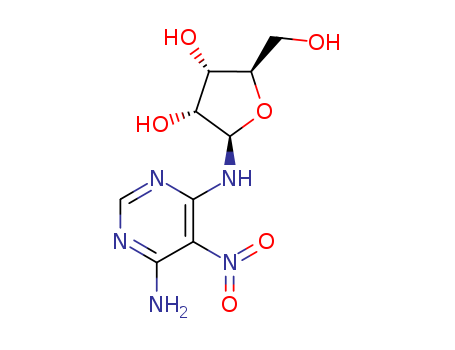
2-[(6-Amino-5-nitropyrimidin-4-yl)amino]-5-(hydroxymethyl)oxolane-3,4-diol

Base Information
  • Chemical Name:2-[(6-Amino-5-nitropyrimidin-4-yl)amino]-5-(hydroxymethyl)oxolane-3,4-diol
  • CAS No.:105798-74-1
  • Molecular Formula:C9H13N5O6
  • Molecular Weight:287.232
  • Hs Code.:
  • Wikidata:Q105192030
  • Mol file:105798-74-1.mol
2-[(6-Amino-5-nitropyrimidin-4-yl)amino]-5-(hydroxymethyl)oxolane-3,4-diol

Synonyms:2-[(6-amino-5-nitropyrimidin-4-yl)amino]-5-(hydroxymethyl)oxolane-3,4-diol;SCHEMBL14003840;A848860;6-Amino-5-nitro-4-imino-b-D-ribofuranosylpyrimidine;N-(6-Amino-5-nitro-4-pyrimidinyl)-b-D-ribofuranosylamine, 9CI;N-(6-Amino-5-nitro-4-pyrimidinyl)-beta-D-ribofuranosylamine;(2R,3R,4S,5R)-2-(6-amino-5-nitropyrimidin-4-ylamino)-5-(hydroxymethyl)-tetrahydrofuran-3,4-diol

Suppliers and Price of 2-[(6-Amino-5-nitropyrimidin-4-yl)amino]-5-(hydroxymethyl)oxolane-3,4-diol
Supply Marketing:
Business phase:
The product has achieved commercial mass production*data from LookChem market partment
Manufacturers and distributors:
  • Manufacture/Brand
  • Chemicals and raw materials
  • Packaging
  • price
  • American Custom Chemicals Corporation
  • CLITOCINE 95.00%
  • 5G
  • $ 3817.80
  • American Custom Chemicals Corporation
  • CLITOCINE 95.00%
  • 5MG
  • $ 502.71
Total 9 raw suppliers
Chemical Property of 2-[(6-Amino-5-nitropyrimidin-4-yl)amino]-5-(hydroxymethyl)oxolane-3,4-diol
Chemical Property:
  • Vapor Pressure:1.04E-20mmHg at 25°C 
  • Boiling Point:702.4°C at 760 mmHg 
  • Flash Point:378.6°C 
  • PSA:179.57000 
  • Density:1.82g/cm3 
  • LogP:-1.00470 
  • XLogP3:-0.4
  • Hydrogen Bond Donor Count:5
  • Hydrogen Bond Acceptor Count:10
  • Rotatable Bond Count:3
  • Exact Mass:287.08658315
  • Heavy Atom Count:20
  • Complexity:354
Purity/Quality:

97% *data from raw suppliers

CLITOCINE 95.00% *data from reagent suppliers

Safty Information:
  • Pictogram(s):  
  • Hazard Codes: 
MSDS Files:

SDS file from LookChem

Useful:
  • Canonical SMILES:C1=NC(=C(C(=N1)NC2C(C(C(O2)CO)O)O)[N+](=O)[O-])N
  • General Description Clitocine is a biologically active compound with notable insecticidal properties and cytostatic effects on leukemia cell lines. Its efficient synthesis has been improved through a revised pathway involving a 1,3-N (endo) to N (exo) migration, facilitated by the use of a p-chlorobenzoyl protecting group to enhance intermediate stability and reduce epimerization. The method yields highly pure clitocine without requiring column separation, offering a more practical and streamlined approach compared to earlier techniques.
Technology Process of 2-[(6-Amino-5-nitropyrimidin-4-yl)amino]-5-(hydroxymethyl)oxolane-3,4-diol

There total 12 articles about 2-[(6-Amino-5-nitropyrimidin-4-yl)amino]-5-(hydroxymethyl)oxolane-3,4-diol which guide to synthetic route it. The literature collected by LookChem mainly comes from the sharing of users and the free literature resources found by Internet computing technology. We keep the original model of the professional version of literature to make it easier and faster for users to retrieve and use. At the same time, we analyze and calculate the most feasible synthesis route with the highest yield for your reference as below:

synthetic route:
Guidance literature:
With sodium methylate; In 1,4-dioxane; methanol; at 0 ℃; for 2h;
DOI:10.1055/s-2005-871564
Guidance literature:
With ammonia; In methanol; Ambient temperature;
DOI:10.1039/c39880000195
Guidance literature:
With trifluoroacetic acid; for 0.1h; Ambient temperature;
DOI:10.1039/c39880000195
Refernces

Efficient synthesis of clitocine via 1,3-N (endo) to N (exo) migration: A revision to Kini's work

10.1055/s-2005-871564

The research aims to develop an efficient synthesis method for clitocine, a compound with significant biological activity, including insecticidal properties and cytostatic effects on leukemia cell lines. The study revisits Kini's previous work and introduces a novel synthetic pathway involving a 1,3-N (endo) to N (exo) migration as a key transformation. The researchers used p-chlorobenzoyl (PCB) as a protecting group to facilitate the solidification of intermediates and minimize epimerization at the final deprotection stage. Key chemicals used in the synthesis include 4,6-diamino-5-nitropyrimidine, 1-O-acetyl-2,3,5-tri-O-benzoyl-D-ribofuranose, and silica gel for isomerization. The study concludes that the endo-product formed during glycosylation is kinetically favored but isomerizes to the thermodynamically stable exo-product under acid catalysis. The incorporation of the PCB group significantly improves the isolation and purification of intermediates. The final deprotection step using methanol and sodium methoxide yields highly pure clitocine without any column separation, demonstrating a more efficient and practical synthesis route compared to previous methods.

Post a RFQ

Enter 15 to 2000 letters.Word count: 0 letters

Attach files(File Format: Jpeg, Jpg, Gif, Png, PDF, PPT, Zip, Rar,Word or Excel Maximum File Size: 3MB)

1 Customer Service

What can I do for you?
Get Best Price

Get Best Price for 105798-74-1