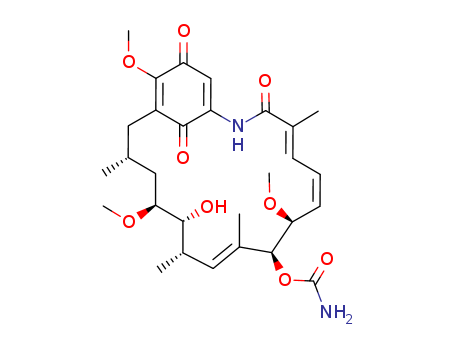
Chemical Property of [(4Z,6Z,8S,9S,10Z,12S,13R,14S,16S)-13-Hydroxy-8,14,19-trimethoxy-4,10,12,16-tetramethyl-3,20,22-trioxo-2-azabicyclo[16.3.1]docosa-1(21),4,6,10,18-pentaen-9-yl] carbamate
Chemical Property:
- Appearance/Colour:yellow to orange powder
- Vapor Pressure:0mmHg at 25°C
- Melting Point:255 °C
- Refractive Index:1.559
- Boiling Point:783.9 °C at 760 mmHg
- PKA:8.42±0.70(Predicted)
- Flash Point:427.9 °C
- PSA:163.48000
- Density:1.23 g/cm3
- LogP:3.43750
- Storage Temp.:−20°C
- Solubility.:DMSO: soluble
- XLogP3:2
- Hydrogen Bond Donor Count:3
- Hydrogen Bond Acceptor Count:9
- Rotatable Bond Count:5
- Exact Mass:560.27338086
- Heavy Atom Count:40
- Complexity:1150
- Purity/Quality:
-
99%, *data from raw suppliers
Geldanamycin *data from reagent suppliers
Safty Information:
- Pictogram(s):
 T,
T,  Xi
Xi
- Hazard Codes:T,Xi
- Statements:
36/37/38
- Safety Statements:
26-27-36/37/39-24/25
- MSDS Files:
-
SDS file from LookChem
Useful:
- Canonical SMILES:CC1CC(C(C(C=C(C(C(C=CC=C(C(=O)NC2=CC(=O)C(=C(C1)C2=O)OC)C)OC)OC(=O)N)C)C)O)OC
- Isomeric SMILES:C[C@@H]1C[C@@H]([C@@H]([C@H](/C=C(\[C@@H]([C@H](/C=C\C=C(/C(=O)NC2=CC(=O)C(=C(C1)C2=O)OC)\C)OC)OC(=O)N)/C)C)O)OC
-
Description
Geldanamycin from Streptomyces hygroscopicus. Geldanamycin is a benzoquinone ansamycin antitumor antibiotic. Geldanamycin binds specifically to Hsp90 (Heat Shock Protein 90) and to its endoplasmic reticulum homologue GP96. The Hsp90 chaperone is required for the activation of several families of eukaryotic protein kinases and nuclear hormone receptors, many of which are proto-oncogenic and play a prominent role in cancer. The geldanamycin antibiotic has antiproliferative and antitumor effects, as it binds to Hsp90, inhibits the Hsp90-mediated conformational maturation/refolding reaction, and results in the degradation of Hsp90 substrates. Hsp90 also plays a key role in regulating the physiology of cells exposed to environmental stress and thus, geldanamycin interferes with cellular stress response. Geldanamycin was found to be a potent antibiotic active at nanomolar concentrations against 60 cell lines as well as in mouse tumor models. It is an inhibitor of proto-oncogenic protein kinases, such as erbB22, EFG receptor tyrosine kinases, and non-receptor tyrosine kinases, such as v-src and Raf-1. In addition, it is a potent inhibitor of the nuclear hormone receptor family including the estrogen and androgen hormone receptors. Geldanamycin is a benzoquinone ansamycin antibiotic which binds heat shock protein 90 (Hsp90) and its paralog GRP94, altering their actions. Through its interaction with these chaperones, geldanamycin indirectly affects numerous client proteins with roles in diverse cellular processes, including gene expression, cell proliferation, apoptosis, and angiogenesis. For example, geldanamycin inhibits c-jun expression in human colon adenocarcinoma HT29 cells (IC50 = 75 nM), inhibiting AP-1 binding. It also reduces signaling through mitogenic signaling proteins and interferes with steroid receptor function. Inhibitors of Hsp90, including geldanamycin, show promise in cancer therapy.
-
Uses
Geldanamycin is a potent antitumor antibiotic active at nanomolar concentration against 60 cell lines.
It binds specifically to the heat shock protein Hsp90 and to its endoplasmic reticulum homologue GP96, and thus interferes with conformational maturation of proteins and the cellular stress response. In addition, it is a potent inhibitor of the nuclear hormone receptor family. Geldanamycin is benzoquinone ansamycin antibiotic isolated from Streptomyces hygroscopicus. It is a potent antitumour metabolite that acts by binding to the 90-kDa heat-shock protein (Hsp90) essential to maintain the conformation, stability, activity and cellular localisation of several key oncogenic proteins such as ERBB2, C-RAF, CDK4, AKT/PKB, steroid hormone receptors, mutant p53, HIF-1α, survivin and telomerase hTERT. Geldanamycin?binds to and inhibits the cytosolic chaperone functions of heat shock protein 90 (HSP90). HSP90 maintains the stability and functional shape of many oncogenic signaling proteins. It interferes with conformational maturation of proteins and the cellular stress response. In addition, it is a potent inhibitor of the nuclear hormone receptor family.