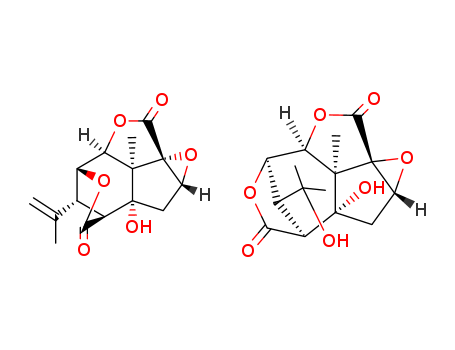
Chemical Property of (1S,3R,5S,8S,9S,12R,13S,14S)-1-Hydroxy-14-(2-hydroxypropan-2-yl)-13-methyl-4,7,10-trioxapentacyclo[6.4.1.19,12.03,5.05,13]tetradecane-6,11-dione;(1S,3R,5S,8S,9S,12R,13S,14R)-1-hydroxy-13-methyl-14-prop-1-en-2-yl-4,7,10-trioxapentacyclo[6.4.1.19,12.03,5.05,13]tetradecane-6,11-dione
Chemical Property:
- Vapor Pressure:1.12E-16mmHg at 25°C
- Melting Point:203 °C(lit.)
- Refractive Index:1.6000 (estimate)
- Boiling Point:595.8°Cat760mmHg
- Flash Point:228.9°C
- PSA:190.95000
- Density:g/cm3
- LogP:-0.92920
- Storage Temp.:Store at RT
- Solubility.:ethanol: 50 mg/mL, clear to slightly hazy
- Water Solubility.:4.083g/L(room temperature)
- Hydrogen Bond Donor Count:3
- Hydrogen Bond Acceptor Count:13
- Rotatable Bond Count:2
- Exact Mass:602.19994113
- Heavy Atom Count:43
- Complexity:1290
- Transport DOT Label:Poison
- Purity/Quality:
-
99%, *data from raw suppliers
Picrotoxin *data from reagent suppliers
Safty Information:
- Pictogram(s):
Toxic in overdose.
- Hazard Codes:T+,T,N
- Statements:
28-52/53
- Safety Statements:
28-36/37/39-45-61
- MSDS Files:
-
SDS file from LookChem
Total 1 MSDS from other Authors
Useful:
- Canonical SMILES:CC(=C)C1C2C3C4(C(C1C(=O)O2)(CC5C4(O5)C(=O)O3)O)C.CC12C3C4C(C(C1(CC5C2(O5)C(=O)O3)O)C(=O)O4)C(C)(C)O
- Isomeric SMILES:CC(=C)[C@@H]1[C@H]2[C@@H]3[C@]4([C@@]([C@@H]1C(=O)O2)(C[C@@H]5[C@]4(O5)C(=O)O3)O)C.C[C@]12[C@H]3[C@@H]4[C@H]([C@H]([C@]1(C[C@@H]5[C@]2(O5)C(=O)O3)O)C(=O)O4)C(C)(C)O
-
Description
Picrotoxin, also known as cocculin, appears as white to light beige crystalline material. It is
isolated from Cocculus indicus (Fructus cocculi), fishberries, or Indian berries. Picrotoxin is a
colourless, flexible, shining, prismatic crystals, or a micro-crystalline powder. It is odourless,
has a very bitter taste, and is permanent in the air. Picrotoxin is soluble in hot water,
readily soluble in strong ammonia water, and in aqueous solutions of sodium hydroxide,
soluble in dilute acids, and alkalis as well as in glacial acetic acid, sparingly soluble in
chloroform and very slightly soluble in cold water and alcohol. Picrotoxin is stable under
normal temperatures and pressures and decompose when exposed to light. Picrotoxin is
incompatible with strong oxidising agents, strong acids, strong bases, light.
-
Physical properties
Appearance: colorless, soft, and glossy rhombic pillar-shaped crystal or crystalline
fine powder. It is odorless and tastes very bitter. It is steady in the air, but it metamorphoses easily when exposed to light. Solubility: its solubility in water is 0.3%;
soluble in diluted acid; slightly soluble in ether or chloroform.
-
Uses
Picrotoxin has been used:as non-competitive antagonist for the γ-aminobutyric acid (GABAA) for studying synchronized burst (SB) dynamicsas a component of extracellular saline for blocking glutamate and acetylcholine receptors in neuronsas a component of artificial cerebrospinal fluid (ACSF) for voltage-clamp recordings studies in dissociated cortical neurons
-
Clinical Use
Acute barbital poisoning is very common and may be life-threatening. Many studies
reported the superior effects of picrotoxin in rescuing barbital poisoning .
Picrotoxin can be used in serious barbital poisoning patients when conventional
central nervous system stimulants are ineffective. The dosage and route of administration depend on the severity and state of the illness. It was usually administrated
intramuscularly or intravenously (3–9?mg), once every 15–30?min, until corneal and
deglutition reflex or slight tremble in the face and four limbs appears.