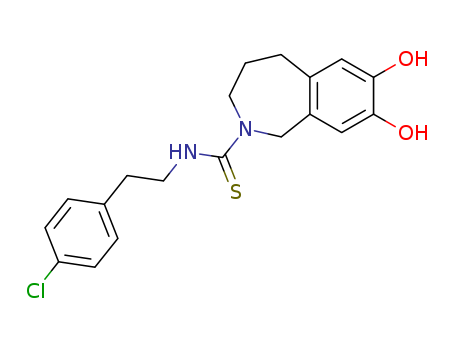
Chemical Property of Capsazepine
Chemical Property:
- Appearance/Colour:Light yellow solid
- Vapor Pressure:4.19E-14mmHg at 25°C
- Melting Point:155-157 °C
- Refractive Index:1.671
- Boiling Point:581.133 °C at 760 mmHg
- PKA:9.73±0.20(Predicted)
- Flash Point:305.259 °C
- PSA:87.82000
- Density:1.351 g/cm3
- LogP:3.94540
- Storage Temp.:2-8°C
- Solubility.:methanol: soluble
- XLogP3:3.9
- Hydrogen Bond Donor Count:3
- Hydrogen Bond Acceptor Count:3
- Rotatable Bond Count:3
- Exact Mass:376.1012268
- Heavy Atom Count:25
- Complexity:445
- Purity/Quality:
-
99%, *data from raw suppliers
Capsazepine *data from reagent suppliers
Safty Information:
- Pictogram(s):
 Xn
Xn
- Hazard Codes:Xn
- Statements:
20/21/22-36/37/38
- Safety Statements:
22-24/25-36-26
- MSDS Files:
-
SDS file from LookChem
Total 1 MSDS from other Authors
Useful:
- Canonical SMILES:C1CC2=CC(=C(C=C2CN(C1)C(=S)NCCC3=CC=C(C=C3)Cl)O)O
-
Description
Transient receptor potential vanilloid type 1 (TRPV1) is a member of the transient receptor potential (TRP) family that is activated or sensitized by a variety of endogenous stimuli as a result of tissue injury and inflammation. TRPV1 is upregulated during inflammation and plays a role in the perception of pain. Capsazepine is a competitive antagonist of transient receptor potential vanilloid type 1 (TRPV1) which blocks the capsaicin-induced uptake of Ca2+ in neonatal rat dorsal root ganglia with an IC50 of 0.42 μM and Chinese hamster ovary cells with an IC50 of 17 nM. It does not block acid- or heat-induced activation of TRPV1 and may block receptors other than TRPV1.
-
Uses
Capsazepine has been used as a transient receptor potential vanilloid-1 (TRPV1) antagonist: to study its effect on capsaicin induced extracellular signal-regulated kinase (ERK) phosphorylation to study the role of TRPV1 in central terminals on nociception in ratsfor functional characterization of the TRPV1 in bull spermatozoa A selective vanilloid receptor antagonist (Ki=3.2uM Capsazepine is shown to inhibit the development of mechanical hyperalgesia induced by intraplanar capsaicin injection. Capsazepine is described to block Resiniferatoxin (sc-24015)- and Capsaicin-induced contractions of guinea pig treacheal smooth muscle. Studies investigating the function of the VR1 (TRPV1 receptor) have employed Capsazepine as a tool for perturbing systemic neuronal response to Capsaicin.