Welcome to LookChem.com Sign In|Join Free
  • or

Encyclopedia

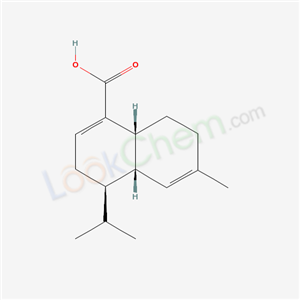
Sclerosporin

Base Information
  • Chemical Name:Sclerosporin
  • CAS No.:66419-03-2
  • Molecular Formula:C15H22O2
  • Molecular Weight:234.334
  • Hs Code.:
  • UNII:DR07Q5J492
  • DSSTox Substance ID:DTXSID70331818
  • Nikkaji Number:J2.771.099I
  • Wikidata:Q27108254
  • ChEMBL ID:CHEMBL1087671
Sclerosporin

Synonyms:Sclerosporin;(+)-Sclerosporin;66419-03-2;UNII-DR07Q5J492;DR07Q5J492;CHEBI:9054;1-Naphthalenecarboxylic acid, 3,4,4a,7,8,8a-hexahydro-6-methyl-4-(1-methylethyl)-, (4R,4aS,8aR)-;(4R,4aS,8aR)-6-methyl-4-propan-2-yl-3,4,4a,7,8,8a-hexahydronaphthalene-1-carboxylic acid;1-Naphthalenecarboxylic acid, 3,4,4a,7,8,8a-hexahydro-6-methyl-4-(1-methylethyl)-, (4R-(4alpha,4aalpha,8aalpha))-;C09721;CHEMBL1087671;DTXSID70331818;Q27108254;1-NAPHTHALENECARBOXYLIC ACID, 3,4,4A,7,8,8A-HEXAHYDRO-6-METHYL-4-(1-METHYLETHYL)-, (4R-(4.ALPHA.,4A.ALPHA.,8A.ALPHA.))-

Suppliers and Price of Sclerosporin
Supply Marketing:
Business phase:
The product has achieved commercial mass production*data from LookChem market partment
Manufacturers and distributors:
  • Manufacture/Brand
  • Chemicals and raw materials
  • Packaging
  • price
Total 1 raw suppliers
Chemical Property of Sclerosporin
Chemical Property:
  • Vapor Pressure:3.45E-06mmHg at 25°C 
  • Boiling Point:360.9°Cat760mmHg 
  • Flash Point:172.1°C 
  • Density:1.039g/cm3 
  • XLogP3:3.4
  • Hydrogen Bond Donor Count:1
  • Hydrogen Bond Acceptor Count:2
  • Rotatable Bond Count:2
  • Exact Mass:234.161979940
  • Heavy Atom Count:17
  • Complexity:376
Purity/Quality:

99% *data from raw suppliers

Safty Information:
  • Pictogram(s):  
  • Hazard Codes: 
MSDS Files:

SDS file from LookChem

Useful:
  • Canonical SMILES:CC1=CC2C(CC1)C(=CCC2C(C)C)C(=O)O
  • Isomeric SMILES:CC1=C[C@H]2[C@@H](CC1)C(=CC[C@@H]2C(C)C)C(=O)O
Technology Process of Sclerosporin

There total 40 articles about Sclerosporin which guide to synthetic route it. The literature collected by LookChem mainly comes from the sharing of users and the free literature resources found by Internet computing technology. We keep the original model of the professional version of literature to make it easier and faster for users to retrieve and use. At the same time, we analyze and calculate the most feasible synthesis route with the highest yield for your reference as below:

synthetic route:
Guidance literature:
With sodium chlorite; 2-methyl-but-2-ene; In water; tert-butyl alcohol; Ambient temperature;
DOI:10.1016/S0040-4020(01)91347-X
Guidance literature:
Multi-step reaction with 16 steps
1: H2 / PtO2 / aq. ethanol / 20 °C
3: 98.8 percent / LiAlH4 / diethyl ether / 1 h / 5 - 10 °C
4: 71.9 percent / NaOAc, PCC / CH2Cl2 / 2 h / Ambient temperature
5: Mg, I2 / tetrahydrofuran / Ambient temperature
6: Et3N / CH2Cl2 / 0.08 h / -10 °C
7: 54.3 percent / i-Pr2NEt / hexamethylphosphoric acid triamide / 0.17 h / 140 °C
8: 64.9 percent / BHT / 8.5 h / 120 °C
9: LiAlH4 / diethyl ether / 1 h / Ambient temperature
10: pyridine / 0 - 5 °C
11: 1.88 g / dimethylsulfoxide / 24 h / 60 - 70 °C
12: 0.683 g / 1.DIBAL 2.tartaric acid / hexane / 0.67 h / 0 - 45 °C
13: 0.875 g / ZnCl2, Et3N / benzene / 50 - 60 °C
14: 0.700 g / Ti(Oi-Pr)4, TiCl4 / CH2Cl2 / 0.83 h / -78 °C
15: 0.174 g / pTsOH / xylene / 1.25 h / Heating
16: 90 percent / 2-methyl-2-butene, NaHPO4, NaClO2 / 2-methyl-propan-2-ol; H2O / Ambient temperature
With titanium(IV) isopropylate; sodium chlorite; lithium aluminium tetrahydride; 2-methyl-but-2-ene; 2,6-di-tert-butyl-4-methyl-phenol; hydrogen; iodine; sodium acetate; titanium tetrachloride; diisobutylaluminium hydride; toluene-4-sulfonic acid; magnesium; tartaric acid; triethylamine; N-ethyl-N,N-diisopropylamine; pyridinium chlorochromate; zinc(II) chloride; platinum(IV) oxide; In tetrahydrofuran; pyridine; N,N,N,N,N,N-hexamethylphosphoric triamide; diethyl ether; ethanol; hexane; dichloromethane; water; dimethyl sulfoxide; xylene; tert-butyl alcohol; benzene;
DOI:10.1016/S0040-4020(01)91347-X
Guidance literature:
Multi-step reaction with 7 steps
1: pyridine / 0 - 5 °C
2: 1.88 g / dimethylsulfoxide / 24 h / 60 - 70 °C
3: 0.683 g / 1.DIBAL 2.tartaric acid / hexane / 0.67 h / 0 - 45 °C
4: 0.875 g / ZnCl2, Et3N / benzene / 50 - 60 °C
5: 0.700 g / Ti(Oi-Pr)4, TiCl4 / CH2Cl2 / 0.83 h / -78 °C
6: 0.174 g / pTsOH / xylene / 1.25 h / Heating
7: 90 percent / 2-methyl-2-butene, NaHPO4, NaClO2 / 2-methyl-propan-2-ol; H2O / Ambient temperature
With titanium(IV) isopropylate; sodium chlorite; 2-methyl-but-2-ene; titanium tetrachloride; diisobutylaluminium hydride; toluene-4-sulfonic acid; tartaric acid; triethylamine; zinc(II) chloride; In pyridine; hexane; dichloromethane; water; dimethyl sulfoxide; xylene; tert-butyl alcohol; benzene;
DOI:10.1016/S0040-4020(01)91347-X
Refernces

Synthesis of the enantiomers of sclerosporin and sclerosporal to determine the absolute configuration of the natural products

10.1016/S0040-4039(01)91234-1

The study focused on the synthesis of sclerostin and enantiomers of sclerostin to determine their absolute configurations. The researchers synthesized both enantiomers from (-)-carvone using intermolecular and intramolecular Diels-Alder reactions. The key chemicals involved included (-)-carvone as a starting material, PCC-NaOAc for oxidation to form the aldehyde, methylallylmagnesium bromide for allylation, and methacrylate for the Diels-Alder reaction. The study identified (4R, 9R, 10R)-(+)-sclerostin and (4R, 9R, 10R)-(-)-sclerostin as natural enantiomers by bioassay and CD spectral comparison. The spectral data of the synthesized sclerostin and sclerostin were exactly the same as those of the authentic samples, and the study found that (+)-sclerostin had strong sporulation activity, while (-)-sclerostin only showed weak activity.

Post a RFQ

Enter 15 to 2000 letters.Word count: 0 letters

Attach files(File Format: Jpeg, Jpg, Gif, Png, PDF, PPT, Zip, Rar,Word or Excel Maximum File Size: 3MB)

1 Customer Service

What can I do for you?
Get Best Price

Get Best Price for 66419-03-2