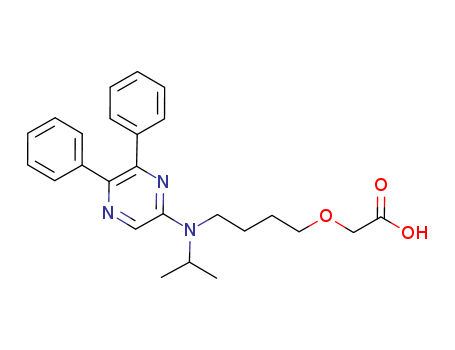
Chemical Property of (4-((5,6-Diphenylpyrazin-2-yl)(isopropyl)amino)butoxy)acetic acid
Chemical Property:
- Boiling Point:602.1±55.0 °C(Predicted)
- PKA:3.51±0.10(Predicted)
- PSA:75.55000
- Density:1.160
- LogP:4.90680
- Storage Temp.:Hygroscopic, -20°C Freezer, Under inert atmosphere
- Solubility.:Chloroform (Slightly), DMSO (Slightly), Methanol (Slightly)
- XLogP3:4.5
- Hydrogen Bond Donor Count:1
- Hydrogen Bond Acceptor Count:6
- Rotatable Bond Count:11
- Exact Mass:419.22089180
- Heavy Atom Count:31
- Complexity:518
- Purity/Quality:
-
HPLC>99%, max single impurity NMT 0.3% *data from raw suppliers
MRE-269 *data from reagent suppliers
Safty Information:
- Pictogram(s):
- Hazard Codes:
- MSDS Files:
-
SDS file from LookChem
Useful:
- Canonical SMILES:CC(C)N(CCCCOCC(=O)O)C1=CN=C(C(=N1)C2=CC=CC=C2)C3=CC=CC=C3
-
Description
Prostacyclin (PGI2) is a potent vasorelaxant and inhibitor of platelet aggregation. It mediates its actions by binding to a specific G protein-coupled receptor, the IP receptor, on the surface of endothelial cells, arterial smooth muscle, and platelets. The IP receptor also participates in signal transduction of the pain response, cardioprotection, and inflammation. MRE-269 is the active form of the prodrug NS-304. It is a potent and selective agonist for the human IP receptor with a Ki value of 20 nM. In contrast to PGI2, which has a half-life of 30 seconds to a few minutes in vivo, plasma concentrations of MRE-269 remain near peak levels for more than eight hours in rats and dogs. Unlike the PGI2 analogues, beraprost and iloprost, MRE-269 lacks high affinity for the EP3 receptor. As a result, MRE-269 induces vasodilation equally in large and small pulmonary arteries, whereas vasodilation of small arteries by beraprost and iloprost is reduced via EP3-mediated vasoconstriction.
-
Uses
MRE-269 an orally available and long-acting prostacyclin receptor agonist prodrug. MRE-269 is used for the treatment of pulmonary arterial hypertension. MRE-269 is an active metabolite of Selexipag (S253150).