Welcome to LookChem.com Sign In|Join Free
  • or

Encyclopedia

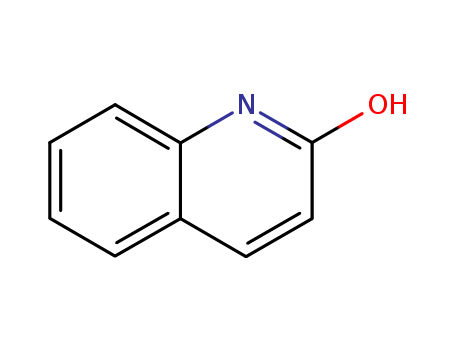
2-Hydroxyquinoline

Base Information
  • Chemical Name:2-Hydroxyquinoline
  • CAS No.:59-31-4
  • Deprecated CAS:493-62-9
  • Molecular Formula:C9H7NO
  • Molecular Weight:145.161
  • Hs Code.:29334900
  • European Community (EC) Number:200-420-6,274-516-1
  • NSC Number:156783,554
  • UNII:803BHY7QWU
  • DSSTox Substance ID:DTXSID1058769
  • Nikkaji Number:J4.598E
  • Wikipedia:2-Quinolone
  • Wikidata:Q27095480
  • Pharos Ligand ID:KB62MC58SY5W
  • Metabolomics Workbench ID:49826
  • ChEMBL ID:CHEMBL186422
  • Mol file:59-31-4.mol
2-Hydroxyquinoline

Synonyms:2-hydroxyquinoline

Suppliers and Price of 2-Hydroxyquinoline
Supply Marketing:
Business phase:
The product has achieved commercial mass production*data from LookChem market partment
Manufacturers and distributors:
  • Manufacture/Brand
  • Chemicals and raw materials
  • Packaging
  • price
  • TRC
  • 2-Hydroxyquinoline
  • 500mg
  • $ 75.00
  • TCI Chemical
  • 2-Quinolinol >98.0%(GC)
  • 10g
  • $ 87.00
  • TCI Chemical
  • 2-Quinolinol >98.0%(GC)
  • 1g
  • $ 15.00
  • SynQuest Laboratories
  • 2-Hydroxyquinoline 98%
  • 2.5 g
  • $ 24.00
  • SynQuest Laboratories
  • 2-Hydroxyquinoline 98%
  • 5 g
  • $ 36.00
  • SynQuest Laboratories
  • 2-Hydroxyquinoline 98%
  • 25 g
  • $ 116.00
  • Sigma-Aldrich
  • 2-Hydroxyquinoline 98%
  • 1g
  • $ 46.00
  • Sigma-Aldrich
  • 2-Hydroxyquinoline 98%
  • 5g
  • $ 106.00
  • Matrix Scientific
  • 2-Hydroxyquinoline >95%
  • 5g
  • $ 86.00
  • J&W Pharmlab
  • 1H-Quinolin-2-one 97%
  • 25g
  • $ 2496.00
Total 101 raw suppliers
Chemical Property of 2-Hydroxyquinoline
Chemical Property:
  • Appearance/Colour:white to light purple or purple-brownish powder 
  • Vapor Pressure:5.67E-05mmHg at 25°C 
  • Melting Point:198-199 °C(lit.) 
  • Refractive Index:1.595 
  • Boiling Point:346.7 °C at 760 mmHg 
  • PKA:-0.31, 11.76(at 20℃) 
  • Flash Point:200.6 °C 
  • PSA:32.86000 
  • Density:1.188 g/cm3 
  • LogP:1.52810 
  • Storage Temp.:Keep in dark place,Sealed in dry,Room Temperature 
  • Solubility.:alcohol: soluble(lit.) 
  • Water Solubility.:1.052g/L(20 oC) 
  • XLogP3:1.3
  • Hydrogen Bond Donor Count:1
  • Hydrogen Bond Acceptor Count:1
  • Rotatable Bond Count:0
  • Exact Mass:145.052763847
  • Heavy Atom Count:11
  • Complexity:198
Purity/Quality:

99.9% *data from raw suppliers

2-Hydroxyquinoline *data from reagent suppliers

Safty Information:
  • Pictogram(s): HarmfulXn, IrritantXi 
  • Hazard Codes:Xn,Xi 
  • Statements: 36/37/38-20/21/22-41-37/38-22 
  • Safety Statements: 26-37/39-36 
MSDS Files:

SDS file from LookChem

Total 1 MSDS from other Authors

Useful:
  • Chemical Classes:Nitrogen Compounds -> Quinolines
  • Canonical SMILES:C1=CC=C2C(=C1)C=CC(=O)N2
  • Recent ClinicalTrials:Evidence Based Management of Acute Biliary Pancreatitis
  • General Description **2-Quinolinol (2-Quinolone)** is a heterocyclic compound with a quinoline core featuring a hydroxyl (or keto) group at the C2 position. It serves as a key intermediate in the synthesis of various pharmacologically active molecules and functionalized quinolines. Recent studies highlight its relevance in sustainable synthetic methods, such as palladium-catalyzed Heck reduction-cyclization reactions, which efficiently produce 2-quinolones under mild conditions with high atom economy. Additionally, 2-quinolinol derivatives are avoided in hazardous chlorination processes (e.g., using phosphorus oxychloride) due to the development of safer alternatives like diphosgene-mediated routes. Its structural versatility makes it valuable in medicinal chemistry and organic synthesis.
Technology Process of 2-Hydroxyquinoline

There total 282 articles about 2-Hydroxyquinoline which guide to synthetic route it. The literature collected by LookChem mainly comes from the sharing of users and the free literature resources found by Internet computing technology. We keep the original model of the professional version of literature to make it easier and faster for users to retrieve and use. At the same time, we analyze and calculate the most feasible synthesis route with the highest yield for your reference as below:

synthetic route:
Guidance literature:
With water; chloroacetic acid ethyl ester; In ethyl acetate; for 0.416667h; Concentration; Reagent/catalyst; Solvent; Wavelength; Microwave irradiation;
Guidance literature:
With aluminum (III) chloride; In chlorobenzene; at 90 - 110 ℃; for 4h;
DOI:10.1016/j.bioorg.2020.103791
Guidance literature:
In methanol; water; Quantum yield; UV-irradiation; Photolysis;
DOI:10.1002/chem.201104065
Refernces

Novel synthesis of 2-chloroquinolines from 2-vinylanilines in nitrile solvent

10.1021/jo016196i

The study presents a novel method for synthesizing 2-chloroquinolines from 2-vinylanilines using diphosgene in acetonitrile as the solvent. The researchers detail a three-step reaction mechanism involving the generation of phenylisocyanate, quinoline ring formation, and chlorination at the C2 position of the quinoline. The purpose of the chemicals used in the study was to facilitate these steps, with diphosgene reacting with 2-vinylanilines to produce phenyl isocyanate, which then reacts with the acetonitrile to form the quinoline ring. The final step involves the chlorination of the C2 position. This new method eliminates the need for the hazardous use of excess phosphorus oxychloride, which was previously required in the synthesis of 2-chloroquinolines from 2(1H)-quinolinones. The study also discusses the role of acetonitrile as a reactive solvent in the process and provides evidence that the third step, chlorination, is likely the rate-determining step in the reaction.

(3R,4S)-4-(2,4,5-Trifluorophenyl)-pyrrolidin-3-ylamine inhibitors of dipeptidyl peptidase IV: Synthesis, in vitro, in vivo, and X-ray crystallographic characterization

10.1016/j.bmcl.2007.07.081

The research focuses on the development of pyrrolidine-based inhibitors of dipeptidyl peptidase IV (DPP4) for the treatment of type 2 diabetes. The purpose of the study was to optimize the potency, selectivity, and pharmacokinetic properties of these inhibitors, leading to the identification of a pre-clinical candidate for further profiling. The team synthesized a series of 3-amino-4-phenyl pyrrolidine inhibitors, starting from a high throughput screening hit, and through structure-based design and parallel synthesis, they improved the potency and ADME properties of the series. The research concluded with the identification of compound (+)15b as a promising candidate for further pre-clinical profiling due to its favorable pharmacokinetic and pharmacodynamic profile in rats. Key chemicals used in the process included various heterocycles as replacements for the quinolone fragment, 2,4,5-trifluorophenyl-substituted phenyl rings, and a series of aryl substitutions on the pyrimidine ring, among others, to fine-tune the potency and selectivity of the inhibitors. The X-ray crystal structures of the compounds were deposited in the RCSB protein data bank with code 2QJR.

Preparation of 2-Quinolones by sequential heck reduction-cyclization (HRC) reactions by using a multitask palladium catalyst

10.1002/chem.200900583

The research aims to develop sustainable and efficient methods for synthesizing 2-quinolones, which are important structural units in many natural products and drugs. The study introduces novel one-pot sequential Heck reduction–cyclization (HRC) reactions catalyzed by a multitask palladium catalyst supported on charcoal. The process involves a Heck cross-coupling of acrylates with diazonium salts, followed by reduction and cyclization steps under mild conditions without the need for additional ligands or bases. The methodology is notable for its simplicity, mild reaction conditions, and high atom economy, as it internally recycles HBF4, a byproduct of the Heck reaction, as a cocatalyst. The study concludes that this approach is highly efficient for synthesizing a variety of 2-quinolones with different substituents and demonstrates the recyclability of the palladium catalyst for other types of reactions, such as hydrogenation and hydrodehalogenation. This work contributes to the field of sustainable chemistry by offering a straightforward and eco-friendly method for the synthesis of valuable heterocyclic compounds.

Post a RFQ

Enter 15 to 2000 letters.Word count: 0 letters

Attach files(File Format: Jpeg, Jpg, Gif, Png, PDF, PPT, Zip, Rar,Word or Excel Maximum File Size: 3MB)

1 Customer Service

What can I do for you?
Get Best Price

Get Best Price for 59-31-4
