Welcome to LookChem.com Sign In|Join Free
  • or

Encyclopedia

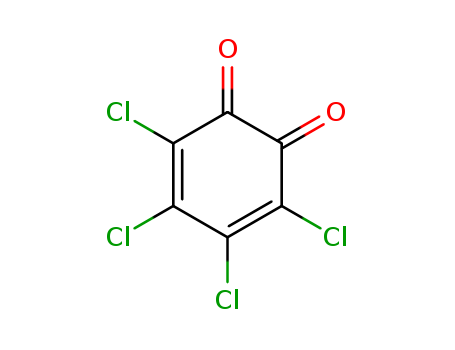
Tetrachloro-O-benzoquinone

Base Information
  • Chemical Name:Tetrachloro-O-benzoquinone
  • CAS No.:2435-53-2
  • Molecular Formula:C6Cl4O2
  • Molecular Weight:245.877
  • Hs Code.:29147090
  • European Community (EC) Number:219-424-4
  • NSC Number:403503
  • UNII:QN2NZL16NG
  • DSSTox Substance ID:DTXSID90883844
  • Nikkaji Number:J44.221F
  • Wikidata:Q27287348
  • Pharos Ligand ID:Z9MVPMAT5DQW
  • ChEMBL ID:CHEMBL364729
  • Mol file:2435-53-2.mol
Tetrachloro-O-benzoquinone

Synonyms:2-chloranil;3,4,5,6-tetrachloro-1,2-benzoquinone;o-chloranil;tetrachloro-o-benzoquinone

Suppliers and Price of Tetrachloro-O-benzoquinone
Supply Marketing:
Business phase:
The product has achieved commercial mass production*data from LookChem market partment
Manufacturers and distributors:
  • Manufacture/Brand
  • Chemicals and raw materials
  • Packaging
  • price
  • Usbiological
  • Triphenyl-2,6-xylylbismuthonium Tetrafluoroborate
  • 250mg
  • $ 355.00
  • TRC
  • o-Chloranil
  • 10g
  • $ 155.00
  • TRC
  • o-Chloranil
  • 25g
  • $ 305.00
  • TCI Chemical
  • o-Chloranil >97.0%(HPLC)(T)
  • 25g
  • $ 460.00
  • TCI Chemical
  • o-Chloranil >97.0%(HPLC)(T)
  • 5g
  • $ 97.00
  • Sigma-Aldrich
  • 3,4,5,6-Tetrachloro-1,2-benzoquinone 97%
  • 5g
  • $ 47.00
  • Matrix Scientific
  • Tetrachloro-1,2-benzoquinone >95%
  • 25g
  • $ 119.00
  • Crysdot
  • 3,4,5,6-Tetrachlorocyclohexa-3,5-diene-1,2-dione 95+%
  • 25g
  • $ 385.00
  • Crysdot
  • 3,4,5,6-Tetrachlorocyclohexa-3,5-diene-1,2-dione 95+%
  • 5g
  • $ 130.00
  • Biosynth Carbosynth
  • o-Chloranil
  • 10 g
  • $ 200.00
Total 51 raw suppliers
Chemical Property of Tetrachloro-O-benzoquinone
Chemical Property:
  • Appearance/Colour:Red powder. 
  • Vapor Pressure:1.94mmHg at 25°C 
  • Melting Point:125-129 ºC 
  • Refractive Index:1.595 
  • Boiling Point:164.7°C at 760 mmHg 
  • Flash Point:60.3°C 
  • PSA:34.14000 
  • Density:1.8g/cm3 
  • LogP:2.51660 
  • Storage Temp.:0-6°C 
  • Solubility.:almost transparency in Methanol 
  • Water Solubility.:insoluble 
  • XLogP3:2.7
  • Hydrogen Bond Donor Count:0
  • Hydrogen Bond Acceptor Count:2
  • Rotatable Bond Count:0
  • Exact Mass:245.862290
  • Heavy Atom Count:12
  • Complexity:306
Purity/Quality:

97% *data from raw suppliers

Triphenyl-2,6-xylylbismuthonium Tetrafluoroborate *data from reagent suppliers

Safty Information:
  • Pictogram(s): HarmfulXnDangerous
  • Hazard Codes:Xi,N,Xn 
  • Statements: 36/37/38-50/53-36/38-20 
  • Safety Statements: 26-36-61-60-37-22 
MSDS Files:

SDS file from LookChem

Total 1 MSDS from other Authors

Useful:
  • Canonical SMILES:C1(=C(C(=O)C(=O)C(=C1Cl)Cl)Cl)Cl
  • Uses o-Chloranil is used as a reagent in the synthesis of fused triazolotriazines and triazolotriazepines which exhibit antibacterial activity. Also used as a reagent in the synthesis of nickel diimine catecholate charge-transfer complexes.
Technology Process of Tetrachloro-O-benzoquinone

There total 28 articles about Tetrachloro-O-benzoquinone which guide to synthetic route it. The literature collected by LookChem mainly comes from the sharing of users and the free literature resources found by Internet computing technology. We keep the original model of the professional version of literature to make it easier and faster for users to retrieve and use. At the same time, we analyze and calculate the most feasible synthesis route with the highest yield for your reference as below:

synthetic route:
Guidance literature:
2,3-dihydroxy-4,5,6-trichloroaniline; With potassium sulfate; cyclohexane; at 31 ℃; for 4.2h;
With 2,3-Dichloroprop-1-ene; cymantrene; at 22 ℃; for 2.16667h; Concentration; Temperature;
Guidance literature:
With ammonium nitrate; trifluoroacetic anhydride; In dichloromethane; at 25 - 30 ℃; for 4h;
DOI:10.1021/jo00328a013
Refernces

In situ coupled oxidation cycle catalyzed by highly active and reusable Pt-catalysts: Dehydrogenative oxidation reactions in the presence of a catalytic amount of o-chloranil using molecular oxygen as the terminal oxidant

10.1039/c0cc02865g

The study presents an in situ coupled oxidation cycle that enables catalytic oxidation of substrates using catalytic amounts of o-chloranil and novel, reusable polymer-immobilized platinum nanocluster catalysts, with molecular oxygen serving as the terminal oxidant. The chemicals used in the study include o-chloranil, a quinone with high oxidation potential, and platinum nanocluster catalysts, which are immobilized on a polymer matrix. These catalysts were designed to overcome the challenges associated with the stoichiometric use of quinones in organic synthesis, such as difficulty in removing by-products and high costs. The purpose of these chemicals was to facilitate a more environmentally friendly and economically viable oxidation process, where molecular oxygen, being abundant and producing water as the only by-product, was utilized as the ideal oxidizer. The study demonstrated the effectiveness of this system in the oxidation of dihydropyridines to pyridines, among other reactions, and showed that the platinum catalysts could be reused multiple times without significant loss of activity.

SUBSTITUENT AND WAVELENGHT EFFECT IN THE PHOTOCHEMISTRY OF 5,6,7,8-TETRACHLORO-3a,9a-DIHYDRO-2,3,9a-TRIARYLFURO(2,3-b)(1,4)BENZODIOXIN DERIVATIVES

10.1016/S0040-4039(00)94524-6

The research investigated the photoreactions of certain triarylfurobenzodioxin derivatives, focusing on how the type and position of substituents on the 9a-aryl group, as well as the wavelength of light used, affect the reaction outcomes. The study synthesized these derivatives by reacting 1,2,4-triarylbuten-1,4-diones with concentrated hydroiodic acid to form phenylated furans, which were then reacted with tetrachloro-1,2-benzoquinone to produce the desired dihydrobenzodioxins. The researchers found that the presence of electron-withdrawing groups at the para-position of the 9a-aryl group altered the reaction pathway, leading to a competition between the cis-stilbene cyclisation-elimination process and a retro-Diels-Alder reaction.


Post a RFQ

Enter 15 to 2000 letters.Word count: 0 letters

Attach files(File Format: Jpeg, Jpg, Gif, Png, PDF, PPT, Zip, Rar,Word or Excel Maximum File Size: 3MB)

1 Customer Service

What can I do for you?
Get Best Price

Get Best Price for 2435-53-2