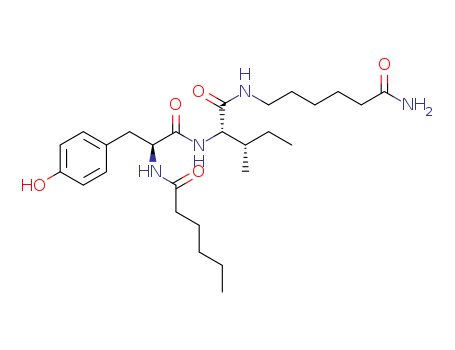
Chemical Property of Dihexa
Chemical Property:
- Boiling Point:866.2±65.0 °C(Predicted)
- PKA:9.83±0.15(Predicted)
- PSA:150.62000
- Density:1.111±0.06 g/cm3(Predicted)
- LogP:4.56560
- Storage Temp.:Hygroscopic, Refrigerator, under inert atmosphere
- Solubility.:DMSO (Slightly), Methanol (Slightly)
- Purity/Quality:
-
99% *data from raw suppliers
N-Hexanoic-Try-Ile-(6)-aminoHexanoicamide(Dihexa) *data from reagent suppliers
Safty Information:
- Pictogram(s):
- Hazard Codes:
- MSDS Files:
-
Useful:
-
Description
Dihexa (developmental code name PNB-0408), also known as N-hexanoic-Tyr-Ile-(6) aminohexanoic amide, is an oligopeptide drug derived from angiotensin IV that binds with high affinity to hepatocyte growth factor (HGF) and potentiates its activity at its receptor, c-Met. The compound has been found to potently improve cognitive function in animal models of Alzheimer's disease-like mental impairment. In an assay of neurotrophic activity, Dihexa was found to be seven orders of magnitude more potent than brain-derived neurotrophic factor.
-
Uses
N-Hexanoic-Try-Ile-(6)-amino Hexanoic amide (Dihexa) is an angiotensin IV analog as a procognitive/antidementia agent. Dihexa, an oligopeptide drug, is an orally active and blood-brain barrier-permeable angiotensin IV analog. Dihexa binds to hepatocyte growth factor (HGF) with high affinity (Kd=65 pM) and potentiates its activity at its receptor, c-Met. Dihexa exhibits excellent antidementia activity and improves cognitive function in animal models. Dihexa may have therapeutic potential as a treatment Alzheimer’s disease.
-
Clinical Use
Dihexa is a peptide variant derived from angiotensin IV which has been found to potently improve cognitive function in animal models of disease such as Alzheimer’s. Angiotensin IV is a derivative of the potent vasoconstrictor angiotensin II and has been shown to enhance acquisition, consolidation, and recall of learning and memory in animal models when administered centrally or peripherally. In an essay of neurotrophic activity, Dihexa was found to be seven orders of magnitude more potent than BDNF. It could possibly help in the repair of the brain and nerves in neurological disease.