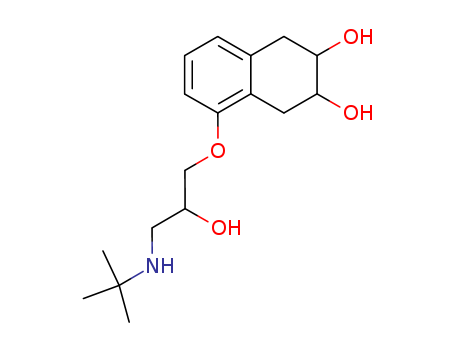
Chemical Property of Nadolol
Chemical Property:
- Appearance/Colour:White Solid
- Vapor Pressure:6.54E-12mmHg at 25°C
- Melting Point:125-130 °C
- Refractive Index:1.573
- Boiling Point:526.437 °C at 760 mmHg
- PKA:9.67(at 25℃)
- Flash Point:272.179 °C
- PSA:81.95000
- Density:1.19 g/cm3
- LogP:1.02570
- Storage Temp.:Refrigerator
- Solubility.:Slightly soluble in water, freely soluble in ethanol (96 per cent), practically insoluble in acetone.
- Water Solubility.:8.30g/L(25 oC)
- XLogP3:0.7
- Hydrogen Bond Donor Count:4
- Hydrogen Bond Acceptor Count:5
- Rotatable Bond Count:6
- Exact Mass:309.19400834
- Heavy Atom Count:22
- Complexity:344
- Purity/Quality:
-
97% *data from raw suppliers
Nadolol *data from reagent suppliers
Safty Information:
- Pictogram(s):
- Hazard Codes:
- MSDS Files:
-
SDS file from LookChem
Total 1 MSDS from other Authors
Useful:
- Drug Classes:Beta-Adrenergic Receptor Antagonists
- Canonical SMILES:CC(C)(C)NCC(COC1=CC=CC2=C1CC(C(C2)O)O)O
- Isomeric SMILES:CC(C)(C)NCC(COC1=CC=CC2=C1C[C@@H]([C@@H](C2)O)O)O
- Recent ClinicalTrials:Study of INV-102 Ophthalmic Solution in Adults With Moderate Symptomatic Dry Eye Disease
- Recent EU Clinical Trials:A Phase II, Randomized, Placebo-Controlled, Double-Blind, Crossover, Study of the Pharmacodynamic Effects of CST-103 co-administered with CST-107 on the Central Nervous System in Subjects with Neurodegenerative Disorders
- Recent NIPH Clinical Trials:Dose-dependent effects of green tea catechin on pharmacokinetics of nadolol in healthy volunteers
-
Uses
Labeled Nadolol, intended for use as an internal standard for the quantification of Nadolol by GC- or LC-mass spectrometry. Labelled Nadolol (N201052). β-Adrenergic
-
Therapeutic Function
Antiarrhythmic
-
Clinical Use
Beta-adrenoceptor blocker:
Hypertension
Angina
Arrhythmias
Migraine
Thyrotoxicosis
-
Drug interactions
Potentially hazardous interactions with other drugs
Anaesthetics: enhanced hypotensive effect. Analgesics: NSAIDs antagonise hypotensive effect.
Anti-arrhythmics: increased risk of myocardial
depression and bradycardia; increased risk of
bradycardia, myocardial depression and AV block
with amiodarone; increased risk of myocardial
depression and bradycardia with flecainide.
Antidepressants: enhanced hypotensive effect with
MAOIs.
Antihypertensives: enhanced hypotensive effect;
increased risk of withdrawal hypertension with
clonidine; increased risk of first dose hypotensive
effect with post-synaptic alpha-blockers such as
prazosin.
Antimalarials: increased risk of bradycardia with
mefloquine.
Antipsychotics enhanced hypotensive effect with
phenothiazines.
Calcium-channel blockers: increased risk of
bradycardia and AV block with diltiazem;
hypotension and heart failure possible with
nifedipine and nisoldipine; asystole, severe
hypotension and heart failure with verapamil.
Cytotoxics: possible increased risk of bradycardia
with crizotinib.
Diuretics: enhanced hypotensive effect.
Fingolimod: possibly increased risk of bradycardia.
Moxisylyte: possible severe postural hypotension.
Sympathomimetics: severe hypertension with
adrenaline and noradrenaline and possibly with
dobutamine.