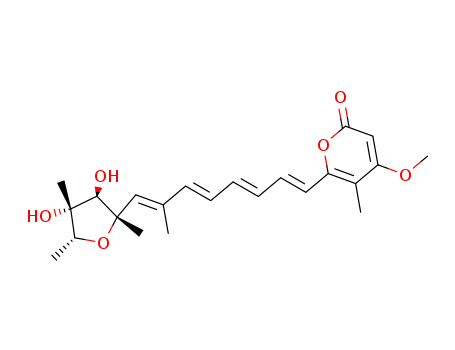
Chemical Property of 6-[8-(3,4-Dihydroxy-2,4,5-trimethyloxolan-2-yl)-7-methylocta-1,3,5,7-tetraenyl]-4-methoxy-5-methylpyran-2-one
Chemical Property:
- Vapor Pressure:3.97E-16mmHg at 25°C
- Melting Point:107-111℃
- Refractive Index:1.4593 (estimate)
- Boiling Point:585.1°Cat760mmHg
- PKA:13.67±0.70(Predicted)
- Flash Point:197.7°C
- PSA:89.13000
- Density:1.18g/cm3
- LogP:3.31800
- Storage Temp.:2-8°C
- XLogP3:2.6
- Hydrogen Bond Donor Count:2
- Hydrogen Bond Acceptor Count:6
- Rotatable Bond Count:6
- Exact Mass:402.20423867
- Heavy Atom Count:29
- Complexity:828
- Purity/Quality:
-
97% *data from raw suppliers
Citreoviridin *data from reagent suppliers
Safty Information:
- Pictogram(s):
T
- Hazard Codes:T
- Statements:
63-23/24/25-36/37/38
- Safety Statements:
22-26-36/37/39-45
- MSDS Files:
-
SDS file from LookChem
Useful:
- Canonical SMILES:CC1C(C(C(O1)(C)C=C(C)C=CC=CC=CC2=C(C(=CC(=O)O2)OC)C)O)(C)O
-
Uses
Citreoviridin is the dominant analogue of a family of tetraene mycotoxins with potent neurotoxic effects, produced by several species of Aspergillus and Penicillium. Citreoviridin inhibits mitochondrial ATPase and is a causative agent of cardiac beriberi. Citreoviridin is a mycotoxin isolated from several Penicillium species that has been shown to inhibit the mitochondrial ATP synthetase system. It inhibits soluble ATPase (KD = 4.1 μM), ADP-stimulated respiration in isolated rat liver mitochondria (KD = 0.15 μM), and ATP-driven reduction of NAD+ by succinate (KD = 2 μM). Citreoviridin has been used to target ectopic ATPase activity in cancer cells in order to modulate the metabolic activity associated with tumorigenesis.[Cayman Chemical]