Welcome to LookChem.com Sign In|Join Free
  • or

Encyclopedia

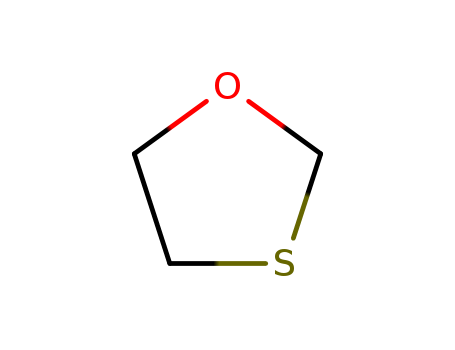
1,3-Oxathiolane

Base Information
  • Chemical Name:1,3-Oxathiolane
  • CAS No.:2094-97-5
  • Molecular Formula:C3H6 O S
  • Molecular Weight:90.146
  • Hs Code.:2934999090
  • Mol file:2094-97-5.mol
1,3-Oxathiolane

Synonyms:1,3-Oxathiole,dihydro-; Dihydro-1,3-oxathiole

Suppliers and Price of 1,3-Oxathiolane
Supply Marketing:
Business phase:
The product has achieved commercial mass production*data from LookChem market partment
Manufacturers and distributors:
  • Manufacture/Brand
  • Chemicals and raw materials
  • Packaging
  • price
Total 7 raw suppliers
Chemical Property of 1,3-Oxathiolane
Chemical Property:
  • Vapor Pressure:5.75mmHg at 25°C 
  • Boiling Point:146.8°Cat760mmHg 
  • Flash Point:42.6°C 
  • PSA:34.53000 
  • Density:1.137g/cm3 
  • LogP:0.70730 
Purity/Quality:

99% *data from raw suppliers

Safty Information:
  • Pictogram(s):  
  • Hazard Codes: 
MSDS Files:

SDS file from LookChem

Useful:
Technology Process of 1,3-Oxathiolane

There total 2 articles about 1,3-Oxathiolane which guide to synthetic route it. The literature collected by LookChem mainly comes from the sharing of users and the free literature resources found by Internet computing technology. We keep the original model of the professional version of literature to make it easier and faster for users to retrieve and use. At the same time, we analyze and calculate the most feasible synthesis route with the highest yield for your reference as below:

synthetic route:
Guidance literature:
With diisobutylaluminium hydride; In hexane; at 35 - 40 ℃;
Guidance literature:
With di-tert-butyl peroxide; In chlorobenzene; at 130 ℃; for 4h; Mechanism; Product distribution; other initiator; other temperature; other time;
Guidance literature:
With potassium permanganate; In dichloromethane; water; for 0.25h; Ambient temperature;
DOI:10.1021/jo01306a019
Refernces

10.1021/je60040a035

The study investigates the physical and spectral properties of a series of heterocyclic compounds, including 2-aryl-1,3-dioxolanes, 1,3-dithiolanes, 1,3-oxathiolanes, and 1,3-N,N-dimethyl imidazolidines. These compounds were synthesized using standard procedures, with aldehydes and glycols (or their heteroanalogues) as starting materials, and p-toluene sulfonic acid as a catalyst. The study focuses on characterizing these compounds through their densities, refractive indexes, melting and boiling points, and infrared (IR) and nuclear magnetic resonance (NMR) spectra. Key findings include the identification of characteristic IR bands between 10.0 and 11.1 microns (1000 to 901 cm?1) for the heterocyclic five-membered ring, which are useful for analysis in the presence of typical starting materials. The NMR spectra reveal distinct chemical shifts for the benzylic hydrogens of these heterocyclic systems, which are insensitive to substituents on the phenyl rings. The study aims to provide detailed spectral data for these compounds to support further kinetic investigations, such as autoxidations, hydrolyses, and hydrogen abstraction reactions.


Post a RFQ

Enter 15 to 2000 letters.Word count: 0 letters

Attach files(File Format: Jpeg, Jpg, Gif, Png, PDF, PPT, Zip, Rar,Word or Excel Maximum File Size: 3MB)

1 Customer Service

What can I do for you?
Get Best Price

Get Best Price for 2094-97-5