Welcome to LookChem.com Sign In|Join Free
  • or

Encyclopedia

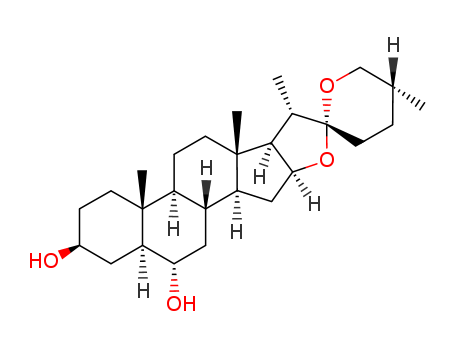
Chlorogenin

Base Information
  • Chemical Name:Chlorogenin
  • CAS No.:562-34-5
  • Molecular Formula:C27H44O4
  • Molecular Weight:432.644
  • Hs Code.:
  • UNII:K8Z178V1DG
  • ChEMBL ID:CHEMBL2047364
  • DSSTox Substance ID:DTXSID30903919
  • Metabolomics Workbench ID:35174
  • Nikkaji Number:J6.501C
  • Wikidata:Q27282108
  • Mol file:562-34-5.mol
Chlorogenin

Synonyms:Chlorogenin;562-34-5;UNII-K8Z178V1DG;K8Z178V1DG;5alpha-Spirostan-3beta,6alpha-diol, (25R)-;(1R,2S,4S,5'R,6R,7S,8R,9S,12S,13R,16S,18S,19S)-5',7,9,13-tetramethylspiro[5-oxapentacyclo[10.8.0.02,9.04,8.013,18]icosane-6,2'-oxane]-16,19-diol;F-Chlorogenin;CHLOROGENIN [MI];SCHEMBL330411;CHEMBL2047364;DTXSID30903919;CHEBI:188325;(25r)-5a-spirostane-3b,6a-diol;AKOS040763844;FS-7297;CS-0530796;NS00093688;Q27282108;(25R)-5.ALPHA.-SPIROSTAN-3.BETA.,6.ALPHA.-DIOL;SPIROSTAN-3,6-DIOL, (3.BETA.,5.ALPHA.,6.ALPHA.,25R)-

Suppliers and Price of Chlorogenin
Supply Marketing:
Business phase:
The product has achieved commercial mass production*data from LookChem market partment
Manufacturers and distributors:
  • Manufacture/Brand
  • Chemicals and raw materials
  • Packaging
  • price
  • American Custom Chemicals Corporation
  • CHLOROGENIN 95.00%
  • 5MG
  • $ 496.01
Total 5 raw suppliers
Chemical Property of Chlorogenin
Chemical Property:
  • Vapor Pressure:2.07E-14mmHg at 25°C 
  • Melting Point:273-276° 
  • Boiling Point:550.5°Cat760mmHg 
  • PKA:14.78±0.70(Predicted) 
  • Flash Point:286.7°C 
  • PSA:58.92000 
  • Density:1.16g/cm3 
  • LogP:4.76460 
  • XLogP3:5.1
  • Hydrogen Bond Donor Count:2
  • Hydrogen Bond Acceptor Count:4
  • Rotatable Bond Count:0
  • Exact Mass:432.32395988
  • Heavy Atom Count:31
  • Complexity:726
Purity/Quality:

99% *data from raw suppliers

CHLOROGENIN 95.00% *data from reagent suppliers

Safty Information:
  • Pictogram(s):  
  • Hazard Codes: 
MSDS Files:
Useful:
  • Canonical SMILES:CC1CCC2(C(C3C(O2)CC4C3(CCC5C4CC(C6C5(CCC(C6)O)C)O)C)C)OC1
  • Isomeric SMILES:C[C@@H]1CC[C@@]2([C@H]([C@H]3[C@@H](O2)C[C@@H]4[C@@]3(CC[C@H]5[C@H]4C[C@@H]([C@@H]6[C@@]5(CC[C@@H](C6)O)C)O)C)C)OC1
  • General Description Chlorogenin is a sterol characterized by hydroxyl groups at positions 3 (beta configuration) and 6 (alpha configuration). Its structure was confirmed through chemical synthesis and reduction methods, including the conversion of chlorogenone to chlorogenin via sodium-ethanol reduction and catalytic hydrogenation. Comparative studies with related compounds, such as the reduction of cholestanedione-3,6, further supported its structural and configurational assignments.
Technology Process of Chlorogenin

There total 18 articles about Chlorogenin which guide to synthetic route it. The literature collected by LookChem mainly comes from the sharing of users and the free literature resources found by Internet computing technology. We keep the original model of the professional version of literature to make it easier and faster for users to retrieve and use. At the same time, we analyze and calculate the most feasible synthesis route with the highest yield for your reference as below:

synthetic route:
Guidance literature:
diosgenin; With diborane; In tetrahydrofuran; at 0 - 20 ℃; Inert atmosphere;
With sodium hydroxide; In tetrahydrofuran; at 0 ℃; for 0.75h;
With dihydrogen peroxide; In tetrahydrofuran; at 20 ℃; for 3h;
Guidance literature:
diosgenin; With sodium tetrahydroborate; In tetrahydrofuran; at -20 ℃; for 2h; Inert atmosphere; Sealed tube;
With boron trifluoride diethyl etherate; In tetrahydrofuran;
With methanol; dihydrogen peroxide; potassium hydroxide; In dichloromethane; at 20 ℃; for 1h; Temperature;
DOI:10.1039/d0sc01701a
Refernces

CONTRIBUTION FROM THE SCHOOL OF CHEMISTRY AND PHYSICS OF THE PENNSYLVANIA STATE COLLEGE: Sterols. CII. Chlorogenin

10.1021/ja01866a074

The study investigates the structure and properties of chlorogenin and its related compounds. Chlorogenin is a sterol compound with hydroxyl groups at positions 3 and 6, which are confirmed to be in the beta and alpha configurations respectively. The researchers used various chemical reactions and reduction methods to synthesize and analyze chlorogenin and its derivatives. For instance, chlorogenone was reduced with sodium in ethanol to obtain chlorogenin, and catalytic reduction with hydrogen and platinum oxide catalyst yielded beta-chlorogenin. The study also involved the oxidation of digitogenin residues to produce chlorogenone, and the reduction of cholestanedione-3,6 with sodium and ethanol to obtain a diol for comparison. These experiments provided evidence supporting the proposed structure of chlorogenin and helped elucidate the configurations of its hydroxyl groups.

Post a RFQ

Enter 15 to 2000 letters.Word count: 0 letters

Attach files(File Format: Jpeg, Jpg, Gif, Png, PDF, PPT, Zip, Rar,Word or Excel Maximum File Size: 3MB)

1 Customer Service

What can I do for you?
Get Best Price

Get Best Price for 562-34-5