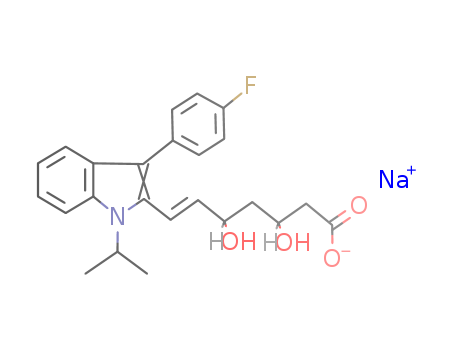
Chemical Property of sodium (3S,5R,E)-7-(3-(4-fluorophenyl)-1-isopropyl-1H-indol-2-yl)-3,5-dihydroxyhept-6-enoate
Chemical Property:
- Appearance/Colour:yellow powder
- Vapor Pressure:1.6E-19mmHg at 25°C
- Melting Point:194-197 °C
- Boiling Point:681.8 °C at 760 mmHg
- Flash Point:366.1 °C
- PSA:85.52000
- LogP:3.29340
- Storage Temp.:Desiccate at -20°C
- Solubility.:H2O: ≥9mg/mL
- Hydrogen Bond Donor Count:2
- Hydrogen Bond Acceptor Count:5
- Rotatable Bond Count:8
- Exact Mass:433.16653072
- Heavy Atom Count:31
- Complexity:596
- Purity/Quality:
-
99%, *data from raw suppliers
FluvastatinSodiumSalt(RelativeStereochemistry) *data from reagent suppliers
Safty Information:
- Pictogram(s):
- Hazard Codes:
- MSDS Files:
-
SDS file from LookChem
Useful:
- Canonical SMILES:CC(C)N1C2=CC=CC=C2C(=C1C=CC(CC(CC(=O)[O-])O)O)C3=CC=C(C=C3)F.[Na+]
- Isomeric SMILES:CC(C)N1C2=CC=CC=C2C(=C1/C=C/C(CC(CC(=O)[O-])O)O)C3=CC=C(C=C3)F.[Na+]
- Recent ClinicalTrials:Efficacy and Safety of Fluvastatin Sodium Extended Release Tablets 80 mg Once Daily in Chinese Patients With Primary Hypercholesterolemia or Mixed Dyslipidemia
- Recent EU Clinical Trials:STATIN RECAPTURE THERAPY BEFORE CORONARY ARTERY BYPASS GRAFTING
- Recent NIPH Clinical Trials:Evaluation of the effect of AngiotensinII receptor blocker on coronary artery after Sirolimus-Eluting Stent implantation
-
Uses
HMG-CoA reductase inhibitors. Anti- hyperlipoproteinemic;'HMG CoA reductase inhibitor Fluvastatin-d6 Sodium Salt is the labeled analogue of Fluvastatin Sodium Salt (F601250), a synthetic HMG-CoA reductase inhibitor. Antilipemic.
-
production method
1. After condensation of (chloroacetyl) fluorobenzeneand N-isopropyl aniline , the compound (I) is obtained. Then in acetonitrile, under the presence of phosphorus oxychloride, react with N, N-dimethylamino acrolein , the compound (Ⅱ) is obtained. Compound (Ⅱ) in the role of a strong base, after condensation with methyl acetoacetate , and then splitting ,the compound (Ⅲ) is produced. At-77 ~-74 ℃, the compound (Ⅲ) is added dropwise into a mixture of boron sodium borohydride , methanol, tetrahydrofuran and diethyl methoxy ,stir 30min; cyclic boronic ester obtained in ethyl acetate is treated with 30% hydrogen peroxide; then it is hydrolyzed to obtain fluvastatin sodium.
2. the compound (Ⅳ)is obtained by catalytic hydrogenation of Phloroglucinol . React it With tert-butyldiphenylsilyl chloride to produce the compound (V), and then oxidize it to generate (Ⅵ). After oxidation of chloroperbenzoic acid to obtain (Ⅶ), (Ⅷ) is produced through ring-opening . And then it is oxidized to (IX) . (Ⅺ) is obtained through condensation of (Ⅸ) and intermediate x , after deprotection and hydrolysis, obtain fluvastatin sodium.
Intermediate (X) can be made through starting from the compound (I), via formylation, reduction, chlorination, and then reacting with triphenylphosphine .
-
Description
Fluvastatin sodium is the fourth HMG-CoA reductase inhibitor to reach the market
as a dietary adjunct for lowing total and low-density lipoprotein (LDL) cholesterol.
Fluvastatin sodium is the first totally synthetic inhibitor of its class and has more
potent effects on reducing serum total and LDL cholesterol and serum triglyceride
levels than compactin or lovastatin. Moreover, fluvastatin exhibits a unique set of
pharmacological properties including a biopharmaceutical profile most consistent
with hepatoselectivity. It has been reported to be well tolerated and to exhibit a
safety profile superior to other agents of its class. The main mechanism by which
HMG-CoA reductase inhibitors lower plasma cholesterol has been suggested to be
up-regulation of hepatocellular LDL-receptor expression and enhancement of
receptor-mediated clearance and catabolism of LDL cholesterol.
-
Therapeutic Function
Antihyperlipidemic