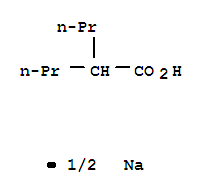
Chemical Property of CID 10154225
Chemical Property:
- Appearance/Colour:a white powder with a characteristic odor
- Vapor Pressure:0.0435mmHg at 25°C
- Melting Point:222 °C
- Boiling Point:220 °C at 760 mmHg
- Flash Point:116.6 °C
- PSA:77.43000
- LogP:3.24010
- Storage Temp.:Refrigerator
- Solubility.:Chloroform (Slightly), Methanol (Slightly)
- Hydrogen Bond Donor Count:1
- Hydrogen Bond Acceptor Count:2
- Rotatable Bond Count:5
- Exact Mass:167.10479903
- Heavy Atom Count:11
- Complexity:93.4
- Purity/Quality:
-
99% *data from raw suppliers
ValproicAcidSemisodiumSalt *data from reagent suppliers
Safty Information:
- Pictogram(s):
- Hazard Codes:
- MSDS Files:
-
SDS file from LookChem
Useful:
- Canonical SMILES:CCCC(CCC)C(=O)O.[Na]
-
Description
Divalproex is a prodrug form of valproic acid that contains valproic acid and valproate sodium. Formulations containing divalproex exhibit delayed gastrointestinal absorption and are converted to valproic acid in the intestine, which reduces gastric irritation and nervous system side effects. Formulations containing divalproex are widely used for the treatment of seizures and bipolar disorder.
-
Uses
Antiepileptic; Anticonvulsant that also acts as a mood stabilizer for those with bipolar disorder. Divalproex sodium consists of a compound of sodium valproate and valproic acid in a 1:1 molar relationship in an enteric coated form. In rare cases, it is also used as a treatment for major depressive disorder, and increasingly taken long-term for prevent Anticonvulsant; Bipolar Agent
-
Therapeutic Function
Anticonvulsant
-
Clinical Use
Treatment of manic episodes associated with bipolar disorder Migraine prophylaxis (unlicensed)
-
Drug interactions
Potentially hazardous interactions with other drugs
Antibacterials: metabolism possibly inhibited
by erythromycin; avoid with pivmecillinam;
concentration reduced by carbapenems - avoid.
Antidepressants: avoid with St John’s wort.
Antiepileptics: concentration reduced by
carbamazepine; concentration of active
carbamazepine metabolite increased; increased
concentration of lamotrigine, phenobarbital,
rufinamide and possibly ethosuximide; sometimes
reduces concentration of active metabolite of
oxcarbazepine; alters phenytoin concentration;
phenytoin and phenobarbital reduce valproate
concentration; hyperammonaemia and CNS toxicity
with topiramate.
Antipsychotics: increased neutropenia with
olanzapine; possibly increases or decreases
concentration of clozapine; possibly increases
quetiapine concentration.
Ciclosporin: variable ciclosporin blood level response.
Sodium oxybate: concentration of sodium oxybate
increased.
Ulcer-healing drugs: metabolism inhibited by
cimetidine, increased concentration.