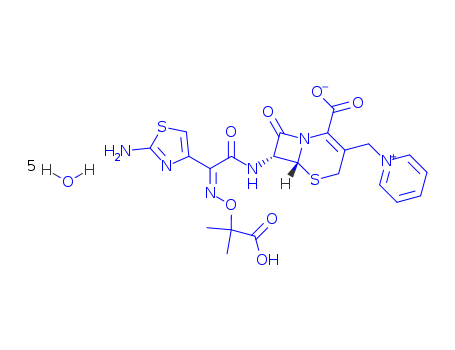
Chemical Property of Ceftazidine
Chemical Property:
- Appearance/Colour:white solid
- Melting Point:>150oC(dec.)
- PKA:pKa 1.8 (Uncertain)
- PSA:244.76000
- LogP:-0.38920
- Storage Temp.:2-8°C
- Solubility.:Sparingly soluble in aqueous solution
- Hydrogen Bond Donor Count:5
- Hydrogen Bond Acceptor Count:13
- Rotatable Bond Count:9
- Exact Mass:564.10970409
- Heavy Atom Count:38
- Complexity:1030
- Purity/Quality:
-
95%-102% *data from raw suppliers
CeftazidimePentahydrate(Contain1equivalentofNa2CO3asstabilizer) *data from reagent suppliers
Safty Information:
- Pictogram(s):
 Xn
Xn
- Hazard Codes:Xn
- Statements:
42/43
- Safety Statements:
22-36/37-45-37-24
- MSDS Files:
-
SDS file from LookChem
Total 1 MSDS from other Authors
Useful:
- Canonical SMILES:CC(C)(C(=O)O)ON=C(C1=CSC(=N1)N)C(=O)NC2C3N(C2=O)C(=C(CS3)C[N+]4=CC=CC=C4)C(=O)O.[OH-]
- Isomeric SMILES:CC(C)(C(=O)O)O/N=C(/C1=CSC(=N1)N)\C(=O)N[C@H]2[C@@H]3N(C2=O)C(=C(CS3)C[N+]4=CC=CC=C4)C(=O)O.[OH-]
-
Description
Ceftazidime is the latest third generation cephalosporin to reach the market. It
has one of the broadest spectrums of the cephalosporins, similar in many regards
to that of cefotaxime. It is particularly active against Pseudomonas aeruginosa,
being perhaps 4-5 times more potent in vitro than moxalactam and cefotaxime.
-
Uses
Third generation cephalosporin antibiotic. Antibacterial. Ceftazidime pentahydrate is an antibacterial agent. It is used especially for Pseudomonas and other gram-negative infections in debilitated patients. It is used in the treatment of patients with infections caused by susceptible strains of organisms in the following diseases: lower respiratory tract infections,skin and skin structure infections, urinary tract infections, bacterial septicemia, bone and joint infections, gynecologic infections, intra abdominal infections (including peritonitis), and central nervous system infections (including meningitis).
-
Clinical Use
It is used, often combined with an aminoglycoside, to treat
a wide range of severe urinary, respiratory and wound infections,
mostly due to enterobacteria or Ps. aeruginosa. Reference
is made to its use in pneumonia, septicemia, meningitis (especially
if caused by Ps. aeruginosa), peritonitis, osteomyelitis,
neonatal sepsis, burns and melioidosis. Concern has been
expressed at the relative frequency with which failure is associated
with superinfection or the emergence of resistance.