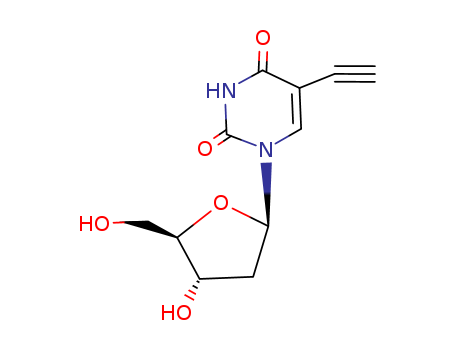
Chemical Property of 5-Ethynyl-2'-deoxyuridine
Chemical Property:
- Melting Point:199°C(lit.)
- Refractive Index:1.644
- PKA:8.29±0.10(Predicted)
- PSA:104.55000
- Density:1.55 g/cm3
- LogP:-1.84140
- Storage Temp.:-20°C
- Solubility.:Soluble in DMSO (up to 10 mg/ml).
- XLogP3:-1.3
- Hydrogen Bond Donor Count:3
- Hydrogen Bond Acceptor Count:5
- Rotatable Bond Count:3
- Exact Mass:252.07462149
- Heavy Atom Count:18
- Complexity:463
- Purity/Quality:
-
98%min *data from raw suppliers
5-Ethynyl-2’-deoxyuridine *data from reagent suppliers
Safty Information:
- Pictogram(s):
T
- Hazard Codes:T
- Statements:
46-61
- Safety Statements:
53-45-24/25
- MSDS Files:
-
SDS file from LookChem
Useful:
- Canonical SMILES:C#CC1=CN(C(=O)NC1=O)C2CC(C(O2)CO)O
- Isomeric SMILES:C#CC1=CN(C(=O)NC1=O)[C@H]2C[C@@H]([C@H](O2)CO)O
-
Description
5-Ethynyl-2′-deoxyuridine (61135-33-9) is a novel agent for fast and sensitive detection of DNA synthesis?in vivo.1 5-EdU is incorporated into proliferating cells followed by detection with a fluorescent azide using click ligation.1 In contrast to the use of BrdU, the new method does not require sample fixation or DNA denaturation. 5-Ethynyl-2′-deoxyuridine may be used for studying cell proliferation in the central nervous system and may be combined with BrdU staining in a novel protocol allowing for double labeling of DNA synthesis.2
-
Uses
5-Ethynyl-2’deoxyuridine is a extensively used nucleoside analog used as a probe for DNA synthesis. However, 5-Ethynyl-2’deoxyuridine is a toxic anti-metabolite, which potentially causes DNA instabi
liy, necrosis and cell-cycle arrest, therefore it is often used for short-term DNA synthesis in tissue culture and living organisms where prolonged cell survival is not required. 5-Ethynyl-2′-deoxyuridine (EdU) is a thymidine analog that can be incorporated into replicating DNA for detection of cell proliferation. It has an alkyne handle that can ligate with azide-containing fluorescent probes through a highly efficient click chemistry reaction. EdU nucleoside can be incorporated into the DNA of cells either in culture or in animals without showing significant toxicity. The assay offers a simpler workflow for detecting cell proliferation than anti-BrdU assays.For information on Baseclick kits containing all the reagents for the assays see: Baseclick kitsFor a listing of the Baseclick kits see: Baseclick kits