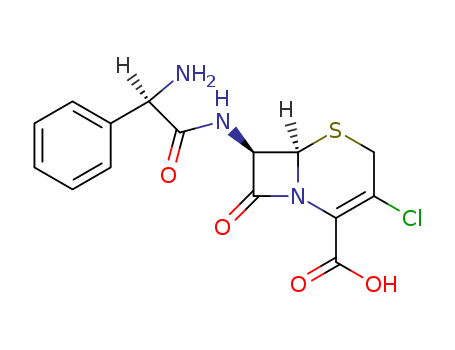
Chemical Property of CID 7048572
Chemical Property:
- Appearance/Colour:white crystalline solid
- Vapor Pressure:3.82E-20mmHg at 25°C
- Refractive Index:1.705
- Boiling Point:713.395 °C at 760 mmHg
- PKA:pKa 1.5±0.2(H2O) (Uncertain)
- Flash Point:385.248 °C
- PSA:138.03000
- Density:1.624 g/cm3
- LogP:1.65040
- Storage Temp.:under inert gas (nitrogen or Argon) at 2–8 °C
- Solubility.:1 M HCl: 50 mg/mL, clear to very faintly turbid, yellow
- Water Solubility.:10g/L(temperature not stated)
- XLogP3:-1.1
- Hydrogen Bond Donor Count:2
- Hydrogen Bond Acceptor Count:5
- Rotatable Bond Count:3
- Exact Mass:367.0393548
- Heavy Atom Count:24
- Complexity:600
- Purity/Quality:
-
95%-102% *data from raw suppliers
Cefaclor *data from reagent suppliers
Safty Information:
- Pictogram(s):
 Xn,
Xn, Xi
Xi
- Hazard Codes:Xn,Xi
- Statements:
42/43
- Safety Statements:
22-36/37-45
- MSDS Files:
-
SDS file from LookChem
Useful:
- Canonical SMILES:C1C(=C(N2C(S1)C(C2=O)NC(=O)C(C3=CC=CC=C3)[NH3+])C(=O)[O-])Cl
- Isomeric SMILES:C1C(=C(N2[C@H](S1)[C@@H](C2=O)NC(=O)[C@@H](C3=CC=CC=C3)[NH3+])C(=O)[O-])Cl
-
Description
Cefaclor is a cephalosporin antibiotic that is active against S. pyogenes, S. pneumoniae, S. aureus, P. mirabilis, S. typhi, E. coli, and H. influenzae (MICs = 0.25, 0.25-2, 1-2, 1, 0.5, 1, and 2-4 μg/ml, respectively). It is protective against S. pyogenes, S. pneumoniae, S. aureus, P. mirabilis, S. typhi, E. coli, and H. influenzae infections in mice (ED50s = 0.08-30.2 mg/kg). Formulations containing cefaclor have been used in the treatment of various bacterial infections. Cefaclor differs from cephalexin primarily in the bio-isosteric replacement of methyl by chlorine at C-3 and is
quite acid stable, allowing oral administration. It also is quite stable to metabolism. It is less active against
Gram-negative bacteria compared with the other second-generation cephalosporins but is more active
against Gram-negative bacteria compared with the first-generation drugs.
-
Uses
Cefaclor is used to study urinary tract, intra-abdominal, and?Haemophilus influenzae?infections. It is used to study the mechanism of human renal organic anion and peptide transporters such as hOAT1, hPEPT1, and hPEPT2 and to study the effects of inhibition of penicillin-binding proteins on bacterial cell wall mucopeptide synthesis. Cefaclor belongs to the family of antibiotics known as the cephalosporins (cefalosporins). The cephalosporins are broad-spectrum antibiotics that are used for the treatment of septicaemia, pneumonia, meningitis, biliary-tract infections, peritonitis, and
-
Therapeutic Function
Antibiotic
-
Clinical Use
Cefaclor (Ceclor) is an orally active semisyntheticcephalosporin that was introduced in the American market in1979. It differs structurally from cephalexin in that the 3-methyl group has been replaced by a chlorine atom. It issynthesized from the corresponding 3-methylenecepham sulfoxideester by ozonolysis, followed by halogenation of theresulting β-ketoester. The 3-methylenecepham sulfoxideesters are prepared by rearrangement of the corresponding 6-acylaminopenicillanic acid derivative. Cefaclor is moderatelystable in acid and achieves enough oral absorption to provideeffective plasma levels (equal to about two-thirds of thoseobtained with cephalexin). The compound is apparentlyunstable in solution, since about 50% of its antimicrobial activityis lost in 2 hours in serum at 37°C. The antibacterialspectrum of activity is similar to that of cephalexin, but it isclaimed to be more potent against some species sensitiveto both agents. Currently, the drug is recommended for thetreatment of non–life-threatening infections caused by H.influenzae, particularly strains resistant to ampicillin. Uses are similar to those of other group 2 cephalosporins.
It is among the few suitable for use in respiratory infections
because of its activity against H. influenzae.
-
Drug interactions
Potentially hazardous interactions with other drugs
Anticoagulants: effects of coumarins may be
enhanced.