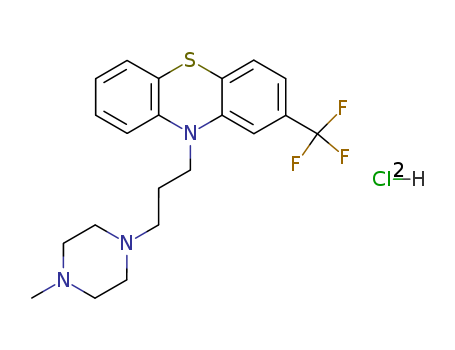
Chemical Property of Riulcfstkrdhbx-uhfffaoysa-N
Chemical Property:
- Appearance/Colour:Cream fine powder
- Vapor Pressure:2.32E-10mmHg at 25°C
- Melting Point:243 °C (dec.)(lit.)
- Boiling Point:506 °C at 760 mmHg
- PKA:pK1 3.9, pK2 8.1(at 25℃)
- Flash Point:259.8 °C
- PSA:35.02000
- LogP:6.49040
- Storage Temp.:2-8°C
- Solubility.:ethanol: soluble5mg/mL
- Hydrogen Bond Donor Count:1
- Hydrogen Bond Acceptor Count:7
- Rotatable Bond Count:4
- Exact Mass:443.1409812
- Heavy Atom Count:29
- Complexity:510
- Purity/Quality:
-
99%, *data from raw suppliers
Trifluoperazine dihydrochloride *data from reagent suppliers
Safty Information:
- Pictogram(s):
 Xn
Xn
- Hazard Codes:Xn
- Statements:
22
- Safety Statements:
36
- MSDS Files:
-
SDS file from LookChem
Useful:
- Canonical SMILES:CN1CC[NH+](CC1)CCCN2C3=CC=CC=C3SC4=C2C=C(C=C4)C(F)(F)F.[Cl-]
-
Description
Trifluoperazine (TFP) is a phenothiazine compound with anti-adrenergic and anti-dopaminergic actions typical of antipsychotic agents. It antagonizes adrenergic receptors, with selectivity for α1 over the α2 subtypes (Kis = 24, 653, 163, and 391 nM for α1A, α2A, α2B, and α2C, respectively). TFP binds with much higher affinity to the dopamine D2-like receptor (Kd = 0.96 nM) compared to the dopamine D4-like and the serotonin 5-HT2A receptors (Kds = 44 and 135 nM, respectively). Furthermore, TFP antagonizes calmodulin (CaM) and alters the calcium-binding properties of calsequestrin (CSQ). TFP has been shown to activate type-2 ryanodine receptors independently of its CaM and CSQ activity.
-
Uses
Trifluoperazine dihydrochloride has been used as a calmodulin kinase antagonist in cultured Aplysia californica neurons. Trifluoperazine dihydrochloride has also been used as a PMCA inhibitor in mouse duodenal tissues to block the transcellular active calcium flux. Antipsychotic
-
Therapeutic Function
Tranquilizer