Welcome to LookChem.com Sign In|Join Free
  • or

Encyclopedia

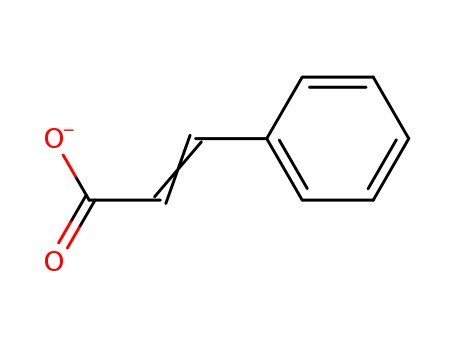
Cinnamate

Base Information
  • Chemical Name:Cinnamate
  • CAS No.:4151-45-5
  • Molecular Formula:C9H7O2-
  • Molecular Weight:147.153
  • Hs Code.:
  • Nikkaji Number:J1.701.529J,J3.580.907D
  • Wikidata:Q74418221
  • Mol file:4151-45-5.mol
Cinnamate

Synonyms:Cinnamate;Cinnamates

Suppliers and Price of Cinnamate
Supply Marketing:
Business phase:
The product has achieved commercial mass production*data from LookChem market partment
Manufacturers and distributors:
  • Manufacture/Brand
  • Chemicals and raw materials
  • Packaging
  • price
Total 3 raw suppliers
Chemical Property of Cinnamate
Chemical Property:
  • Vapor Pressure:0.00471mmHg at 25°C 
  • Boiling Point:265°C at 760 mmHg 
  • Flash Point:189.5°C 
  • PSA:40.13000 
  • LogP:0.44970 
  • XLogP3:2.8
  • Hydrogen Bond Donor Count:0
  • Hydrogen Bond Acceptor Count:2
  • Rotatable Bond Count:1
  • Exact Mass:147.044604462
  • Heavy Atom Count:11
  • Complexity:149
Purity/Quality:

99% *data from raw suppliers

Safty Information:
  • Pictogram(s):  
  • Hazard Codes: 
MSDS Files:

SDS file from LookChem

Useful:
  • Canonical SMILES:C1=CC=C(C=C1)C=CC(=O)[O-]
  • Isomeric SMILES:C1=CC=C(C=C1)/C=C/C(=O)[O-]
  • General Description Cinnamate, also known as 2-Propenoic acid, 3-phenyl-, ion(1-), is a key structural motif in compounds like ethyl 3,4,5-trimethoxythionocinnamate (ETMTC), which demonstrate potent inhibitory effects on the expression of cell adhesion molecules (CAMs) such as ICAM-1, VCAM-1, and E-selectin in human endothelial cells. These derivatives, particularly those with sulfur substitutions (thiocinnamates and thionocinnamates), exhibit enhanced anti-inflammatory activity by suppressing TNF-α-induced CAM expression and neutrophil adhesion. The inhibitory potency is influenced by structural features like alkyl chain length, methoxy group substitution, and the presence of sulfur, highlighting their potential as therapeutic agents for inflammatory conditions.
Technology Process of Cinnamate

There total 1 articles about Cinnamate which guide to synthetic route it. The literature collected by LookChem mainly comes from the sharing of users and the free literature resources found by Internet computing technology. We keep the original model of the professional version of literature to make it easier and faster for users to retrieve and use. At the same time, we analyze and calculate the most feasible synthesis route with the highest yield for your reference as below:

synthetic route:
Guidance literature:
With sodium hydroxide; In acetonitrile; at 25 ℃; Rate constant;
DOI:10.1002/jps.2600720928
Guidance literature:
With ruthenium(II) tris(4,4'-dimethyl-2,2'-bipyridine); sodium dodecyl-sulfate; ascorbate; In water; for 14h; pH=12.7; UV-irradiation;
DOI:10.1002/chem.201801955
upstream raw materials:

cinmetacine

Downstream raw materials:

3-phenylpropionate

Refernces

Novel natural product-based cinnamates and their thio and thiono analogs as potent inhibitors of cell adhesion molecules on human endothelial cells

10.1016/j.ejmech.2011.09.008

The research investigates the design, synthesis, and evaluation of novel cinnamate, thiocinnamate, and thionocinnamate analogs derived from natural products for their ability to inhibit the expression of cell adhesion molecules (CAMs) on human endothelial cells. The study aims to identify potent inhibitors of TNF-α-induced ICAM-1, VCAM-1, and E-selectin expression, which are critical in inflammatory responses. The key chemicals used include various cinnamates, thiocinnamates, and thionocinnamates, with ethyl 3,4,5-trimethoxythionocinnamate (ETMTC) emerging as the most potent inhibitor. The research concludes that these compounds, particularly ETMTC, significantly inhibit the expression of CAMs and neutrophil adhesion to endothelial cells, suggesting their potential as anti-inflammatory agents. The findings highlight the importance of the alkyl chain length, the number of methoxy groups, and the presence of sulfur in the structure for enhancing inhibitory activity.

Facile generation of vicinal bromoazides from olefins using TMSN3 and TsNBr2 without any catalyst

10.1016/j.tetlet.2009.06.059

The research aimed to develop an efficient method for the synthesis of vicinal bromoazides directly from olefins using N,N-dibromo-p-toluenesulfonamide (TsNBr2) as the bromine source and trimethylsilyl azide (TMSN3) as the azide source, without the need for any catalyst. The study concluded that this method is extremely rapid and efficient, applicable to various olefins such as cinnamates, chalcone, styrenes, and acrylates, yielding the corresponding 1,2-bromoazides in excellent yields. The reaction is particularly effective for α,β-unsaturated carbonyl compounds, which are known to be challenging for such transformations. However, the reaction was found to be less effective for aliphatic alkenes like cyclohexene and 1-octene. The procedure is performed at room temperature in acetonitrile as the solvent, and the reaction is instantaneous, highlighting its ease of performance.

Post a RFQ

Enter 15 to 2000 letters.Word count: 0 letters

Attach files(File Format: Jpeg, Jpg, Gif, Png, PDF, PPT, Zip, Rar,Word or Excel Maximum File Size: 3MB)

1 Customer Service

What can I do for you?
Get Best Price

Get Best Price for 4151-45-5
