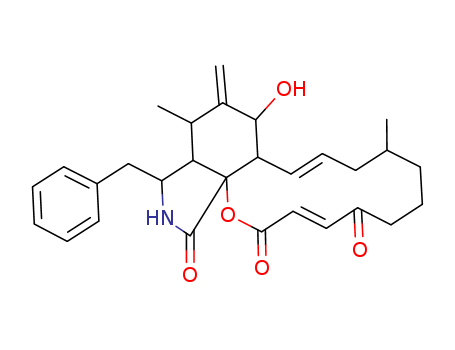
Chemical Property of (4Z,12E)-19-benzyl-15-hydroxy-10,17-dimethyl-16-methylidene-2-oxa-20-azatricyclo[12.7.0.01,18]henicosa-4,12-diene-3,6,21-trione
Chemical Property:
- Appearance/Colour:white crystalline powder
- Vapor Pressure:0mmHg at 25°C
- Melting Point:147 to 148'c
- Boiling Point:725.1 °C at 760 mmHg
- PKA:13.54±0.70(Predicted)
- Flash Point:392.3 °C
- PSA:92.70000
- Density:1.2 g/cm3
- LogP:4.02910
- Storage Temp.:−20°C
- Sensitive.:Light Sensitive
- Solubility.:ethanol: 20 mg/mL, clear, colorless
- Water Solubility.:Soluble in DMF, DMSO, ethanol and acetone. Insoluble in water.
- XLogP3:3.3
- Hydrogen Bond Donor Count:2
- Hydrogen Bond Acceptor Count:5
- Rotatable Bond Count:2
- Exact Mass:477.25152322
- Heavy Atom Count:35
- Complexity:901
- Purity/Quality:
-
98%,99%, *data from raw suppliers
Cytochalasin A *data from reagent suppliers
Safty Information:
- Pictogram(s):
 T+
T+ T
T
- Hazard Codes:T+,T
- Statements:
26/27/28-63
- Safety Statements:
28-36/37-45
- MSDS Files:
-
SDS file from LookChem
Useful:
- Canonical SMILES:CC1CCCC(=O)C=CC(=O)OC23C(C=CC1)C(C(=C)C(C2C(NC3=O)CC4=CC=CC=C4)C)O
- Isomeric SMILES:CC1CCCC(=O)/C=C\C(=O)OC23C(/C=C/C1)C(C(=C)C(C2C(NC3=O)CC4=CC=CC=C4)C)O
-
Description
The cytochalasins are cell-permeable fungal metabolites which inhibit actin polymerization. This interferes with such diverse processes as cell movement, growth, phagocytosis, degranulation, and secretion. Cytochalasin A is an oxidized analog of cytochalasin B which uniquely inhibits HIV-1 protease (IC50 = 3 μM). Cytochalasins A and B differ from other cytochalasins in being able to rapidly and reversibly inhibit glucose transport by competitively binding glucose transporters (Ki = 4.0 and 0.6 μM, respectively). Cytochalasin A also induces the phosphorylation of the tyrosine phosphatase PTP3 of Dictyostelium, activating STATc.
-
Uses
Cytochalasin A is one of a family of potent mycotoxins produced by several species of fungi. All members of the class exhibit profound effects on cytoskeletal proteins, giving rise to pronounced morphogenic activity in animals and plants. Like most cytochalsins, cytochalasin A exhibits potent inhibition of actin filament function leading to cell death by apoptosis, and displays a broad range of resultant cellular actions. Despite the common mode of action, there is evidence that individual members of the class display diverse selectivity. Specifically, cytochalasin A is one of the few cytochalasins exhibiting activity against HIV-1 protease. Cytochalasin A binds to the glucose transporter and inhibit monosaccharide transport across the plasma membrane. Preventing growth and sugar uptake in a Saccharomyces strain.