Welcome to LookChem.com Sign In|Join Free
  • or

Encyclopedia

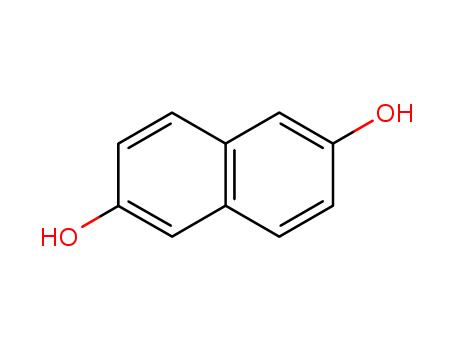
2,6-Naphthalenediol

Base Information
  • Chemical Name:2,6-Naphthalenediol
  • CAS No.:581-43-1
  • Molecular Formula:C10H8 O2
  • Molecular Weight:160.172
  • Hs Code.:29309090
  • European Community (EC) Number:209-465-6
  • NSC Number:62687
  • UNII:4XX2ND0257
  • DSSTox Substance ID:DTXSID7060384
  • Nikkaji Number:J70.177G
  • Wikidata:Q27260648
  • ChEMBL ID:CHEMBL205074
  • Mol file:581-43-1.mol
2,6-Naphthalenediol

Synonyms:2,6-dihydroxynaphthalene

Suppliers and Price of 2,6-Naphthalenediol
Supply Marketing:
Business phase:
The product has achieved commercial mass production*data from LookChem market partment
Manufacturers and distributors:
  • Manufacture/Brand
  • Chemicals and raw materials
  • Packaging
  • price
  • TRC
  • 2,6-Dihydroxynaphthalene
  • 10 g
  • $ 80.00
  • TCI Chemical
  • 2,6-Dihydroxynaphthalene >95.0%(GC)
  • 25g
  • $ 148.00
  • TCI Chemical
  • 2,6-Dihydroxynaphthalene >95.0%(GC)
  • 5g
  • $ 57.00
  • Sigma-Aldrich
  • 2,6-Dihydroxynaphthalene 98%
  • 5g
  • $ 63.40
  • Matrix Scientific
  • Naphthalene-2,6-diol
  • 5g
  • $ 47.00
  • Matrix Scientific
  • Naphthalene-2,6-diol
  • 25g
  • $ 118.00
  • Crysdot
  • Naphthalene-2,6-diol 98%
  • 5g
  • $ 80.00
  • ChemScene
  • 2-Hydroxy-6-naphthol
  • 10g
  • $ 75.00
  • ChemScene
  • 2-Hydroxy-6-naphthol
  • 25g
  • $ 107.00
  • ChemScene
  • 2-Hydroxy-6-naphthol
  • 100g
  • $ 297.00
Total 96 raw suppliers
Chemical Property of 2,6-Naphthalenediol
Chemical Property:
  • Appearance/Colour:grey to brown powder 
  • Vapor Pressure:3.62E-06mmHg at 25°C 
  • Melting Point:223 - 225 C (Decomposes)  
  • Refractive Index:1.5418 (estimate) 
  • Boiling Point:  
  • PKA:9.55±0.40(Predicted) 
  • Flash Point:193.5 °C 
  • PSA:40.46000 
  • Density:1.33 g/cm3 
  • LogP:2.25100 
  • Storage Temp.:Inert atmosphere,Room Temperature 
  • Solubility.:DMSO (Slightly), Methanol (Slightly) 
  • Water Solubility.:Soluble in methanol and hot water. Slightly soluble in water. 
  • XLogP3:2.3
  • Hydrogen Bond Donor Count:2
  • Hydrogen Bond Acceptor Count:2
  • Rotatable Bond Count:0
  • Exact Mass:160.052429494
  • Heavy Atom Count:12
  • Complexity:140
Purity/Quality:

99% *data from raw suppliers

2,6-Dihydroxynaphthalene *data from reagent suppliers

Safty Information:
  • Pictogram(s):  
  • Hazard Codes:Xi 
  • Statements: 36/37/38 
  • Safety Statements: 26-37/39 
MSDS Files:

SDS file from LookChem

Total 1 MSDS from other Authors

Useful:
  • Chemical Classes:Other Classes -> Naphthols
  • Canonical SMILES:C1=CC2=C(C=CC(=C2)O)C=C1O
  • General Description 2,6-Naphthalenediol, also known as 2,6-dihydroxynaphthalene, serves as a key intermediate in the synthesis of symmetric naphthalene-based liquid crystals. In this study, it was used to develop derivatives with 4′-alkoxybenzoate moieties, which exhibited stable smectic (SmA) and nematic (N) mesophases. The resulting compounds demonstrated smectogenic and nematogenic properties, with the smectic phase having a narrower mesomorphic range compared to the nematic phase. The molecular structure, confirmed by X-ray diffraction, featured a distinct dihedral angle between the naphthalene core and the benzoate group, highlighting its role in influencing liquid crystalline behavior.
Technology Process of 2,6-Naphthalenediol

There total 33 articles about 2,6-Naphthalenediol which guide to synthetic route it. The literature collected by LookChem mainly comes from the sharing of users and the free literature resources found by Internet computing technology. We keep the original model of the professional version of literature to make it easier and faster for users to retrieve and use. At the same time, we analyze and calculate the most feasible synthesis route with the highest yield for your reference as below:

synthetic route:
Guidance literature:
With potassium hydroxide; at 200 ℃; for 4h; Reagent/catalyst;
Guidance literature:
With hexamethyldisilathiane; sodium methylate; In various solvent(s); at 185 ℃; for 24h;
DOI:10.1021/jo00311a016
Guidance literature:
With magnesium; sodium hydroxide; at 180 ℃; for 3h; Reagent/catalyst; Temperature;
Refernces

Synthesis, characterization, crystal structure and liquid crystal studies of some symmetric naphthalene derivative molecules

10.1016/j.molstruc.2018.07.036

This research focused on the synthesis, characterization, crystal structure, and liquid crystal studies of symmetric naphthalene derivative molecules. The purpose was to investigate the mesomorphic properties of a series of symmetrical liquid crystals with a naphthalene core and long-chain flexible 4′-alkoxybenzoate moieties. The study aimed to understand the correlation between molecular structure and physical properties, particularly the effects of varying alkyl chain lengths on mesomorphic properties. The chemicals used in the synthesis included 2,6-dihydroxynaphthalene, 4-alkoxybenzoic acids, dicyclohexylcarbodiimide (DCC) as a coupling reagent, and dimethylaminopyridine (DMAP) as a catalyst. The synthesized compounds exhibited stable enantiotropic mesophases of Smectic A (SmA) and Nematic (N) phases, with the appearance of these phases being independent of the alkyl chain length. The molecular structure was determined using single crystal X-ray diffraction, revealing a dihedral angle between the naphthalene ring system and the benzoate moiety. The study concluded that the synthesized naphthalene derivatives are predominantly smectogenic and partly nematogenic, with the mesomorphic range of the smectic phase being shorter than that of the nematic phase.


Post a RFQ

Enter 15 to 2000 letters.Word count: 0 letters

Attach files(File Format: Jpeg, Jpg, Gif, Png, PDF, PPT, Zip, Rar,Word or Excel Maximum File Size: 3MB)

1 Customer Service

What can I do for you?
Get Best Price

Get Best Price for 581-43-1