Welcome to LookChem.com Sign In|Join Free
  • or

Encyclopedia

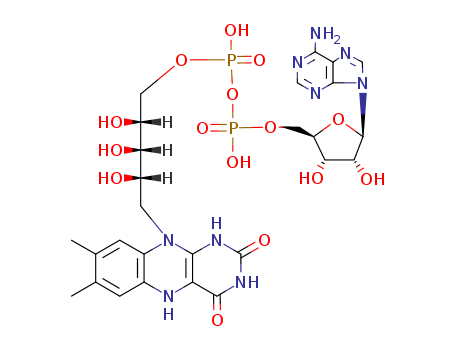
Dihydroflavine-adenine dinucleotide

Base Information
  • Chemical Name:Dihydroflavine-adenine dinucleotide
  • CAS No.:1910-41-4
  • Molecular Formula:C27H35 N9 O15 P2
  • Molecular Weight:787.574
  • Hs Code.:
  • DSSTox Substance ID:DTXSID301343006
  • Nikkaji Number:J792.632D
  • Wikidata:Q27102690,Q27113979
  • Metabolomics Workbench ID:37656
Dihydroflavine-adenine dinucleotide

Synonyms:1,5-dihydro-FAD;FADH2

Suppliers and Price of Dihydroflavine-adenine dinucleotide
Supply Marketing:
Business phase:
The product has achieved commercial mass production*data from LookChem market partment
Manufacturers and distributors:
  • Manufacture/Brand
  • Chemicals and raw materials
  • Packaging
  • price
Total 3 raw suppliers
Chemical Property of Dihydroflavine-adenine dinucleotide
Chemical Property:
  • Boiling Point:°Cat760mmHg 
  • Flash Point:°C 
  • PSA:388.35000 
  • Density:2.09g/cm3 
  • LogP:-1.36600 
  • XLogP3:-4.8
  • Hydrogen Bond Donor Count:11
  • Hydrogen Bond Acceptor Count:21
  • Rotatable Bond Count:13
  • Exact Mass:787.17278544
  • Heavy Atom Count:53
  • Complexity:1520
Purity/Quality:

98%,99%, *data from raw suppliers

Safty Information:
  • Pictogram(s):  
  • Hazard Codes: 
MSDS Files:

SDS file from LookChem

Useful:
  • Canonical SMILES:CC1=CC2=C(C=C1C)N(C3=C(N2)C(=O)NC(=O)N3)CC(C(C(COP(=O)(O)OP(=O)(O)OCC4C(C(C(O4)N5C=NC6=C(N=CN=C65)N)O)O)O)O)O
  • Isomeric SMILES:CC1=CC2=C(C=C1C)N(C3=C(N2)C(=O)NC(=O)N3)C[C@@H]([C@@H]([C@@H](COP(=O)(O)OP(=O)(O)OC[C@@H]4[C@H]([C@H]([C@@H](O4)N5C=NC6=C(N=CN=C65)N)O)O)O)O)O
  • General Description **Conclusion:** [(2R,3S,4R,5R)-5-(6-aminopurin-9-yl)-3,4-dihydroxyoxolan-2-yl]methyl [[(2R,3S,4S)-5-(7,8-dimethyl-2,4-dioxo-1,5-dihydrobenzo[g]pteridin-10-yl)-2,3,4-trihydroxypentoxy]-hydroxyphosphoryl] hydrogen phosphate, also known as reduced flavin adenine dinucleotide (FADH2), is a biologically active, reduced form of FAD that serves as a redox cofactor. It can be catalytically generated from FAD using hydrogen (H2) as a reductant, as demonstrated by platinum cluster catalysts and Escherichia coli hydrogenase 1 (Hyd1), which facilitate the non-native reduction of flavins for applications such as alkene hydrogenation. This reduced cofactor plays a critical role in electron transfer processes in enzymatic reactions.
Technology Process of Dihydroflavine-adenine dinucleotide

There total 2 articles about Dihydroflavine-adenine dinucleotide which guide to synthetic route it. The literature collected by LookChem mainly comes from the sharing of users and the free literature resources found by Internet computing technology. We keep the original model of the professional version of literature to make it easier and faster for users to retrieve and use. At the same time, we analyze and calculate the most feasible synthesis route with the highest yield for your reference as below:

synthetic route:
Guidance literature:
With phosphate buffer; hydrogen; Na2 anchored onto OAE-SEPHADEX anion exchanger; at 20 ℃; for 1.66667h;
DOI:10.1039/cc9960000207
Guidance literature:
With hydrogen; hydrogenase 1 from Escherichia coli; In aq. buffer; at 25 ℃; under 750.075 Torr; pH=8; Kinetics; Glovebox; Enzymatic reaction;
DOI:10.1002/anie.202101186
Post a RFQ

Enter 15 to 2000 letters.Word count: 0 letters

Attach files(File Format: Jpeg, Jpg, Gif, Png, PDF, PPT, Zip, Rar,Word or Excel Maximum File Size: 3MB)

1 Customer Service

What can I do for you?
Get Best Price

Get Best Price for 1910-41-4