Welcome to LookChem.com Sign In|Join Free
  • or

Encyclopedia

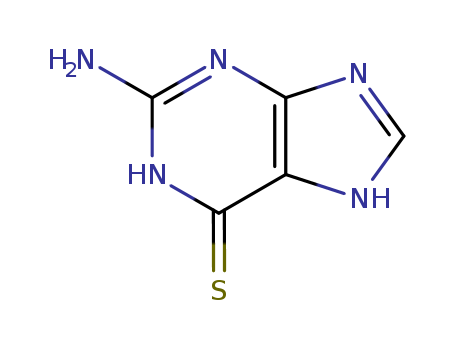
Thioguanine

Base Information
  • Chemical Name:Thioguanine
  • CAS No.:154-42-7
  • Molecular Formula:C5H5N5S
  • Molecular Weight:167.194
  • Hs Code.:29335990
  • European Community (EC) Number:205-827-2
  • NSC Number:757348,752
  • UN Number:2811
  • UNII:WIX31ZPX66
  • DSSTox Substance ID:DTXSID6023652
  • Nikkaji Number:J21.274A
  • Wikipedia:Tioguanine
  • Wikidata:Q385347
  • NCI Thesaurus Code:C61970
  • RXCUI:1546005
  • Pharos Ligand ID:U8PQ7YG4YFSF
  • Metabolomics Workbench ID:42726
  • ChEMBL ID:CHEMBL727
  • Mol file:154-42-7.mol
Thioguanine

Synonyms:2 Amino 6 Purinethiol;2-amino-6-purinethiol;6 Thioguanine;6-Thioguanine;Anhydrous, Thioguanine;Lanvis;Tabloid;Thioguanin GSK;Thioguanin-GSK;Thioguanine;Thioguanine Anhydrous;Thioguanine Hemihydrate;Thioguanine Monosodium Salt;Thioguanine Tabloid;ThioguaninGSK;Tioguanina Wellcome;Tioguanine

Suppliers and Price of Thioguanine
Supply Marketing:
Business phase:
The product has achieved commercial mass production*data from LookChem market partment
Manufacturers and distributors:
  • Manufacture/Brand
  • Chemicals and raw materials
  • Packaging
  • price
  • Usbiological
  • 6-Thioguanine
  • 50mg
  • $ 267.00
  • Usbiological
  • 2-Amino-6-mercaptopurine
  • 1g
  • $ 347.00
  • Tocris
  • 6-Thioguanine ≥99%(HPLC)
  • 50
  • $ 47.00
  • TCI Chemical
  • 6-Thioguanine >95.0%(HPLC)
  • 5g
  • $ 256.00
  • TCI Chemical
  • 6-Thioguanine >95.0%(HPLC)
  • 1g
  • $ 86.00
  • SynQuest Laboratories
  • 2-Amino-6-purinethiol
  • 5 g
  • $ 61.00
  • SynQuest Laboratories
  • 2-Amino-6-purinethiol
  • 1 g
  • $ 21.00
  • Sigma-Aldrich
  • 6-Thioguanine Hybri-Max , 50 ×, γ-irradiated, lyophilized powder, BioXtra, suitable for hybridoma
  • 2.5mg
  • $ 22.10
  • Sigma-Aldrich
  • 6-Thioguanine ≥98%
  • 100mg
  • $ 42.70
  • Sigma-Aldrich
  • 6-Thioguanine ≥98%
  • 250mg
  • $ 57.50
Total 101 raw suppliers
Chemical Property of Thioguanine
Chemical Property:
  • Appearance/Colour:Odorless or almost odorless pale yellow crystalline powder 
  • Vapor Pressure:1.5E-17mmHg at 25°C 
  • Melting Point:≥300 °C(lit.) 
  • Refractive Index:1.5605 (estimate) 
  • Boiling Point:555.4 °C at 760 mmHg 
  • PKA:pKa 8.22 (Uncertain) 
  • Flash Point:289.7 °C 
  • PSA:119.28000 
  • Density:2.08 g/cm3 
  • LogP:0.80500 
  • Storage Temp.:Store at RT. 
  • Solubility.:Practically insoluble in water and in ethanol (96%). It dissolves in dilute solutions of alkali hydroxides. 
  • Water Solubility.:soluble 
  • XLogP3:-0.1
  • Hydrogen Bond Donor Count:3
  • Hydrogen Bond Acceptor Count:2
  • Rotatable Bond Count:0
  • Exact Mass:167.02656635
  • Heavy Atom Count:11
  • Complexity:225
  • Transport DOT Label:Poison
Purity/Quality:

99%, *data from raw suppliers

6-Thioguanine *data from reagent suppliers

Safty Information:
  • Pictogram(s): ToxicT,IrritantXi 
  • Hazard Codes:T,Xi 
  • Statements: 25-23/24/25 
  • Safety Statements: 28-36/37/39-45-28A 
MSDS Files:

SDS file from LookChem

Total 1 MSDS from other Authors

Useful:
  • Drug Classes:Antineoplastic Agents
  • Canonical SMILES:C1=NC2=C(N1)C(=S)N=C(N2)N
  • Recent ClinicalTrials:Combination Chemotherapy in Treating Young Patients With Newly Diagnosed T-Cell Acute Lymphoblastic Leukemia or T-cell Lymphoblastic Lymphoma
  • Recent EU Clinical Trials:TEMPLE - Thiopurine Enhanced Mutations for PD-1/Ligand-1 Efficacy
  • General Description 6-Thioguanine is a purine analogue and antimetabolite used as a chemotherapeutic agent, particularly in the treatment of leukemia. It functions by interfering with nucleic acid synthesis, incorporating into DNA and RNA to inhibit cell proliferation. Structurally related to 6-mercaptopurine, it shares similar cytotoxic mechanisms and has been evaluated alongside other purine derivatives for antitumor activity. Studies highlight its role in comparative cytotoxicity assessments and its potential as a reference compound in the development of novel anticancer agents.
Technology Process of Thioguanine

There total 14 articles about Thioguanine which guide to synthetic route it. The literature collected by LookChem mainly comes from the sharing of users and the free literature resources found by Internet computing technology. We keep the original model of the professional version of literature to make it easier and faster for users to retrieve and use. At the same time, we analyze and calculate the most feasible synthesis route with the highest yield for your reference as below:

synthetic route:
Guidance literature:
With tetraphosphorus decasulfide; In sulfolane; at 160 - 165 ℃; for 4h;
DOI:10.1007/BF00771781
Guidance literature:
With sodium hydroxide; at 240 ℃;
DOI:10.1021/ja01593a062
Guidance literature:
With pyridine; tetraphosphorus decasulfide;
DOI:10.1021/ja01611a082
Refernces

Synthesis and cytotoxic activity of imidazo[1,2-a]-1,3,5-triazine analogues of 6-mercaptopurine

10.1002/ardp.200700176

The research focuses on the synthesis and cytotoxic activity evaluation of imidazo[1,2-a]-1,3,5-triazine analogues, which are structurally related to the chemotherapeutic drug 6-mercaptopurine. The study involved the preparation of 2-substituted imidazo[1,2-a]-1,3,5-triazines using various aliphatic and aromatic amines as reactants. The synthesized compounds were characterized using IR, 1H-NMR, and elemental analysis. The cytotoxic activity of these compounds was assessed through in-vitro studies on five human cancer cell lines, with one active compound further tested on 12 human cancer cell lines. The experiments utilized a microtiter assay based on crystal violet staining to determine antiproliferative activity, and the IC50 values were calculated from the results of three independent experiments. The study aimed to develop new antitumor agents and compared the cytotoxic activity of the synthesized compounds with that of 6-mercaptopurine and thioguanine, two established anticancer drugs.

Aminomethylation and hydroxymethylation of purine-6(1H)-thione and 6-alkylthiopurines.

10.1021/jm00313a025

The research focuses on the chemical synthesis and analysis of various purine derivatives, specifically 6-(alkylthio)-9-(hydroxymethyl)-SH-purines. The study investigates the hydroxymethylation of purine-6(1H)-thione and its derivatives, revealing that substitution occurs at the 9 position of the purine ring. Key chemicals involved include ethyl acetate, ligroin, benzene, ethyl alcohol, and petroleum ether, used as solvents in the synthesis and analysis processes. The researchers also utilized aqueous formaldehyde and sodium carbonate for hydroxymethylation reactions. Additionally, the study examines the infrared and ultraviolet spectra of these compounds, as well as their stability and reactivity with isocyanates. One of the synthesized compounds was screened for antitumor activity, showing promising results in certain leukemia models. The research provides valuable insights into the structure and potential applications of these purine derivatives.

Post a RFQ

Enter 15 to 2000 letters.Word count: 0 letters

Attach files(File Format: Jpeg, Jpg, Gif, Png, PDF, PPT, Zip, Rar,Word or Excel Maximum File Size: 3MB)

1 Customer Service

What can I do for you?
Get Best Price

Get Best Price for 154-42-7
