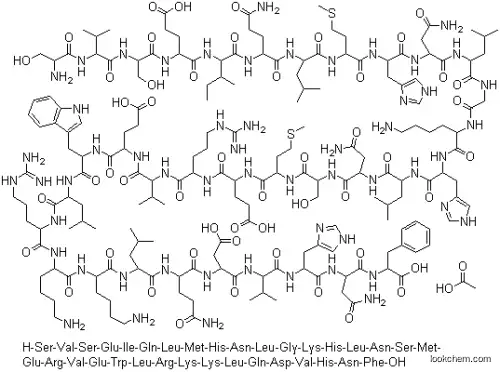
Chemical Property of Teriparatide acetate hydrate
Chemical Property:
- Appearance/Colour:powder
- PSA:0.00000
- LogP:0.00000
- Storage Temp.:−20°C
- Solubility.:DMSO (Slightly), Water (Slightly)
- XLogP3:-18.7
- Hydrogen Bond Donor Count:60
- Hydrogen Bond Acceptor Count:62
- Rotatable Bond Count:146
- Exact Mass:4116.1342973
- Heavy Atom Count:289
- Complexity:9740
- Purity/Quality:
-
99% *data from raw suppliers
ParathyroidHormoneFragment(1-34) *data from reagent suppliers
Safty Information:
- Pictogram(s):
- Hazard Codes:
- MSDS Files:
-
SDS file from LookChem
Useful:
- Drug Classes:Osteoporosis Agents
- Canonical SMILES:CCC(C)C(C(=O)NC(CCC(=O)N)C(=O)NC(CC(C)C)C(=O)NC(CCSC)C(=O)NC(CC1=CNC=N1)C(=O)NC(CC(=O)N)C(=O)NC(CC(C)C)C(=O)NCC(=O)NC(CCCCN)C(=O)NC(CC2=CNC=N2)C(=O)NC(CC(C)C)C(=O)NC(CC(=O)N)C(=O)NC(CO)C(=O)NC(CCSC)C(=O)NC(CCC(=O)O)C(=O)NC(CCCNC(=N)N)C(=O)NC(C(C)C)C(=O)NC(CCC(=O)O)C(=O)NC(CC3=CNC4=CC=CC=C43)C(=O)NC(CC(C)C)C(=O)NC(CCCNC(=N)N)C(=O)NC(CCCCN)C(=O)NC(CCCCN)C(=O)NC(CC(C)C)C(=O)NC(CCC(=O)N)C(=O)NC(CC(=O)O)C(=O)NC(C(C)C)C(=O)NC(CC5=CNC=N5)C(=O)NC(CC(=O)N)C(=O)NC(CC6=CC=CC=C6)C(=O)O)NC(=O)C(CCC(=O)O)NC(=O)C(CO)NC(=O)C(C(C)C)NC(=O)C(CO)N
- Recent ClinicalTrials:Precision Medicine Approach for Osteoporosis - Follow Up Study
- Recent EU Clinical Trials:Treatment of adynamic bone disorder with parathyroid hormone in patients with chronic kidney disease
- Recent NIPH Clinical Trials:Japanese Osteoporosis Intervention Trial 06 (JOINT-06)
-
Uses
A fragment of human parathyroid hormone (hPTH) peptide sequence containing the 34 N-terminal residues of hPTH. This fragment was also found to be an agonist at PTH1 and PTH2 receptors.
-
Clinical Use
In 2002, the U.S. FDA approved teriparatide for the treatment of postmenopausal osteoporosis in patients who
have a high risk of fracture as well as to increase bone mass in men with primary or hypogonadal osteoporosis
who have a high risk of fracture. Teriparatide is recombinant human PTH 1-34, the
biologically active portion of the endogenously produced preprohormone. Unlike the bisphosphonates, which
are classified as bone restorative agents, teriparatide is the first approved bone-forming agent. Bone formation
is possible because of the ability of this agent to increase the number of osteoblasts. Although teriparatide
enhances the function of both osteoclasts and osteoblasts, the exposure incidence dictates its effect on the
skeleton.